
Miss a VAT return deadline and HMRC’s points system logs it; hit the threshold for your filing frequency and a £200 fine follows, with another £200 for each further late return. Miss a payment instead, and you face separate escalating penalties (3% at day 15, another 3% at day 30, then a daily charge) plus interest at Bank of England base rate plus 4 percentage points. The two regimes run independently, so filing on time even when you can’t pay still matters.
TL;DR:
- Reaching your VAT penalty point threshold results in a £200 fine plus an additional £200 for each late return while at or above that level, regardless of filing frequency.
- Once points expire after two years of good compliance, you must submit all overdue returns and maintain continuous compliance for two consecutive periods to reset your points.
- Late payment penalties escalate quickly from 3% at day 16 to daily charges at 10% per year if unpaid past day 30, with interest accumulating from day one.
- Filing on time can prevent points accumulation even if you are unable to pay immediately, and requesting a Time to Pay arrangement before penalties escalate is crucial.
- Regularly monitoring your points balance and acting swiftly on payment issues can avoid additional penalties and help maintain VAT compliance.
Table of Contents
- How does the VAT late filing penalty points system work?
- What are the VAT penalty point thresholds and how do you reset them?
- How do late payment penalties and interest actually work?
- What should you do if you can’t pay or you’ve been penalised?
- Worked examples: how the numbers stack up
- Practical checklist to avoid VAT penalties
- Practitioner perspective: common pitfalls and first actions
- How I can help with VAT compliance and penalty reviews
- Sources
How does the VAT late filing penalty points system work?
Since VAT accounting periods starting on or after 1 January 2023, HMRC has used a points based system for every late VAT return, including nil returns and returns showing a refund is due. There’s no exemption just because you owed nothing.
Each late submission adds one point to your record, and this includes situations where you miss several deadlines close together. HMRC doesn’t cap the damage just because the misses cluster in the same period.
Once you reach your threshold, the consequences become financial rather than just administrative:
- You receive a fixed £200 penalty the moment you hit your threshold.
- A further £200 penalty applies for every subsequent late return while you remain at or above that threshold.
- HMRC notifies you of points and penalties through letters and, more usefully day to day, through your VAT online account, where your current points total is visible.
- There’s no grace period once you’re at threshold. The next miss costs you £200, guaranteed.
Checking your points balance regularly is a habit worth building, particularly if you’ve had a wobble with a previous return.
What are the VAT penalty point thresholds and how do you reset them?
Your threshold depends entirely on how often you file:
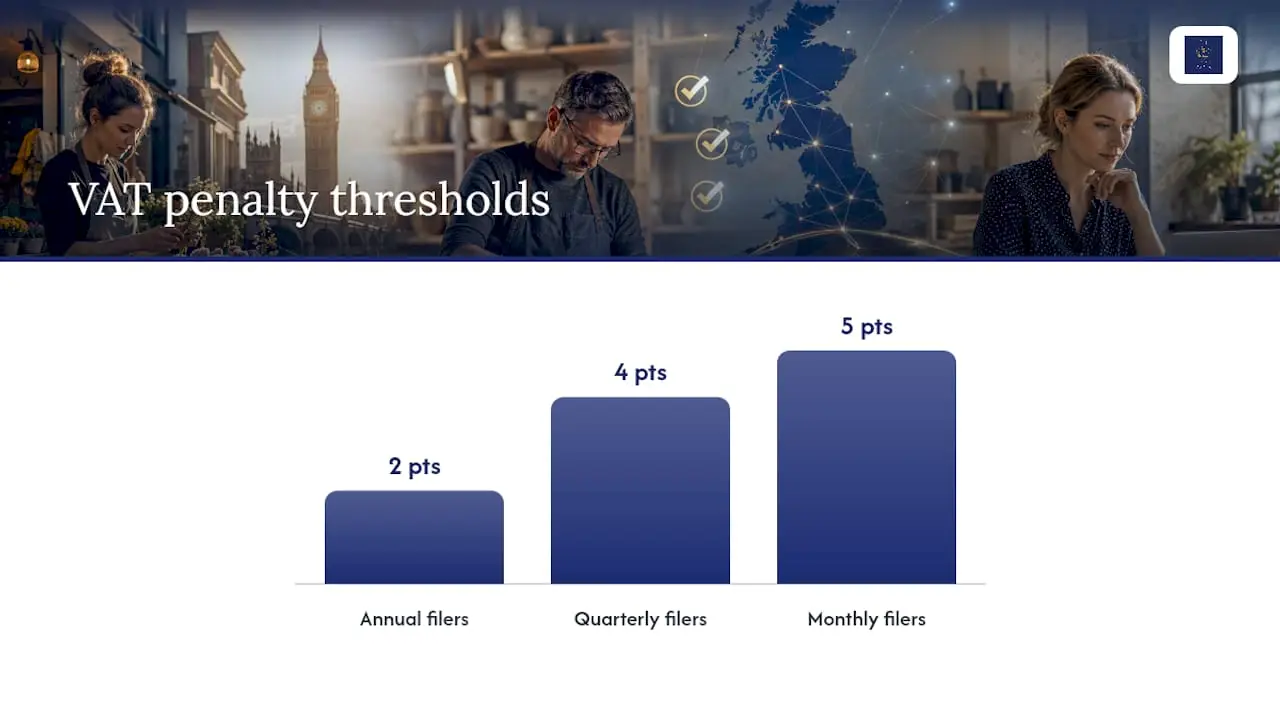
- Annual filers reach threshold at 2 points.
- Quarterly filers reach threshold at 4 points.
- Monthly filers reach threshold at 5 points.
Individual points expire automatically two years after the month following the missed submission, but only if you haven’t reached the threshold. Once you’re at threshold, expiry stops working the same way, and you need to actively reset.
Resetting to zero requires two things done together: completing a “period of compliance” (its length depends on your filing frequency) and submitting every outstanding return from the previous 24 months. Miss either condition and the points stay put. HMRC’s own guidance on removing penalty points is worth bookmarking if you’re working towards a clean slate.
One detail that catches people out: if you change your filing frequency, HMRC doesn’t wipe existing points. It adjusts them proportionally, which can leave you closer to a new threshold than you’d expect.
How do late payment penalties and interest actually work?
Late payment penalties run on a strict timeline, separate from the points system entirely. Even if you’ve filed on time, paying late triggers its own set of charges.
The structure looks like this:
| Timing | What happens |
|---|---|
| Days 1 to 15 | No penalty, but interest starts accruing from day one |
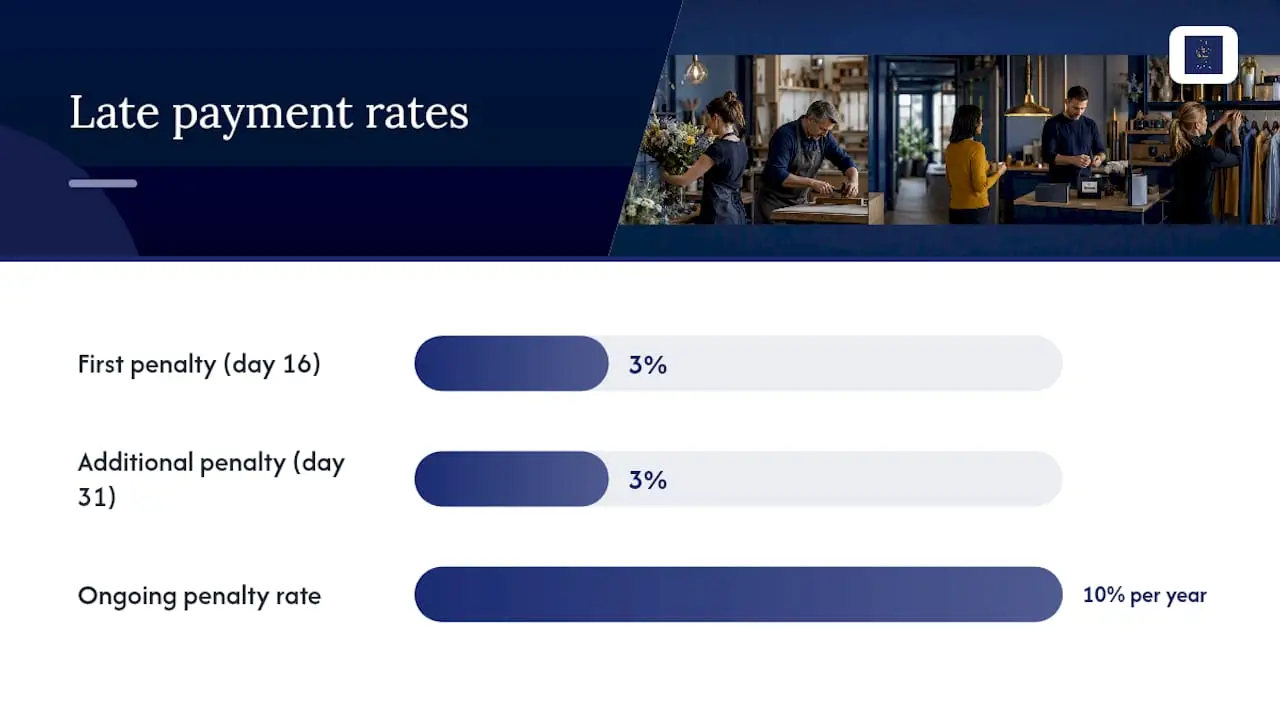
| Day 16 (if unpaid at day 15) | First penalty: 3% of the VAT outstanding at day 15 |
| Day 31 (if still unpaid at day 30) | Additional 3% of the amount outstanding at day 30 |
| From day 31 onwards | Second penalty accrues daily at 10% per year on the outstanding balance |
Late payment interest runs from day one at the Bank of England base rate plus 4 percentage points, and it keeps accruing until you clear the balance, regardless of any penalty charges layered on top.
A few things worth remembering:
- The 3% charges are calculated on the outstanding balance at each specific trigger point, not the original bill.
- Interest and penalties run in parallel; you don’t get one instead of the other.
- Agreeing a Time to Pay arrangement before the relevant trigger day can stop these penalties escalating further, though interest generally keeps running.
HMRC’s internal manual CH193140 sets out the operational detail behind these rules, including how Time to Pay interacts with each stage.
What should you do if you can’t pay or you’ve been penalised?
Timing is everything here. A Time to Pay request made before day 16, or at worst before day 31, can stop the escalating penalties in their tracks. Request one through your VAT online account or by contacting HMRC directly; waiting until after a penalty lands is far less effective.
If you’ve already received a penalty you think is wrong, you have two routes:
- Request a review through your VAT online account or in writing, generally within 30 days of the penalty decision.
- If the review doesn’t resolve things, you can escalate to the tax tribunal, though this takes longer than an internal review.
HMRC does accept reasonable excuses, but the bar is genuine unforeseen disruption (serious illness, a system failure outside your control, bereavement) rather than simply forgetting or being busy. Bring evidence: dates, correspondence, and anything that shows the sequence of events.
Pro Tip: Keep a simple log every time you contact HMRC, noting the date, who you spoke to, and what was agreed. If a dispute drags on, that record often matters more than the original excuse.
Worked examples: how the numbers stack up
A quarterly filer who misses four consecutive returns reaches threshold on the fourth miss and gets a £200 penalty immediately, which is why understanding quarterly tax rules is so important for maintaining compliance. A fifth late return, even months later, adds another £200. That’s the points system doing exactly what it’s designed to do.
Now a payment example. Say you owe £15,000 and pay nothing until day 40:
- Days 1 to 15: interest accrues, no penalty yet.
- Day 16: first penalty charged at 3% of £15,000, which is £450.
- Day 31: second 3% charge on the outstanding balance, another £450, plus the daily second penalty starts accruing at 10% per year.
- By day 40, you’ve added roughly nine days of that daily charge on top, plus interest throughout.
Had you filed on time but simply couldn’t pay, none of the points penalties would apply. Filing late and paying late together is the expensive combination, and it’s entirely avoidable by separating the two problems.
Practical checklist to avoid VAT penalties
- File the return on time, always, even if you can’t pay a penny towards the bill. This alone avoids every points penalty.
- Use HMRC-recognised, MTD-compatible software and keep digital records rather than relying on memory or spreadsheets.
- Set automated reminders ahead of each deadline and reconcile your VAT control account monthly, not just at return time.
- Check your points balance in your VAT online account regularly, and treat getting back to zero as an active task, not something that happens by itself.
- Contact HMRC as soon as you sense a payment problem coming, and keep evidence ready in case you need to request a review later.
Pro Tip: If you’re on the Flat Rate Scheme, the filing deadlines and points system work identically to standard VAT accounting. The scheme changes how you calculate what you owe, not when or how penalties apply.
Practitioner perspective: common pitfalls and first actions
The pattern I see most often isn’t recklessness, it’s a nil return someone assumes doesn’t need filing, or a spreadsheet error that pushes a deadline past unnoticed. When a penalty lands, my first move is always the same: check the online account, gather the paperwork, and work out whether a review or a Time to Pay proposal fits the situation better. Sorting the filing cadence properly usually prevents the next one.
— Chris
How I can help with VAT compliance and penalty reviews
Sorting through penalty points, payment deadlines, and HMRC correspondence isn’t something most business owners have time to untangle alongside actually running things. That’s where working with an accountant who handles this daily makes the difference between guessing and knowing.

I help sole traders, landlords and small companies across Tonbridge, Sevenoaks and Kent (and remotely across the UK) get VAT returns filed correctly and on time, set up MTD compatible software properly from the outset, and negotiate Time to Pay arrangements before penalties escalate. If you’ve already received a penalty notice, I can help you work out whether a review has legs and pull together the evidence HMRC expects. For software specifically, I offer accounting software setup and training across Xero, QuickBooks and FreeAgent, which removes a good chunk of the manual error risk that leads to late filings in the first place. Get in touch through my contact page for a fixed price quote tailored to your situation.
Need help?
If VAT deadlines, penalty points or a payment you can’t quite meet are causing you stress, get in touch via my contact page and I’ll help you work out the right next step.
This article is general information, not a substitute for advice from a qualified financial advisor. Consult a qualified financial professional about your own circumstances before acting on anything here.