You can correct a Self Assessment tax return. HMRC allows amendments within 12 months of the statutory filing date — so You can amend a tax return within 12 months of the statutory filing deadline for that return. For a tax year, the filing deadline is 31 January following the end of the tax year, and you have up to 12 months after that date to make changes.
Here is your immediate checklist:
- Are you within 12 months of the filing deadline? If yes, you can amend online or by post.
- Sign into your HMRC account via GOV.UK One Login or the Government Gateway, or contact your agent to request the amendment.
- Outside the 12-month window? You will need to write to HMRC or use the Digital Disclosure Service.
Pro Tip: You should wait around three days after submitting your return online before attempting to amend it, to allow HMRC’s system time to process the original submission.
Table of Contents
- How do you amend your Self Assessment return?
- What happens to your tax bill after an amendment?
- What if you missed the 12-month amendment window?
- What are the most common Self Assessment mistakes?
- How do you avoid the same mistakes next year?
- When should you contact an accountant?
- Key takeaways
- Why acting quickly is the most important thing you can do
- How Cwabc helps you correct returns and avoid future mistakes
- Useful sources and further reading
- Need help?
How do you amend your Self Assessment return?
The method you use depends on how you originally filed. Each route is straightforward once you know the steps.
Amending online via GOV.UK One Login or Government Gateway
- Sign into your HMRC Self Assessment account at GOV.UK. If you need help setting up access, the HMRC Personal Tax Account guide walks you through the process.
- Wait at least 72 hours after your original online submission before starting.
- Select “Self Assessment” from your account dashboard.
- Choose the relevant tax year and select “Amend return.”
- Update the figures in the relevant boxes — only change what needs correcting.
- Review the revised tax calculation before resubmitting.
- Submit the amended return. HMRC will confirm receipt.
The statutory filing date rules under TMA S9ZA confirm that this online amendment route is the accepted method for taxpayer corrections within the 12-month window.
Amending by paper
If you filed on paper, submit amended pages clearly marked “amendment”, including your full name and Unique Taxpayer Reference (UTR) on every page. Send only the corrected supplementary pages, not the entire return again, to the address shown on your original Self Assessment paperwork.
Amending through commercial software
If you filed using FreeAgent, Xero, or QuickBooks, use the same software to make your amendment. Open the relevant tax year, update the figures, and resubmit directly to HMRC through the software. If you cannot locate the amendment function, contact the software provider’s support team directly. Do not attempt to amend separately via the HMRC portal if you filed through software, as this can create duplicate submissions.
Amending through an authorised agent
Your accountant or bookkeeper can amend on your behalf, provided they are authorised on your HMRC account. HMRC requires a valid 64-8 authorisation form or an online agent authorisation before an agent can access or amend your return. If you have not yet authorised an agent, your accountant can guide you through that process quickly.
If you cannot sign in: Visit the GOV.UK sign-in help page or call the HMRC Self Assessment helpline on 0300 200 3310.
What happens to your tax bill after an amendment?
Once HMRC processes your amendment, one of four things will happen:
- You owe more tax — HMRC will update your account and interest will accrue from the original payment due date (usually 31 January), not from the date of the amendment.
Pay any additional tax as soon as possible. Interest runs from the original due date, so the sooner you pay, the less it accumulates.
Understanding penalties
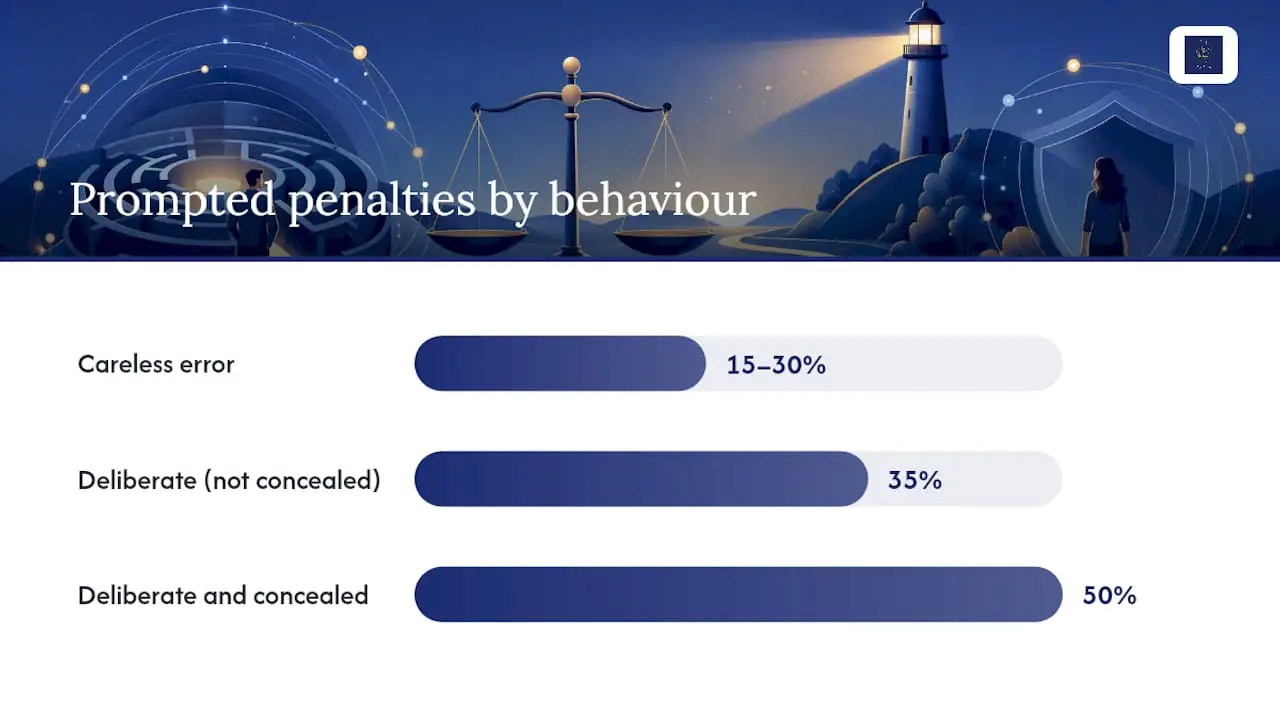
HMRC’s penalty structure depends on the behaviour behind the error, not simply the fact that a mistake was made. There is a meaningful difference between a careless error and a deliberate one, and between disclosing voluntarily before HMRC asks versus waiting until they prompt you.
| Behaviour | Unprompted penalty range | Prompted penalty range |
|---|---|---|
| Careless error | 0–30% of tax owed | 15–30% of tax owed |
| Deliberate (not concealed) | 20% of tax owed | 35% of tax owed |
| Deliberate and concealed | 30–100% of tax owed | 50% of tax owed |
| Late filing (one day late) | £100 automatic fine | N/A |
| Three months late | £10 daily penalty | N/A |
| Six months late | 5% of tax due | N/A |
| Twelve months late | Further 5% | N/A |
Example: Suppose you underpaid £800 due to a careless error and you disclose it voluntarily before HMRC contacts you. The penalty could be as low as 0% of £800 (i.e., no penalty at all) if HMRC accepts the disclosure as unprompted and in good faith. Wait for HMRC to write to you first, and the minimum rises to 15%, meaning at least £120 on top of the tax and interest owed.
HMRC operates a “process now, check later” approach, which means a return being processed quickly does not mean it has been accepted as correct. Compliance checks can follow months or even years later, so correcting errors promptly and voluntarily is always the better position to be in.
What if you missed the 12-month amendment window?
Outside the 12-month window, the standard online amendment route is closed. You still have options, but the process is different.
Overpayment relief
If you overpaid tax, you can claim overpayment relief up to four years after the end of the relevant tax year. Overpayment relief claims may be made up to four years after the end of the tax year to which they relate.
Voluntary disclosure and the Digital Disclosure Service
For underpayments, HMRC’s Digital Disclosure Service (DDS) is the formal route. It covers income tax, Capital Gains Tax, National Insurance contributions, and other tax heads. Making a disclosure through the DDS before HMRC contacts you is treated as unprompted, which keeps penalties at the lower end of the range.
GfC13 guidance from HMRC instructs taxpayers to include the reference “GfC13” when making voluntary disclosures in writing, covering income tax, corporation tax, VAT, and PAYE errors.
Writing to HMRC directly
If the DDS does not apply to your situation, write to HMRC. Your letter should include:
- Your full name and UTR.
- The tax year(s) in question.
- A clear explanation of the error and why it occurred.
- The corrected figures and the amount of tax you believe is due.
- How you calculated the difference.
- Your signature and the date.
Attach supporting evidence: bank statements, dividend vouchers, P60s, or invoices as appropriate. Send the letter to HMRC Self Assessment, HM Revenue and Customs, BX9 1AS.
Template lines to adapt:
If the amounts involved are significant, or if HMRC has already written to you, seek professional advice before responding. A licensed accountant can prepare the disclosure, calculate the correct liability, and liaise with HMRC on your behalf.
What are the most common Self Assessment mistakes?
Forgetting sources of income is the most frequent cause of corrections, but the list of common errors is longer than most people expect.
- Payments on account confusion — If you set up a payment plan or made a voluntary payment, it may not have been applied to the correct tax year. Check your HMRC account to confirm allocations.
Worked examples
Sole trader: James runs a small plumbing business. He forgot to include £1,200 of bank interest on his 2023/24 return. To correct this, he signs into his HMRC account, selects the 2023/24 return, navigates to the “Interest and dividends” section (SA100, Box 1), and enters the correct figure. He resubmits and pays the additional tax promptly.
Landlord: Sarah owns a rental property and claimed a new kitchen (a capital improvement) as a repair on her 2023/24 return. She needs to remove that figure from the “Allowable expenses” box on the UK Property pages (SA105) and recalculate her profit. For more on landlord-specific tax return requirements, Cwabc has a dedicated guide.
Pro Tip: Before you file, reconcile every income figure against a third-party document: your P60, bank statements, dividend vouchers, or letting agent statements. HMRC cross-checks these sources routinely, and matching your figures to theirs before submission is the single most effective way to avoid a correction later.
For a broader list of common sole trader tax return errors, the Cwabc guide covers the most frequent pitfalls with practical fixes.
How do you avoid the same mistakes next year?
Good habits built now save a great deal of stress come January. The goal is to arrive at filing time with clean, reconciled records rather than a box of receipts and a vague memory of what happened in April.
Build a weekly bookkeeping routine
Set aside 20–30 minutes each week to record income and expenses. Reconcile your bank feed against your records, tag receipts as you go, and match any PAYE figures to your payslips. Weekly reconciliations catch errors when they are easy to fix, not months later when the context is gone. The bookkeeping habits guide from Cwabc explains exactly how to build this routine without it taking over your week.
Run a pre-filing checklist
Before you submit, check:
- Total income matches your P60, bank statements, and dividend vouchers.
- All expense categories are correctly classified (business versus personal).
- Pension contributions are entered and higher-rate relief claimed if applicable.
- Payments on account from the previous year are correctly reflected.
- The tax year dates are correct for every entry.
Keep your records for the right length of time
HMRC can open an enquiry up to one year after you file (or amend) a return. For suspected fraud, that window extends considerably further. As a general rule, keep all supporting records for at least five years after the 31 January filing deadline for the relevant tax year. For landlords and sole traders, that means invoices, receipts, bank statements, and letting agent statements.
Use cloud accounting software
FreeAgent, Xero, and QuickBooks all connect directly to your bank via a live feed, categorise transactions automatically, and produce figures you can feed straight into your Self Assessment return. All three are Making Tax Digital (MTD) compatible, which matters as MTD for Income Tax is being phased in. Cwabc can help you set up and configure accounting software in Kent so it works for your specific business from day one.
When should you contact an accountant?
Some amendments are straightforward enough to handle yourself. Others carry enough risk that professional help is worth every penny.
Red flags that call for professional support
- You have undeclared income from multiple sources (employment, self-employment, rental, and investments in the same year).
- You have capital gains to report, particularly from property sales or share disposals.
- You have foreign income or offshore assets.
- The underpayment is substantial and HMRC has already written to you.
- HMRC has opened a formal enquiry or rejected your amendment.
- You are unsure whether an expense is allowable and the amounts are significant.
- You have missed more than one year’s filing obligations.
If any of these apply, the 7 signs you need an accountant guide is a useful starting point.
What to bring to your first meeting
- Your UTR and National Insurance number.
- P60 or P45 for all employments in the relevant year.
- Bank statements covering the full tax year.
- Invoices and receipts for business income and expenses.
- Your SA302 tax calculation or the HMRC tax year overview.
- Dividend vouchers and any investment income statements.
- Letting agent statements or rental income records (for landlords).
What Cwabc will do for you
Cwabc will review your original return, calculate the correct liability, prepare the amendment or disclosure, and liaise directly with HMRC on your behalf. If HMRC opens an enquiry, Cwabc can represent you throughout that process. For a no-obligation conversation about your situation, get in touch with Cwabc.
Key takeaways
Correcting a Self Assessment return is straightforward within 12 months of the filing deadline; acting promptly and voluntarily keeps penalties at their lowest.
| Point | Details |
|---|---|
| Amendment window | Amend online within 12 months of the statutory filing date. |
| 72-hour rule | Wait 72 hours after online filing before attempting to amend; the system will not allow earlier edits. |
| Outside the window | Write to HMRC or use the Digital Disclosure Service; overpayment relief is available up to four years back. |
| Penalty mitigation | Unprompted, voluntary disclosure can reduce careless-error penalties to 0%; waiting for HMRC to contact you raises the minimum to 15%. |
| Cwabc | Cwabc prepares amendments, calculates liabilities, and liaises with HMRC for sole traders and landlords in Tonbridge and Kent. |
Why acting quickly is the most important thing you can do
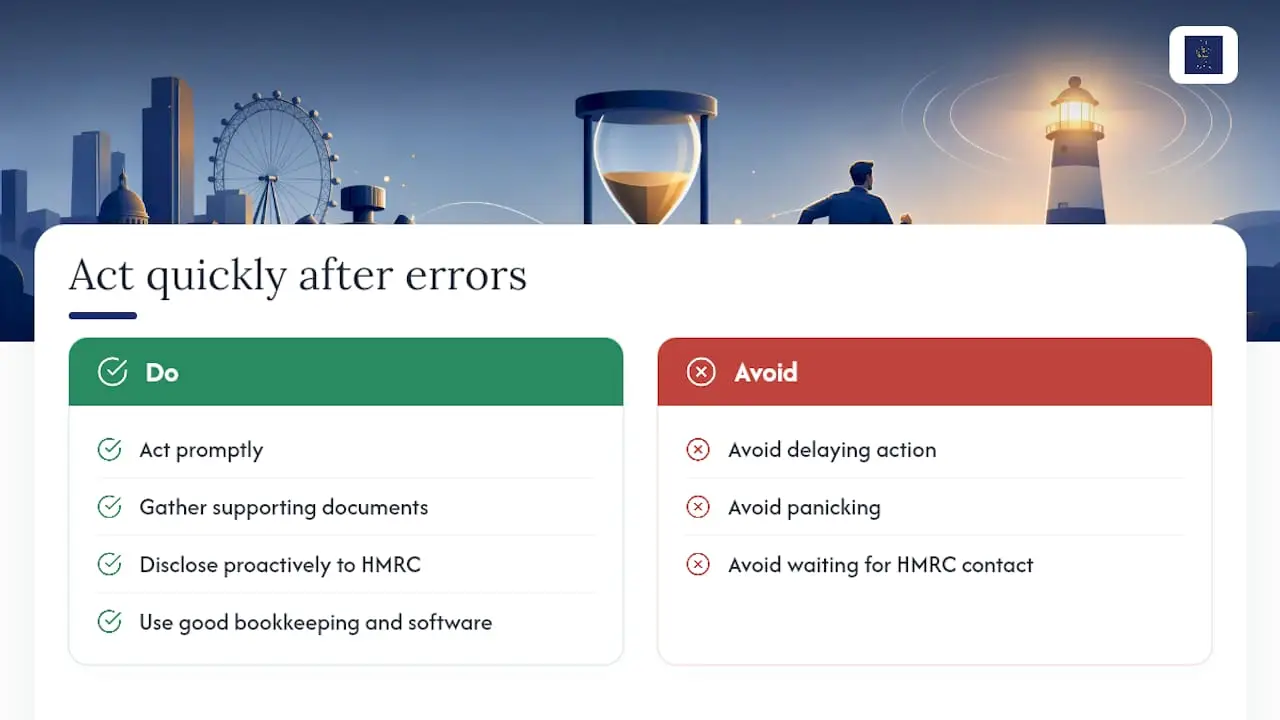
Most people who discover an error on their Self Assessment return feel a wave of anxiety. That reaction is understandable, but it is also the thing most likely to make the situation worse. Delay is what turns a simple correction into a penalty notice.
What strikes me most, having worked with sole traders and landlords in Kent over many years, is how rarely the mistake itself is the real problem. The real problem is usually the gap between spotting the error and doing something about it. HMRC’s “process now, check later” approach means your return may have sailed through without a query, but that does not mean it has been accepted as final. A compliance check can arrive long after you assumed everything was settled.
The other thing worth saying plainly: the penalty system genuinely rewards people who come forward. An unprompted, well-prepared disclosure is treated very differently from one made after HMRC has already identified the discrepancy. Good bookkeeping habits, a pre-filing checklist, and the right software reduce the chance of errors in the first place. But when errors do happen, the single best thing you can do is act calmly, gather your documents, and correct the position as quickly as possible.
If you are not sure where to start, that is exactly what Cwabc is here for.
How Cwabc helps you correct returns and avoid future mistakes
Fixing a tax return error on your own is possible, but when the numbers are significant or HMRC is already involved, having a licensed accountant in your corner changes the outcome. Cwabc offers sole traders and landlords in Tonbridge and Kent a clear, fixed-price service with no jargon and no surprises.

From a first review of your return through to submitting the amendment and confirming the revised liability with HMRC, Cwabc handles the process end to end. Services include amendment preparation, voluntary disclosure drafting, bookkeeping tidy-ups, and cloud accounting software setup so the same errors do not recur. For landlords, Cwabc also covers the full annual tax return process and ongoing compliance support.
At your first meeting, you will receive a clear checklist of what needs correcting, an estimate of any additional tax due, and a plain-English explanation of your options. No obligation, no pressure. To book a free, no-obligation conversation, visit the Cwabc accounting services page or go straight to the contact page.
Useful sources and further reading
The links below are the authoritative references for everything covered in this guide. Always verify current figures directly with HMRC, as thresholds and deadlines can change.
| Resource | What it covers |
|---|---|
| GOV.UK: Correct your Self Assessment return | Amendment deadlines, online process, and overpayment relief |
| HMRC GfC13 guidance | Voluntary disclosure reference and correction routes across tax types |
| HMRC SAM124165 internal manual | Statutory filing date rules and TMA S9ZA amendment basis |
| LITRG: Amending a tax return | Paper and software amendment procedures |
| HMRC Digital Disclosure Service guide | Formal voluntary disclosure process and what to include |
| Macfarlanes: Amending Self Assessment returns | “Process now, check later” and compliance check risk |
| Lexology: Penalties and disclosure | Penalty ranges by behaviour and mitigation through disclosure |
Need help?
If you have spotted an error on your return and are not sure what to do next, Cwabc is ready to help. A short conversation is often all it takes to clarify the position and agree a plan. Contact Cwabc for a free, no-obligation chat and get the peace of mind that comes from knowing your tax affairs are in order.
This article provides general information about UK Self Assessment tax returns and is not a substitute for professional advice. Tax rules can change; always confirm current deadlines and thresholds with HMRC or a qualified tax professional before acting.