
What is rental income tax and who needs to pay it?
Rental income tax is the tax you pay on the profit you make from letting property, not on the total rent you receive. The formula is straightforward: rental income minus allowable expenses equals your taxable rental profit. That distinction matters because many landlords overestimate their bill by forgetting to deduct legitimate costs first.
You need to pay tax on rental profits if your total property income exceeds £1,000 in a tax year. The first £1,000 is tax-free under the property allowance, and you do not even need to report it to HMRC. Above that threshold, your rental profits are added to your other income and taxed at your marginal rate.
UK income tax rates on rental profits (2025/26):
- Personal Allowance: up to £12,570 — 0%
- Basic rate: £12,571 to £50,270 — 20%
- Higher rate: £50,271 to £125,140 — 40%
- Additional rate: above £125,140 — 45%
A few key facts to keep in mind:
- The property allowance is £1,000 per tax year across all your property income combined.
- Claiming the property allowance means you cannot also deduct allowable expenses — you choose one or the other.
- Non-resident landlords are taxed on UK property income and must declare it accordingly, with tax withheld under the Non-Resident Landlord Scheme.
- Rental profits from overseas properties are reported separately from UK rental income.
£1,000 property allowance: All property income up to £1,000 is exempt from tax and does not need to be reported on a Self Assessment tax return. If your allowable expenses exceed this amount, it is nearly always better to claim expenses instead.
Table of Contents
- Which expenses can you deduct, and how does mortgage interest relief work?
- Does rental income attract National Insurance contributions?
- How losses from rental properties work, and what changes with multiple properties
- How to file your rental income via Self Assessment
- Getting ready for Making Tax Digital: record keeping that actually works
- Capital Gains Tax when you sell a rental property
- Furnished holiday lettings: what changed from April 2026
- VAT and rental income: when does it apply?
- Tax reliefs and incentives available to landlords
- Cwabc helps landlords stay on top of rental tax compliance
- Key takeaways
- Need help?
Which expenses can you deduct, and how does mortgage interest relief work?
Getting your expenses right is where landlords can genuinely reduce their tax bill. The golden rule from HMRC is the “wholly and exclusively” test: an expense must be incurred solely for the purpose of your rental business to be deductible.
Common allowable expenses include:
- Letting agent fees and management charges
- Buildings and contents insurance
- Repairs and maintenance (not improvements)
- Accountancy and legal fees related to the letting
- Ground rent and service charges
- Utility bills you pay on behalf of tenants
- Travel costs to inspect or manage the property
The distinction between revenue expenses and capital expenses is critical. Replacing a broken boiler is a revenue expense — deductible in full. Extending the kitchen is a capital improvement — not deductible against rental income (though it may reduce Capital Gains Tax later). Replacing like-for-like counts as a repair; upgrading to something better crosses into improvement territory.
Mortgage interest relief: the Section 24 change

Since Section 24 was fully phased in from April 2020, individual landlords can no longer deduct mortgage interest as an expense. Instead, you receive a 20% basic-rate tax credit on your finance costs. This change hit higher-rate taxpayers hardest.
Here is a simple illustration. Say your rental income is £15,000, your allowable expenses (excluding mortgage interest) are £3,000, and your mortgage interest is £6,000. Your taxable profit is £12,000 (not £6,000 as it would have been pre-2020). You then receive a tax credit of 20% of £6,000, which is £1,200, deducted from your final tax bill.
Pro Tip: If you own rental property through a limited company rather than in your personal name, Section 24 does not apply. Companies can still deduct mortgage interest as a business expense. Whether incorporation makes financial sense depends on your individual circumstances, so take professional advice before making any changes.
For a full breakdown of landlord tax deductions, Cwabc’s guide covers every category in detail.
Does rental income attract National Insurance contributions?
For most landlords, the answer is no. Rental income is generally not subject to Class 2 or Class 4 National Insurance Contributions (NICs). HMRC treats property letting as investment activity rather than a trade, so the NIC rules that apply to self-employed sole traders do not automatically apply.
That said, there are situations worth knowing about:
- If HMRC considers your property activities to amount to a trade (for example, running a guest house or providing substantial services to tenants), you may be treated as self-employed and liable for NICs.
- Landlords who are not employed or self-employed elsewhere may have gaps in their National Insurance record. You can pay voluntary NICs to protect your entitlement to the State Pension and certain benefits.
- If you also run a separate self-employed business, your rental profits do not count towards your Class 4 NIC threshold — they are assessed independently.
The practical takeaway: rental income alone will not trigger a NIC liability, but it also will not build your NIC record. If you rely solely on rental income, check your State Pension forecast via your Personal Tax Account on GOV.UK and consider voluntary contributions if there are gaps.
How losses from rental properties work, and what changes with multiple properties
Rental losses are more useful than many landlords realise. HMRC treats all your UK rental properties as a single business, which means you can combine profits and losses across your portfolio to arrive at one taxable figure.
How loss offsetting works in practice:
- If Property A makes a £4,000 profit and Property B makes a £2,500 loss, your taxable rental profit for the year is £1,500.
- If your total rental business makes a loss in a tax year, you cannot offset it against other income (such as employment income). The loss is carried forward and set against future rental profits from the same business.
- Overseas properties are treated as a separate rental business from your UK properties. A loss on a Spanish flat cannot offset a profit on a Kent terrace.
Pro Tip: If you let a property to a family member or friend at below-market rent, HMRC may restrict the expenses you can claim to the amount of rent actually received. You cannot create or increase a loss through a below-market arrangement.
A practical example: you own three UK properties. In 2025/26, two generate a combined profit of £8,000 and one makes a £3,000 loss due to a major roof repair. Your net taxable rental profit is £5,000. The repair cost is not wasted — it reduces your bill this year rather than being carried forward.
How to file your rental income via Self Assessment
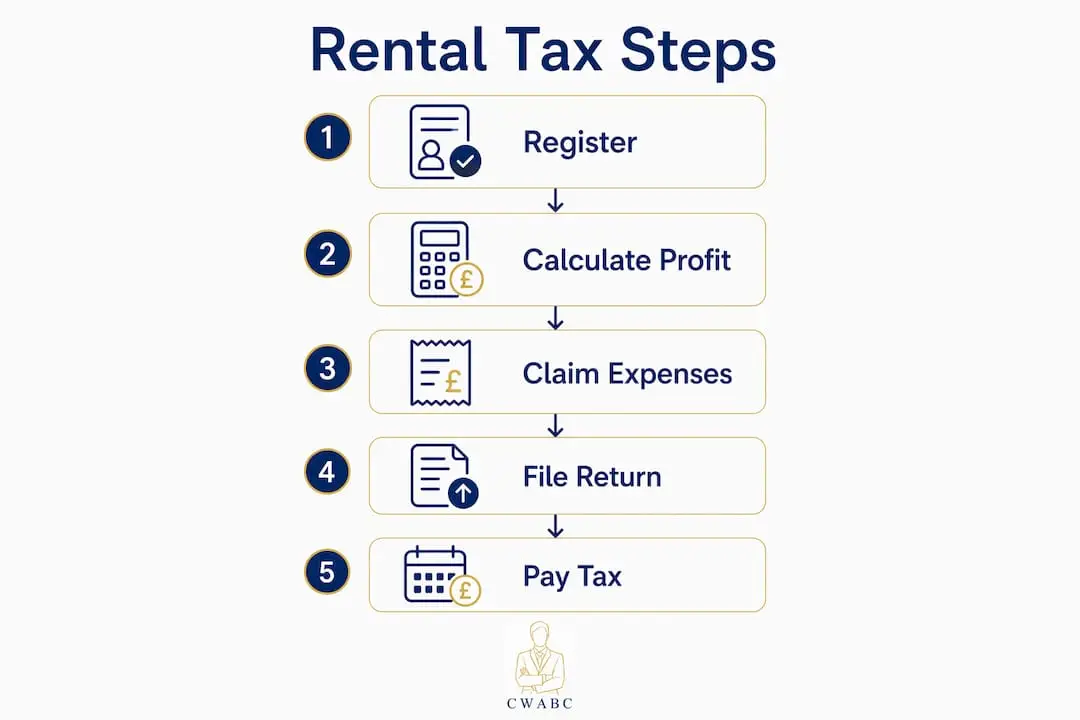
Every landlord with taxable rental profits above the property allowance must register for Self Assessment and complete a tax return each year. If you are new to letting, you must register with HMRC by 5 October following the end of the tax year in which you first received rental income.

Key deadlines at a glance:
| Deadline | Action required |
|---|---|
| 5 October | Register for Self Assessment (new landlords) |
| 31 January | Online Self Assessment return and tax payment due |
| 31 July | Second payment on account (where applicable) |
| 31 January (following year) | Balancing payment for any underpayment |
On your Self Assessment return, rental income goes in the UK Property pages (SA105). You will record total rental income in Box 20, allowable expenses in Boxes 24 to 29, and your mortgage interest separately as a finance cost. The property income allowance, if claimed, goes in Box 20.1.
Penalties for late filing or payment:
- One day late: £100 fixed penalty
- Three months late: additional daily penalties of £10, up to £900
- Six months late: a further 5% of the tax due or £300, whichever is greater
- Interest accrues on unpaid tax from the due date
Making Tax Digital for Income Tax (MTD ITSA) will require landlords with qualifying income above the relevant threshold to keep digital records and submit quarterly updates to HMRC. For a clear overview of what this means for you, Cwabc’s MTD ITSA guide explains the requirements step by step. You can also find the full property income tax return guide on the Cwabc website.
Getting ready for Making Tax Digital: record keeping that actually works
Good record keeping is not just about compliance — it genuinely makes your tax return faster and less stressful. The Low Incomes Tax Reform Group (LITRG) recommends that landlords start keeping digital records now, even before MTD ITSA becomes mandatory for them, because the habits you build today will save real time later.
Under Making Tax Digital, landlords above the qualifying income threshold must keep digital records and submit quarterly updates categorised by type of expense. One detail that catches many landlords out: mortgage interest must be recorded separately from other expenses in your digital records, because it is treated as a tax reducer rather than a deductible cost.
Practical record keeping tips:
- Keep a dedicated bank account for rental income and expenses — it makes categorisation far simpler.
- Log every repair visit with a date, description, and receipt. HMRC may ask for evidence years later.
- Maintain a mileage log if you travel to inspect or manage properties; the approved HMRC rate applies.
- Separate capital expenditure (improvements) from revenue expenditure (repairs) at the point of recording, not at year-end.
- Use accounting software such as Xero, FreeAgent, or QuickBooks to categorise expenses in real time.
Pro Tip: When setting up your software categories, create a dedicated category for “residential finance costs” from day one. Mixing mortgage interest with other expenses is one of the most common MTD errors and can distort your tax calculation significantly.
For more detailed guidance, Cwabc’s landlord bookkeeping guide walks you through setting up a system that works for both current Self Assessment and future MTD requirements.
Capital Gains Tax when you sell a rental property
Selling a rental property triggers Capital Gains Tax (CGT) on the gain, not the sale price. The gain is broadly the sale proceeds minus the original purchase price, plus any capital improvement costs you have incurred over the years (which is one reason to keep records of capital expenditure carefully).
CGT rates for residential property are higher than for other assets. For the 2025/26 tax year, basic-rate taxpayers pay 18% on residential property gains, and higher or additional-rate taxpayers pay 24%. Every individual has an Annual Exempt Amount, which for 2025/26 is £3,000. Gains above this threshold are taxable.
Private Residence Relief (PRR) can reduce or eliminate CGT if the property was at any point your main home. Lettings Relief, which used to provide significant relief for periods of letting, was substantially restricted from April 2020 and now only applies in limited circumstances where the owner was in shared occupancy with the tenant.
You must report and pay CGT on UK residential property within 60 days of completion using HMRC’s online CGT on UK property service. Missing this deadline attracts penalties and interest, so build it into your conveyancing timeline.
Furnished holiday lettings: what changed from April 2026
The Furnished Holiday Lettings (FHL) tax regime was abolished from 5 April 2025. This is a significant change for landlords who let short-term holiday accommodation. From that date, income and gains from furnished holiday lets are treated as part of your ordinary UK property business, with no separate reporting requirements.
Before abolition, FHL properties attracted several tax advantages: full mortgage interest deductibility, access to capital allowances on furniture and equipment, and the ability to treat profits as relevant earnings for pension contributions. All of these benefits ceased from 5 April 2025.
If you previously ran an FHL business, your income now sits alongside your other rental income in the UK Property pages of your Self Assessment return. The HMRC helpsheet HS253 covers the transitional rules for any periods straddling the change. Capital allowances already claimed on FHL assets may have balancing charge implications on disposal, so review your position carefully.
VAT and rental income: when does it apply?
Residential lettings are exempt from VAT as a general rule. If you let a house or flat to a tenant for residential use, you do not charge VAT and you cannot reclaim VAT on related costs. This is the position for the vast majority of UK landlords.
Commercial property lettings are different. Letting commercial premises is also VAT-exempt by default, but landlords can opt to tax the property, which means charging VAT at the standard rate on rents and reclaiming input VAT on costs. This is a significant decision with long-term consequences and is not reversible without HMRC’s permission.
Holiday lets and serviced accommodation can attract VAT if your total taxable turnover exceeds the VAT registration threshold (£90,000 for 2025/26). If you provide substantial services alongside accommodation, HMRC may treat the income as a supply of services rather than a simple letting, which changes the VAT treatment. If you are close to the threshold or unsure about your position, take advice before assuming you are exempt.
Tax reliefs and incentives available to landlords
Beyond allowable expenses, several specific reliefs can reduce your rental tax bill.
Replacement of Domestic Items Relief allows you to deduct the cost of replacing furnishings, appliances, and kitchenware in furnished residential lets. You can claim for like-for-like replacements; if you upgrade to something better, only the equivalent cost of the original item is deductible. This replaced the old Wear and Tear Allowance from April 2016.
Rent a Room Relief lets you earn up to £7,500 per year tax-free from letting a furnished room in your own home. If you share the income with a joint owner, each person’s threshold is £3,750. Claiming Rent a Room Relief means you cannot also claim the property income allowance on that income, and you cannot deduct expenses against it.
Annual Investment Allowance (AIA) is available for equipment purchased for use in your property business, though not for cars. Commercial landlords and those with qualifying FHL businesses (in prior years) could claim AIA on fixtures and fittings.
Landlord compliance services offered by property management specialists can also help you stay on top of regulatory obligations alongside your tax position. For landlords managing multiple properties, specialist landlord support can be worth considering alongside your accountant.
Cwabc helps landlords stay on top of rental tax compliance
Rental income tax involves more moving parts than most landlords expect: allowable expenses, mortgage interest restrictions, Self Assessment deadlines, MTD preparation, and now the post-FHL changes. Getting it right the first time is far less stressful than correcting errors later.

Cwabc is a licensed bookkeeper and accountant based in Tonbridge, working specifically with landlords and sole traders to take the complexity out of property tax. Rather than leaving you to piece together HMRC guidance alone, Cwabc sets up clear, organised systems from the start — categorising your income and expenses correctly, keeping mortgage interest separated for MTD compliance, and filing your Self Assessment return accurately and on time. There are no surprises with pricing, and no jargon in the process. Whether you need accounting software set up to prepare for Making Tax Digital, or simply want someone reliable to handle your annual return, Cwabc offers a free, no-obligation initial conversation to discuss your situation. Get in touch via the Cwabc contact page to take the first step.
Key takeaways
UK landlords pay income tax on rental profits after deducting allowable expenses, with mortgage interest restricted to a 20% tax credit and Self Assessment returns due by 31 January each year.
| Point | Details |
|---|---|
| Tax on profit, not rent | Deduct allowable expenses from rental income first; only the remaining profit is taxable. |
| £1,000 property allowance | The first £1,000 of property income is tax-free, but claiming it means you cannot also deduct expenses. |
| Mortgage interest restriction | Individual landlords receive a 20% tax credit on finance costs, not a full expense deduction, since April 2020. |
| Self Assessment deadlines | Register by 5 October, file and pay by 31 January; late filing attracts a £100 penalty from day one. |
| Cwabc for landlord compliance | Cwabc handles Self Assessment filing, expense categorisation, and MTD software setup for landlords in Tonbridge and beyond. |
Need help?
Rental income tax does not have to be stressful. Whether you are a first-time landlord or managing a growing portfolio, Cwabc offers clear, friendly, and professional support tailored to your situation. Book a free, no-obligation conversation with the Cwabc team today.