
Incorporation relief under section 162 of the Taxation of Chargeable Gains Act 1992 defers Capital Gains Tax when you transfer a going-concern business into a limited company wholly or mainly in exchange for shares. It works by reducing the base cost of those shares, not by writing off the tax. If any part of the price is paid in cash rather than shares, that portion is taxed straight away.
TL;DR:
- Incorporation relief only defers Capital Gains Tax if you transfer the entire unincorporated business as a going concern, with cash being the only exception.
- If part of the consideration includes cash, that amount is taxed immediately, while the gain on shares is deferred based on their value.
- From April 2026, claiming relief requires an active claim on your Self Assessment return, rather than automatic acceptance.
- Proper valuation of shares and careful modelling before transfer are essential to avoid underestimating the deferred gain or forgetting taxes on cash considered.
- Relief is most beneficial for long-term owners or those planning succession, but less suitable if immediate cash needs or quick sales are expected.
Table of Contents
- What is incorporation relief s162 and who qualifies?
- How does incorporation relief work in practice?
- What happens if you receive cash as well as shares?
- Claiming s162 relief: deadlines from 6 April 2026
- Practical checklist before you incorporate
- A simplified worked example
- Practitioner perspective: when I’d recommend s162, and when I wouldn’t
- How I can help with your incorporation
- Sources
- FAQ
What is incorporation relief s162 and who qualifies?
Section 162 relief is open to sole traders, partners and trustees running an unincorporated business. Limited companies cannot claim it, because the relief exists specifically to smooth the move from unincorporated trading into corporate form.
Two conditions do most of the work. First, you must transfer the business as a going concern, meaning it keeps trading rather than winding down and selling off assets piecemeal. Second, you must generally hand over the whole of the assets, with cash the only asset you are allowed to hold back. Miss either condition and the relief falls away, according to HMRC’s Capital Gains Manual.
For partnerships, HMRC computes the relief separately for each partner based on their share of the gain. Watch out for these common disqualifiers:
- Retaining a key trading asset, such as a property the business still needs, outside the transfer
- Transferring only part of the business rather than the whole trade
- A corporate partner already sitting in the partnership, which can block relief for that share
- Treating a sale of assets, rather than the business as a whole, as an incorporation
If you currently trade as a sole trader, my guide to sole trader tax sets out the wider filing picture before you even think about incorporating.
How does incorporation relief work in practice?
Relief is calculated in three steps, and each one matters if you want an accurate figure rather than a guess.
- Work out the gain. Calculate the chargeable gain (or loss) on each business asset transferred, using normal Capital Gains Tax rules.
- Apply the fraction A/B. “A” is the cost of the shares you receive; “B” is the total consideration for the business, shares plus anything else. This fraction determines what proportion of the gain qualifies for deferral.
- Reduce the share base cost. The deferred gain is deducted from the cost of the new shares, so the tax bill effectively moves to whenever you eventually sell those shares.
The relief cannot exceed the cost of the shares issued. If the business assets barely exceed its liabilities, the amount you can defer might be very small, or even nil, which HMRC’s guidance on the computation makes clear is a real risk in asset-light or heavily-geared businesses. Where you receive more than one class of shares, the deferred amount is apportioned between classes by reference to their relative market values, so getting a sensible valuation matters more than most people expect.
It’s also worth thinking about how s162 sits alongside other reliefs. Business Asset Disposal Relief, for example, taxes gains at a lower rate rather than deferring them, so combining the two needs careful sequencing rather than assuming they simply stack.
Pro Tip: Model the deferred gain and the resulting share base cost before you sign anything. Once the transfer completes, the numbers are fixed, and unpicking a mistake later is far harder than getting the valuation right at the outset.
What happens if you receive cash as well as shares?
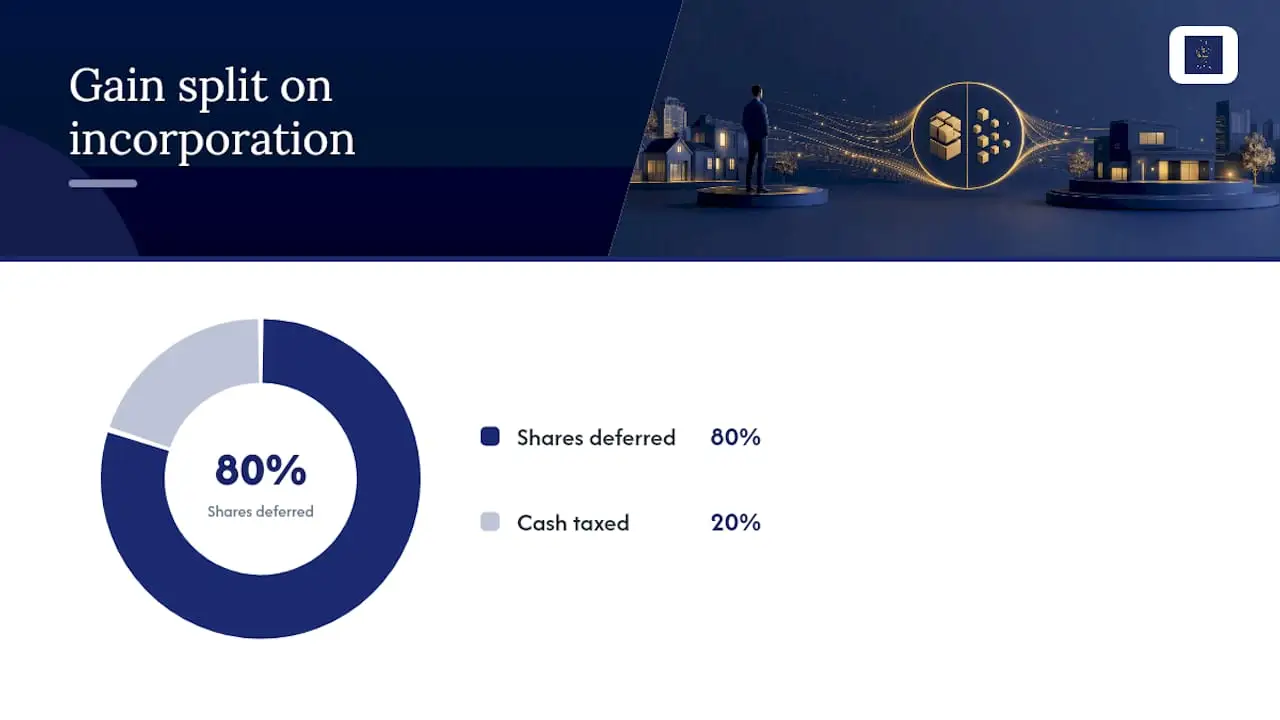
Relief only shelters the slice of the gain attributable to shares. Any cash element is treated as a normal disposal and taxed immediately, with no deferral available on that part.
Say your business gain on incorporation is £100,000, and you take payment as 80% new shares and 20% cash. Only 80% of that gain, £80,000, rolls into the share base cost under GOV.UK’s incorporation relief rules. The remaining £20,000 is chargeable to Capital Gains Tax in the year of the transfer, in full.
- Shares received: rolled into base cost, tax deferred
- Cash received: taxed as a disposal in the year of transfer
- Mixed consideration: apportioned pro rata between the two
This is exactly why the shares-versus-cash split deserves proper modelling before completion, not after. Taking a larger cash sum out at incorporation might solve a short-term liquidity need, but it brings forward a tax bill you could otherwise have deferred for years.
Claiming s162 relief: deadlines from 6 April 2026
Incorporation relief has traditionally applied automatically once the conditions are met, with no separate claim needed. That changes for transfers happening on or after 6 April 2026.
For any qualifying transfer from that date, you must actively claim the relief within your Self Assessment return for the tax year in which the transfer took place, under section 162 TCGA 1992. In practice, that means:
- Filing your claim by the normal Self Assessment deadline for that tax year
- Including the transaction details and supporting computations HMRC expects with the claim
- Considering whether you actually want the relief, because you can elect under section 162A not to have it apply, and there is a “relevant date” that governs how that election is timed, as HMRC’s guidance on elections explains
If you’ll be pulling together figures for the claim, my piece on preparing accounts for a tax return walks through the groundwork most people underestimate.
Practical checklist before you incorporate
A rushed incorporation is where most of the avoidable problems creep in. Work through this before agreeing terms with your new company:
- Map every asset. List everything the business owns and confirm the whole lot transfers, cash aside, to protect the going-concern condition.
- Decide on cash. Work out how much, if any, cash consideration you actually need, knowing it triggers immediate tax.
- Get share valuations agreed. Independent or clearly documented valuations support your apportionment figures if HMRC ever queries them.
- Check the wider tax picture. Incorporation can trigger Stamp Duty Land Tax on property transfers, VAT registration questions, and changes to capital allowances, according to LexisNexis’s guidance on incorporating a business.
- Keep the paperwork. Retain valuations, computations and the transfer agreement, since you’ll need them for the Self Assessment claim.
Landlords considering incorporating a rental portfolio face their own quirks here, particularly around Stamp Duty Land Tax on properties, so it’s worth reading my landlord bookkeeping guide alongside this checklist.
Pro Tip: Don’t sign off a share valuation just because it’s convenient for the deal. Undervaluing shares shrinks the amount you can defer, since relief is capped at the cost of the shares you receive.
A simplified worked example
Picture a sole trader incorporating a business with a total chargeable gain of £60,000.
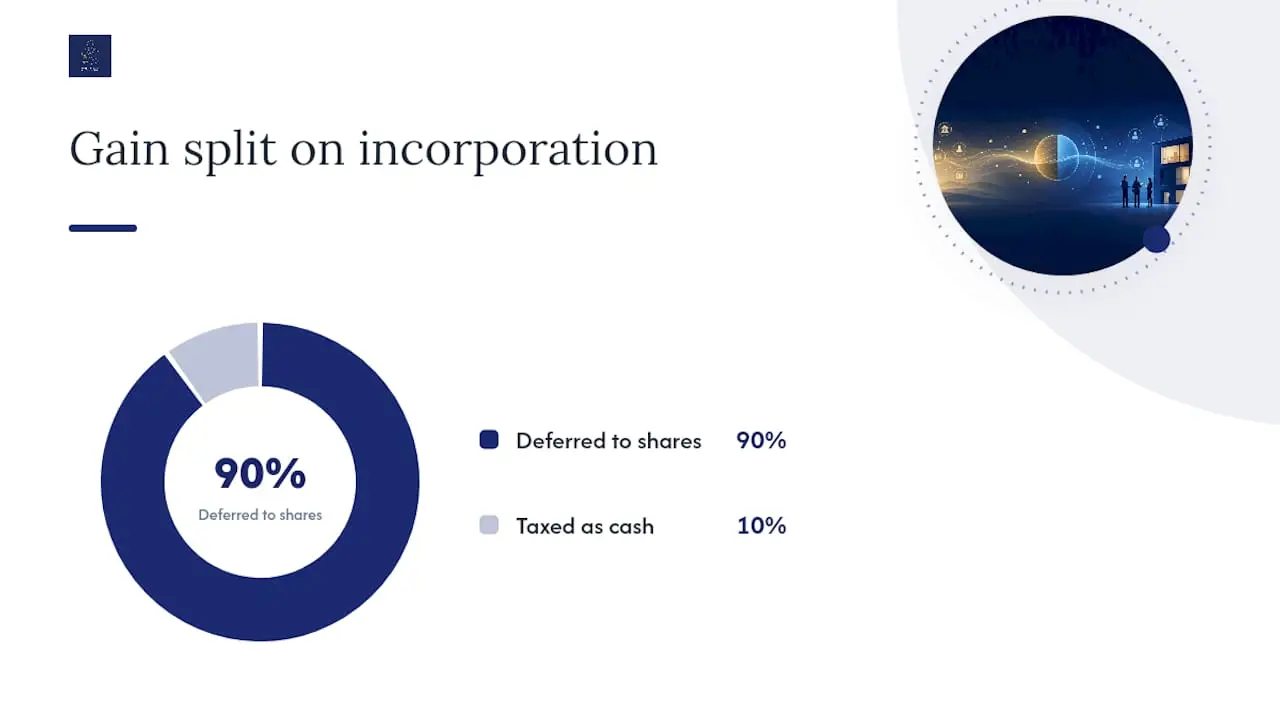
Applying the A/B fraction, 90% of the gain, £54,000, is deferred and deducted from the base cost of the shares. The remaining £6,000, tied to the cash, is taxed immediately in that tax year. If the shares originally cost £54,000 to acquire, the effective base cost after relief drops to nil, meaning the full £54,000 becomes taxable whenever those shares are eventually sold.
The lesson: deferral doesn’t erase the gain, it just changes when and against what asset it crystallises. Anyone planning to sell their shares within a few years should factor that eventual bill into their decision now, not later.
Practitioner perspective: when I’d recommend s162, and when I wouldn’t
Deferral suits businesses building for the long term, where you’re not planning to sell shares soon and want to keep more capital working in the company. It suits succession planning too, spreading the eventual tax rather than triggering it all at once.
Where I’m more cautious is when cash needs are immediate, when losses could otherwise offset the gain, or when Business Asset Disposal Relief might tax the gain more favourably now than deferral would later. The maths only works if the valuations behind it are sound, so get those checked before you commit. If your situation looks anything but straightforward, get in touch and I’ll talk through the numbers with you.
— Chris
How I can help with your incorporation
CWABC is a direct alternative to piecing this together yourself from HMRC manuals and forum threads. I check whether your transfer genuinely meets the s162 conditions, help you model the shares-versus-cash split before you commit to terms, liaise on share valuations, and get your Self Assessment claim filed correctly and on time.

I offer a fixed-fee initial review so you know the cost before any work starts, and I work remotely or in person for clients across Tonbridge, Sevenoaks and the rest of Kent. If your bookkeeping isn’t already in good shape, that’s worth sorting first, since incorporation only compounds messy records. My guide on signs your bookkeeping needs professional help is a useful starting point, and if you’re weighing up how incorporating affects your working capital, this piece on business capital and missed opportunities is worth a read too. To discuss your own transfer, contact CWABC and I’ll talk you through what a review would involve.
Sources
FAQ
What are the new rules for incorporation relief from April 2026?
For transfers on or after 6 April 2026, you must formally claim incorporation relief within your Self Assessment return for the tax year of the transfer, rather than relying on it applying automatically.
What are the conditions for incorporation relief?
You must transfer an unincorporated business as a going concern, hand over the whole of its assets (cash aside), and receive shares as some or all of the consideration; companies themselves cannot claim.
How does incorporation relief actually work for HMRC purposes?
HMRC treats it as a deferral: the gain on the assets transferred is rolled into the base cost of the shares you receive, so tax becomes due later when you dispose of those shares rather than at the point of incorporation.
Can I claim other Corporation Tax reliefs alongside incorporation relief?
Incorporation relief is a Capital Gains Tax relief for you personally, not a Corporation Tax relief for the new company, though the incorporation itself may affect capital allowances and other Corporation Tax positions, which is worth reviewing through my small business Corporation Tax guide.
Need help?
If you’re weighing up incorporating your business and want the s162 position checked properly before you commit, get in touch with CWABC and I’ll talk you through what’s involved.