A sole trader is an individual who runs a business as themselves. You and the business are the same legal entity, which means you keep all profits after tax but are personally responsible for any business debts. If you plan to start trading, your first step is to register with HMRC for Self Assessment, ideally within three months of starting.
This guide covers everything you need to know before you begin:
- How to register with HMRC and get your UTR
- Tax, Income Tax and National Insurance obligations
- Bookkeeping requirements and Making Tax Digital (MTD)
- Trading name rules and licences
- Insurance and when to consider a limited company instead
Table of Contents
- What being a sole trader actually means in law and practice
- How does a sole trader differ from ‘self-employed’ or a limited company?
- How to register as a sole trader with HMRC
- Tax and National Insurance: what sole traders owe and when
- Keeping records and bookkeeping: what to keep and for how long
- Choosing a trading name, licences and permissions
- Liability, insurance and when to consider incorporating
- Typical costs, how long set-up takes and key deadlines
- Your first 10 steps: a practical checklist for new sole traders
- When to get an accountant: Cwabc’s practical advice and common mistakes
- Key takeaways
- Starting out is simpler than you think
- How Cwabc helps new sole traders get started with confidence
- Useful sources and further reading
- Need help?
What being a sole trader actually means in law and practice
As a sole trader, there is no legal separation between you and your business. Unlike a limited company, your personal money and your business money are treated as one. You keep every pound of profit after tax, but if the business runs up debts it cannot pay, your personal assets, including your home and savings, are at risk.
In everyday terms, this structure suits a freelance graphic designer invoicing clients directly, a self-employed plumber running their own round, or a personal trainer working independently. You make all the decisions, you set your own hours, and you file your own tax return each year through Self Assessment.
You can trade under your own name or choose a business name, provided it is not already trademarked or offensive. Wherever you use a business name, you must still display your own name and address on invoices and correspondence.
Liability callout: unlimited personal liability is the single biggest legal risk of this structure. Public liability insurance and professional indemnity cover are not legally required in most trades, but they are strongly advisable from day one.
How does a sole trader differ from ‘self-employed’ or a limited company?
The terms sole trader and self-employed overlap considerably. Being self-employed simply means you work for yourself rather than an employer. A sole trader is one specific business structure for doing that. You can be self-employed as a sole trader, or as a partner in a partnership, but the two phrases are often used interchangeably in everyday conversation.
A limited company is a different matter entirely. The company is a separate legal entity, which means your personal finances are protected if the business fails. That protection comes with more administration: annual accounts filed at Companies House, corporation tax returns, and director responsibilities.

| Dimension | Sole trader | Limited company |
|---|---|---|
| Liability | Unlimited personal liability | Limited to share capital |
| Tax treatment | Income Tax on profits via Self Assessment | Corporation Tax on profits; salary and dividends for directors |
| Admin filings and deadlines | Self Assessment return annually; simpler records | Annual accounts, confirmation statement, corporation tax return |
| Suitability for growth | Ideal for start-up and lower-risk trading | Better suited as profits rise or contracts require it |
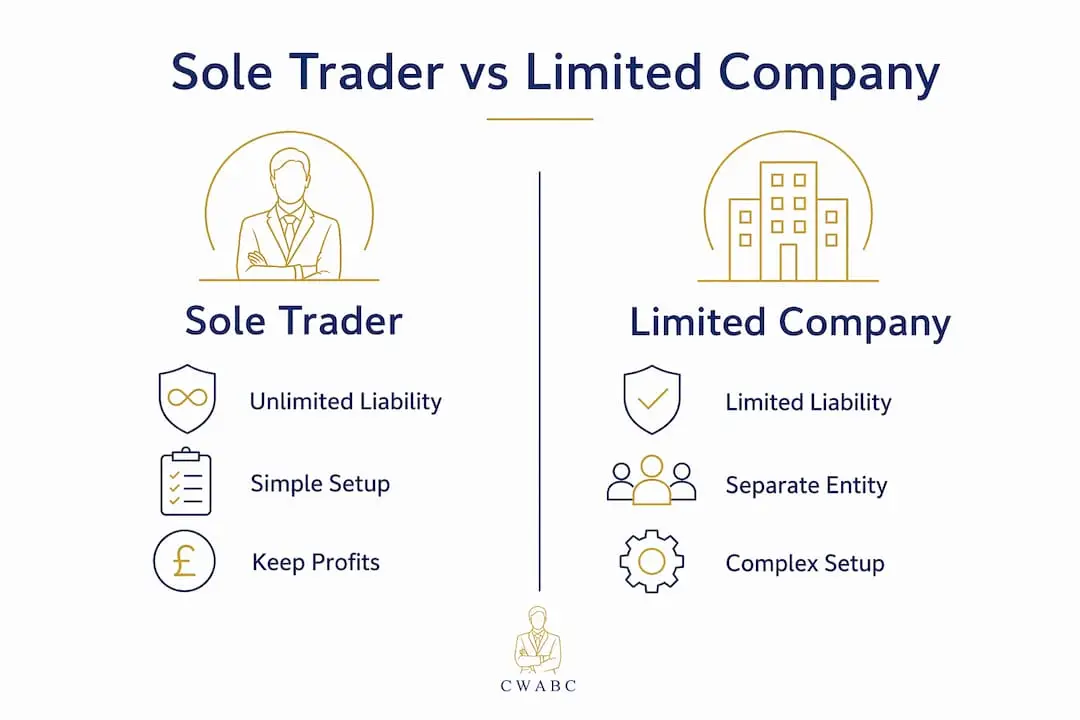
A simple rule of thumb: start as a sole trader if you are testing an idea or trading at modest profit levels. Consider incorporation when profits consistently exceed the higher-rate Income Tax threshold, when a client contract requires a limited company, or when personal liability becomes a genuine concern. For a fuller look at the company setup process, that partner guide walks through the steps clearly.
How to register as a sole trader with HMRC
Registration means signing up for Self Assessment and telling HMRC you are self-employed. HMRC will issue you a Unique Taxpayer Reference (UTR), usually within ten working days, and will then expect you to file a Self Assessment return each year.
Step-by-step:
- Go to GOV.UK and use the Self Assessment registration service.
- Create or sign in to your Government Gateway account.
- Select “I am self-employed” and enter your personal details, National Insurance number and the date you started trading.
- Wait for your UTR to arrive by post (allow up to ten working days).
- Use your UTR to activate your Self Assessment online account.
Timing matters. Register within three months of starting to trade. Missing this window will not stop you registering, but HMRC may issue a notice to file and could charge a late registration penalty.
If your self-employment income is under £1,000 in a tax year, the trading allowance may mean you do not need to register for Self Assessment at all. Check the current rules on GOV.UK before assuming this applies to you.
Already on Self Assessment for rental income? You still need to update HMRC to record your trading status so that Class 2 National Insurance contributions are applied correctly.
Pro Tip: Start a simple spreadsheet or cloud accounting file the day you begin trading. Your first tax return will be far easier if you have a clear record of income and expenses from week one, rather than trying to reconstruct them months later.
Tax and National Insurance: what sole traders owe and when
Your taxable profit is your total trading income minus allowable business expenses. You pay Income Tax on that profit through Self Assessment. Unless your trading income is below the £1,000 trading allowance, a Self Assessment return is normally required.
Key Self Assessment dates:
- 31 January — online return and any tax owed for the previous tax year, plus the first Payment on Account for the current year
- 31 July — second Payment on Account
- 31 October — deadline for paper returns (most people file online)
Payments on Account catch many new sole traders off guard. If your tax bill exceeds £1,000, HMRC requires you to pay half of next year’s estimated bill in advance, split across January and July. Budget for this from the start.
National Insurance for sole traders comes in two classes. Class 2 and Class 4 NICs are both collected through Self Assessment. Class 2 protects your entitlement to the State Pension and certain benefits. For the relevant tax year, if your taxable profits exceed the applicable threshold, Class 2 contributions are treated as paid automatically. Below that threshold, you can choose to pay voluntarily to protect your State Pension record. Class 4 is calculated as a percentage of profits above the lower profits limit and is paid alongside your Income Tax.
Budget tip: set aside a portion of every payment you receive into a separate savings pot. Running a simple quarterly check on your tax position means the January deadline never comes as a shock.
Keeping records and bookkeeping: what to keep and for how long
Good records are not optional. HMRC can open an enquiry into any Self Assessment return, and you will need to produce evidence to support every figure you have claimed.
Core records to keep:
- Sales invoices and receipts for all income
- Receipts and invoices for every business expense
- Bank statements (business and, where mixed, personal)
- VAT records if you are VAT-registered
- Payroll records if you employ staff
Keep most business records for at least five years after the 31 January filing deadline for the relevant tax year. VAT records must be kept for six years.
Making Tax Digital for Income Tax (MTD ITSA) is the change that affects sole traders most significantly from April 2026. If your qualifying income exceeds the relevant threshold, you will need HMRC-compatible digital software and must submit quarterly updates to HMRC rather than a single annual return. Early adoption of cloud accounting now reduces the pressure when MTD ITSA becomes mandatory for more traders. Check the current income threshold on GOV.UK, as it is subject to change.
Pro Tip: Open a dedicated business bank account before you make your first sale. Separating business and personal transactions from day one is the single most effective way to avoid bookkeeping chaos and keep your financial records clean for Self Assessment.
Choosing a trading name, licences and permissions
You have two options: trade under your own full name, or choose a business name. Both are perfectly valid. If you use a business name, the rules are straightforward.
Trading name checklist:
- The name must not be the same as or too similar to a registered trademark.
- It cannot include words like “limited”, “Ltd” or “PLC” as these imply a different legal structure.
- It must not be offensive or suggest a connection with government.
- Your own name and a contact address must appear on all business stationery and invoices.
Search the GOV.UK trademark database and the Intellectual Property Office before settling on a name.
Beyond the name, certain activities require a licence or registration before you can legally trade. Food businesses need to register with their local authority. Taxi and private hire drivers need a local council licence. Some financial services activities require Financial Conduct Authority authorisation. Regulated professions such as electricians, gas engineers and certain healthcare roles have their own registration requirements. For a thorough overview of professional registration in the UK, that partner guide covers the main regulated sectors clearly.
Check GOV.UK and your local authority website for the specific licences that apply to your trade before you begin.
Liability, insurance and when to consider incorporating
Unlimited liability means that if your business cannot pay its debts, creditors can pursue your personal assets. Your home, car and savings are all potentially at risk. This is not a reason to avoid sole trading, but it is a reason to take insurance seriously and to review your structure as the business grows.
Insurance to consider from day one:
- Public liability insurance — covers claims from clients or members of the public for injury or property damage.
- Professional indemnity insurance — covers claims arising from professional advice or services you provide.
- Business equipment cover — protects tools, laptops and other assets you rely on.
| Dimension | Sole trader | Limited company |
|---|---|---|
| Liability protection | None — personal assets at risk | Personal assets protected |
| Tax flexibility | Income Tax rates on all profits | Salary and dividend split possible |
| Admin burden | Low — one Self Assessment return | Higher — Companies House filings, corporation tax |
| Suitability for growth | Best for early stage and lower risk | Better as profits and risk increase |
The primary appeal of the sole trader structure is its simplicity and low administrative burden. As profits grow, incorporation may offer tax efficiency and personal financial protection. Consider making the switch when profits consistently reach the higher-rate tax band, when a client contract specifically requires a limited company, or when borrowing for the business puts personal assets at meaningful risk. Practitioners advise that choosing when to incorporate requires regular financial forecasting, so revisit the question at least annually.
Typical costs, how long set-up takes and key deadlines
Registration as a sole trader on GOV.UK is free. There is no fee to register for Self Assessment, and setting up as a sole trader is quick — most people complete the online registration in under thirty minutes.
Typical early costs:
- Registration: free via GOV.UK
- Cloud accounting software: varies by provider; many offer a free trial period
- Business bank account: some providers offer free accounts for the first year
- Insurance: depends on your trade and level of cover required
- Accountant or bookkeeper fees: these vary widely depending on the scope of work and the provider
Timeline from day one:
- Register online: same day
- Receive UTR by post: up to ten working days
- Open a business bank account: a few days to a week depending on the provider
- Set up bookkeeping software: one to two hours
VAT: you must register for VAT if your taxable turnover exceeds £90,000 in any rolling twelve-month period. You can also register voluntarily if your turnover is below that threshold. Always check the current threshold on GOV.UK, as it can change at each Budget.
Your first 10 steps: a practical checklist for new sole traders
Follow these steps in your first month to start trading correctly and reduce compliance risk.
- Confirm you are self-employed — check that sole trader is the right structure for your situation.
- Choose your trading name — search trademarks and check GOV.UK rules before committing.
- Register with HMRC — use the HMRC registration guide to sign up for Self Assessment within three months of starting.
- Open a business bank account — keep personal and business money separate from day one.
- Set up your bookkeeping — choose a simple spreadsheet or cloud accounting software and start recording income and expenses immediately.
- Set aside money for tax — put a portion of every payment into a savings pot to cover Income Tax and National Insurance.
- Get appropriate insurance — at minimum, consider public liability cover before you take on your first client.
- Check licences and permissions — confirm whether your trade requires a local authority licence or professional registration.
- Consider VAT — check whether you are approaching the registration threshold or whether voluntary registration would benefit you.
- Plan for your first tax return — note the 31 January deadline and consider whether you need support with your Self Assessment return.
When to get an accountant: Cwabc’s practical advice and common mistakes
Knowing when to bring in professional support can save you money and stress. You do not need an accountant on day one if your affairs are simple, but there are clear triggers that make it worthwhile.
Consider getting help when:
- Your income is approaching the VAT threshold
- You are taking on staff and need to run PAYE
- You have multiple income streams or complex expenses
- MTD ITSA is approaching and you are not confident with digital software
- You simply do not have the time to keep records accurately
The most common mistakes new sole traders make are avoidable with a little preparation. Mixing personal and business expenses is the biggest one — it creates hours of untangling at year end and risks errors on your Self Assessment return. Underestimating Payments on Account is another: many people are caught out by the January bill being larger than expected because it includes the first advance payment for the following year. Late registration with HMRC is a third, since it can trigger penalties and create gaps in your National Insurance record.
Pro Tip: Set up simple systems early and build a relationship with an adviser before problems arise. At Cwabc, we work with sole traders in Tonbridge and Kent to put straightforward bookkeeping routines in place from the start, so tax time is calm rather than chaotic. If you are unsure whether your bookkeeping needs professional help, that guide sets out the clearest signs.
Key takeaways
A sole trader is the simplest UK business structure: you are the business, you keep profits after tax, and you are personally liable for all debts, which makes early insurance and good record-keeping non-negotiable.
| Point | Details |
|---|---|
| Register promptly | Sign up for Self Assessment with HMRC within three months of starting to trade. |
| Unlimited liability | Your personal assets are at risk if the business cannot pay its debts — consider insurance from day one. |
| Tax and NICs | Pay Income Tax on profits via Self Assessment; Class 2 and Class 4 NICs are collected through the same return. |
| MTD ITSA from April 2026 | Many sole traders must use HMRC-compatible digital software and submit quarterly updates from April 2026. |
| Cwabc can help | Cwabc supports sole traders in Tonbridge and Kent with Self Assessment, bookkeeping set-up and MTD readiness. |
Starting out is simpler than you think
Starting as a sole trader genuinely is straightforward once you know the steps. The registration is free, the process is online, and most of the ongoing obligations, filing a return, keeping records, setting aside tax, are manageable with a simple routine in place.
What trips people up is not the complexity of the rules but the habit of leaving things until the last minute. A separate bank account, a basic bookkeeping file, and a note of the 31 January deadline will take you a long way. If your situation grows more complex, or if you simply want the reassurance of knowing it is done correctly, that is exactly where a local accountant adds real value.
How Cwabc helps new sole traders get started with confidence
Cwabc gives sole traders in Tonbridge and Kent a straightforward alternative to piecing together compliance on their own. Fixed, upfront fees mean you know exactly what you are paying, with no surprises at year end.
The services most relevant to new sole traders include Self Assessment preparation, bookkeeping set-up and training, MTD ITSA software configuration, VAT registration support, and payroll if you take on staff. Cwabc’s processes are already MTD-ready, so clients are not scrambling to adapt when quarterly reporting becomes mandatory.
If you are not sure whether your records are in good shape, the bookkeeping FAQ for small businesses is a good starting point. When you are ready to talk through your specific situation, get in touch via the contact page for a free, no-obligation conversation.
Useful sources and further reading
Official guidance:
- Become a sole trader — GOV.UK
- Register for Self Assessment — GOV.UK
- Self-employed National Insurance rates — GOV.UK
- Register for VAT — GOV.UK
- Tax and National Insurance when self-employed — MoneyHelper
- Self-employment: registering for tax and NIC — Low Incomes Tax Reform Group
Cwabc resources:
- Sole trader HMRC registration guide
- Sole trader tax explained: 2026 UK guide
- Making Tax Digital: sole trader transition guide
- Avoid bookkeeping errors: guide for the self-employed
Check GOV.UK for the latest thresholds and deadlines, as these can change at each Budget. For personalised guidance, contact Cwabc for a free, no-obligation conversation.
Need help?
Starting out as a sole trader raises a lot of questions, and getting the basics right from the beginning saves a great deal of stress later. Cwabc offers a free, no-obligation initial conversation for sole traders in Tonbridge and Kent. Get in touch today and we will help you set up with confidence.