The sole trader VAT threshold is the £90,000 rolling 12-month taxable turnover level set by HMRC that triggers mandatory VAT registration. Once your VAT-taxable sales cross this figure, you are legally required to register, charge VAT to customers, and submit regular VAT returns. This is not based on profit, take-home pay, or the tax year. It is based purely on your VAT-taxable turnover measured across any rolling 12-month window. Understanding this distinction is the single most important step in managing your sole trader tax obligations correctly.
How does HMRC calculate the sole trader VAT threshold?
HMRC uses two separate tests to determine whether you have crossed the £90,000 limit. Most sole traders only know about one of them, which is where problems start.
The historic test looks backwards. At the end of every month, you add up your VAT-taxable turnover for the previous 12 months. If that total exceeds £90,000, you have triggered the registration obligation. This is not a calendar year check or a tax year check. It is a rolling window that shifts forward by one month every month.
Here is a practical example of how the historic test works:
- At the end of April 2026, you add up your VAT-taxable sales from May 2025 to April 2026.
- If that total is £91,000, you have exceeded the threshold.
- You must notify HMRC within 30 days of the end of April, meaning by 30 May 2026.
- Your effective registration date becomes 1 June 2026, the first day of the second month after the breach.
- From that date, you must charge VAT on all applicable sales, even if your VAT number has not yet arrived.
The future test looks forward. If you have reasonable grounds to believe your VAT-taxable turnover will exceed £90,000 in the next 30 days alone, you must register immediately. This test exists to capture sudden growth events such as winning a large contract or launching a new service. You cannot wait for the historic test to catch up.
Pro Tip: Keep a simple spreadsheet with one column per month showing your VAT-taxable sales. At the end of each month, sum the previous 12 rows. This takes five minutes and removes all guesswork.
What counts towards your taxable turnover matters enormously. Standard-rated, reduced-rated, and zero-rated supplies all count. Exempt sales do not. A sole trader selling a mix of zero-rated food and exempt insurance-related services, for example, must be careful to include only the zero-rated sales in the threshold calculation. Many sole traders miscalculate the threshold by using profit figures, cash received, or annual totals instead of rolling VAT-taxable turnover. This leads to late or missed registrations and the penalties that follow.
What are the VAT registration requirements once the threshold is exceeded?
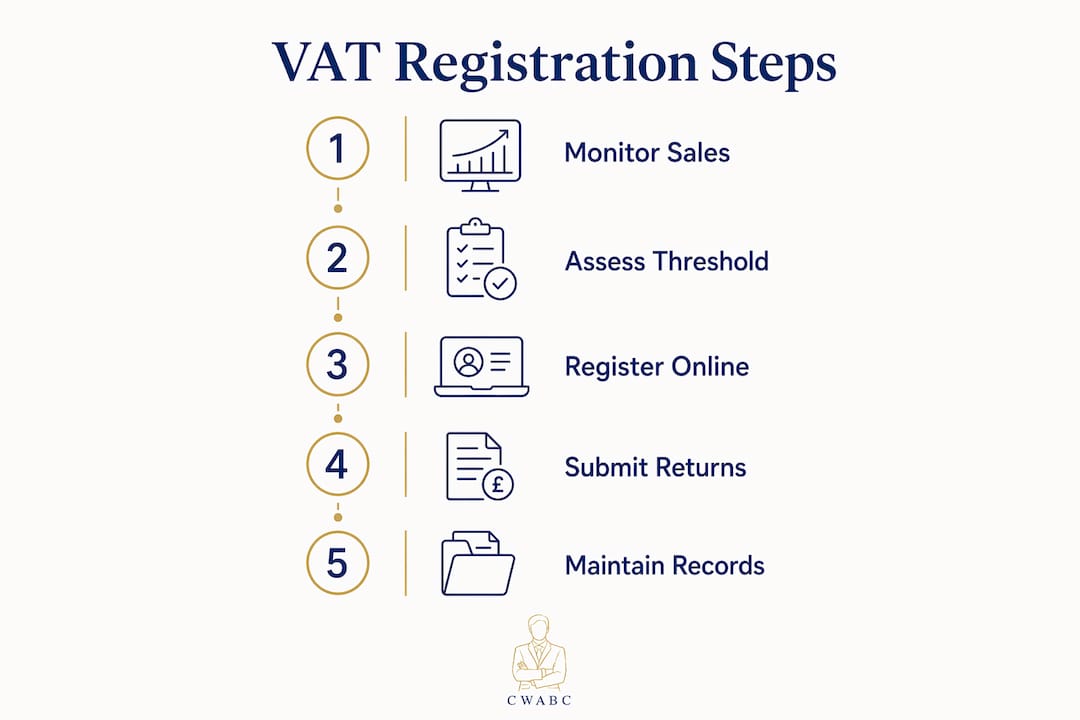
Once you cross the £90,000 mark, the clock starts immediately. Here is what you are required to do and when.
- Notify HMRC within 30 days of the end of the month in which you exceeded the threshold. If you exceeded it during April, you must notify HMRC by 30 May.
- Your effective registration date is the first day of the second month after the breach. Using the April example, that is 1 June.
- For the future test, your effective registration date is the date you first expected to exceed the threshold in the next 30 days. Registration is immediate, not deferred.
- Start charging VAT from the effective date, regardless of whether your VAT number has arrived. Charging VAT starts from the HMRC effective date, not the date the certificate lands in your inbox.
- Issue VAT invoices showing your VAT number, the VAT rate applied, and the VAT amount charged.
- Submit VAT returns, typically quarterly, and pay any VAT owed to HMRC.
Late registration can result in penalties calculated as a percentage of the VAT that should have been paid from the effective date. HMRC can also backdate your VAT liability, meaning you may owe VAT on sales you already received without charging it to customers. That is a cash flow problem you want to avoid entirely.
Pro Tip: Register for VAT online through your HMRC Government Gateway account. The process is straightforward and you will receive your VAT registration number within a few weeks. Set up your accounting software to issue VAT invoices from day one of your effective date.
One detail that catches sole traders off guard: you must issue corrected invoices or add VAT to invoices already sent if they fall after your effective registration date. If customers are VAT-registered businesses themselves, they can reclaim that VAT, so it is usually a manageable conversation. If your customers are members of the public, absorbing the VAT cost is sometimes the only practical option.
Should you register voluntarily, and when does deregistration make sense?
Not every sole trader who registers for VAT has been forced to. Voluntary VAT registration is available to any business below the threshold, and for some sole traders it is a genuinely good decision.
| Scenario | Voluntary registration | Compulsory registration |
|---|---|---|
| Turnover level | Below £90,000 | Above £90,000 |
| Reclaim input VAT | Yes, on business purchases | Yes, from effective date |
| B2B credibility | Appears more established | Standard expectation |
| Admin burden | Full VAT returns required | Full VAT returns required |
| Customer impact | End consumers pay more | End consumers pay more |
Voluntary registration makes most sense when you have significant VAT-bearing business expenses, such as equipment, materials, or software, and your customers are VAT-registered businesses who can reclaim the VAT you charge. A sole trader builder buying £20,000 of materials per year, for example, can reclaim thousands in input VAT that would otherwise be a dead cost.
The downside is real. You take on quarterly VAT returns, stricter recordkeeping, and the administrative overhead of Making Tax Digital (MTD) for VAT, which requires compatible software. For sole traders selling primarily to the public, adding 20% VAT to prices can reduce competitiveness.
Deregistration is the reverse process. If your taxable turnover is expected to stay below £88,000, you can apply to cancel your VAT registration. You must notify HMRC promptly and submit a final VAT return that includes VAT due on any business assets you hold. The deregistration threshold sitting £2,000 below the registration threshold is deliberate. It prevents sole traders from repeatedly crossing and uncrossing the line and toggling their registration status.
Consider deregistration carefully if your turnover has genuinely and sustainably dropped. Deregistering and then crossing the threshold again shortly afterwards creates more work, not less.
What practical steps help sole traders stay on top of VAT compliance?
Staying compliant with the sole trader VAT limit is mostly a matter of good habits rather than complex accounting knowledge. These steps keep you in control.
- Track turnover monthly. Maintain a rolling 12-month worksheet updated at the end of every month. Include only VAT-taxable sales. Exclude exempt income. This single habit prevents the most common compliance errors.
- Use MTD-compatible software. HMRC’s Making Tax Digital rules require VAT-registered businesses to keep digital records and submit returns through approved software. Tools such as Xero, FreeAgent, and QuickBooks all meet this requirement and can automate much of the threshold tracking for you. Setting up accounting software early means you are ready before registration becomes mandatory.
- Separate your income types. If you have both taxable and exempt income streams, record them separately from the start. Mixing them creates errors that are time-consuming to untangle later.
- Know your VAT rates. Standard rate is 20%, reduced rate is 5%, and zero rate is 0%. All three count towards your threshold, but the VAT you charge customers differs. Applying the wrong rate is a common and avoidable mistake.
- Prepare your invoices in advance. Before your effective registration date arrives, update your invoice template to include your VAT number, the applicable VAT rate, and the VAT amount as a separate line. HMRC has specific requirements for what a valid VAT invoice must show.
- Get professional advice early. A sole trader accountant who understands VAT registration for sole traders can review your turnover position, flag risks, and handle the registration process on your behalf. The cost of advice is almost always less than the cost of a penalty.
Recordkeeping for VAT purposes means retaining invoices, receipts, and bank statements for at least six years. Digital records stored in MTD-compatible software satisfy this requirement automatically, which is one more reason to set up proper bookkeeping systems before you need them rather than after.
Key takeaways
The sole trader VAT threshold is a £90,000 rolling 12-month taxable turnover limit, and missing it costs more in penalties and backdated VAT than any amount of preparation.
| Point | Details |
|---|---|
| The threshold figure | £90,000 in VAT-taxable turnover across any rolling 12-month period, not the tax year. |
| Two HMRC tests apply | The historic test looks back monthly; the future test requires immediate registration if you expect to exceed the limit in 30 days. |
| Registration timing | Notify HMRC within 30 days of month end; effective date is the first day of the following month. |
| Voluntary registration | Beneficial if you have high VAT-bearing costs or B2B customers; deregistration is available below £88,000. |
| Practical compliance | A monthly rolling turnover tracker and MTD-compatible software are the two most effective tools for staying compliant. |
What I have seen go wrong with the VAT threshold
Working with sole traders across Kent and beyond, the pattern I see most often is not recklessness. It is a genuine misunderstanding of what the threshold measures. People track their annual invoiced total, compare it to £90,000, and feel safe. But the rolling 12-month window means you could breach the threshold in February even if your financial year runs April to April and your year-to-date total looks fine.
The future test catches people even more off guard. A sole trader who wins a large contract in March and expects to invoice £95,000 in April alone must register immediately, not wait until the end of April to run the historic test. That distinction matters enormously when HMRC calculates backdated liability.
My honest view is that voluntary registration is underused by sole traders with B2B clients. The admin overhead is real, but so is the input VAT reclaim. If you are spending £15,000 a year on VAT-bearing costs, that is £3,000 you are handing to HMRC unnecessarily. A bookkeeping system set up correctly from the start makes the compliance side manageable.
The sole traders who handle VAT most calmly are the ones who set up their tracking and software before they needed to, not after the letter from HMRC arrived.
— Chris
How Cwabc helps sole traders manage VAT with confidence
If you are approaching the £90,000 mark or simply want to get your VAT position clear before it becomes urgent, Cwabc is here to help. Based in Tonbridge, we work with sole traders across Kent to handle VAT registration, set up MTD-compatible software, and keep your records clean and compliant throughout the year.

We take the paperwork off your plate so you can focus on running your business. Whether you need VAT return support or a full accounting service in Tonbridge, our clear, upfront pricing means no surprises. Get in touch today and let us make your VAT obligations straightforward.
FAQ
What is the VAT threshold for sole traders in 2026?
The VAT threshold for sole traders in 2026 is £90,000 in VAT-taxable turnover measured across any rolling 12-month period. This figure is set by HMRC and applies to all UK sole traders regardless of business type.
Does zero-rated income count towards the VAT threshold?
Yes. Zero-rated sales count towards the £90,000 threshold even though no VAT is charged on them. Only exempt sales are excluded from the threshold calculation.
How do I register for VAT as a sole trader?
You register for VAT online through your HMRC Government Gateway account. Once registered, HMRC will confirm your effective registration date and issue your VAT number, typically within a few weeks.
What happens if I miss the VAT registration deadline?
Late registration results in penalties based on the VAT you should have paid from your effective registration date. HMRC can backdate your liability, meaning you may owe VAT on sales you already received without charging it.
Can I deregister for VAT if my turnover drops?
Yes. You can apply to cancel your VAT registration if your taxable turnover is expected to remain below £88,000. You must notify HMRC and submit a final VAT return covering any VAT due on business assets you hold at the point of deregistration.