
Making Tax Digital for Income Tax Self Assessment (MTD for ITSA) is the mandatory system requiring UK sole traders and landlords to keep digital records and submit quarterly income updates to HMRC, replacing the traditional once-yearly Self Assessment return. From april 2026, this applies to anyone with qualifying gross income above £50,000. The change affects an estimated 864,000 sole traders and landlords across the UK. If you are self-employed, a landlord, or both, this guide explains exactly what you need to do, when you need to do it, and how to prepare without the last-minute chaos.
What is MTD for ITSA and who does it affect?
MTD for ITSA is defined as a legal requirement to maintain digital income and expense records and send quarterly summary updates to HMRC using compatible software. The system replaces the annual Self Assessment tax return for those in scope. HMRC designed it to spread tax reporting across the year, reducing the end-of-year scramble that most sole traders and landlords know all too well.
The scheme applies to sole traders and landlords whose combined qualifying gross income exceeds the relevant threshold. Employees paying tax through PAYE only are not affected. Partnership income is not currently in scope, though HMRC has confirmed plans to include it in the future.

Qualifying income is your total gross turnover from self-employment plus gross rental income before any expenses are deducted. This is a critical point. Many sole traders assume their expenses bring them below the threshold, but HMRC measures gross income, not net profit. A freelance consultant earning £55,000 in fees but spending £10,000 on business costs still has qualifying income of £55,000 and falls within scope from april 2026.
Who needs to comply: income thresholds and exemptions
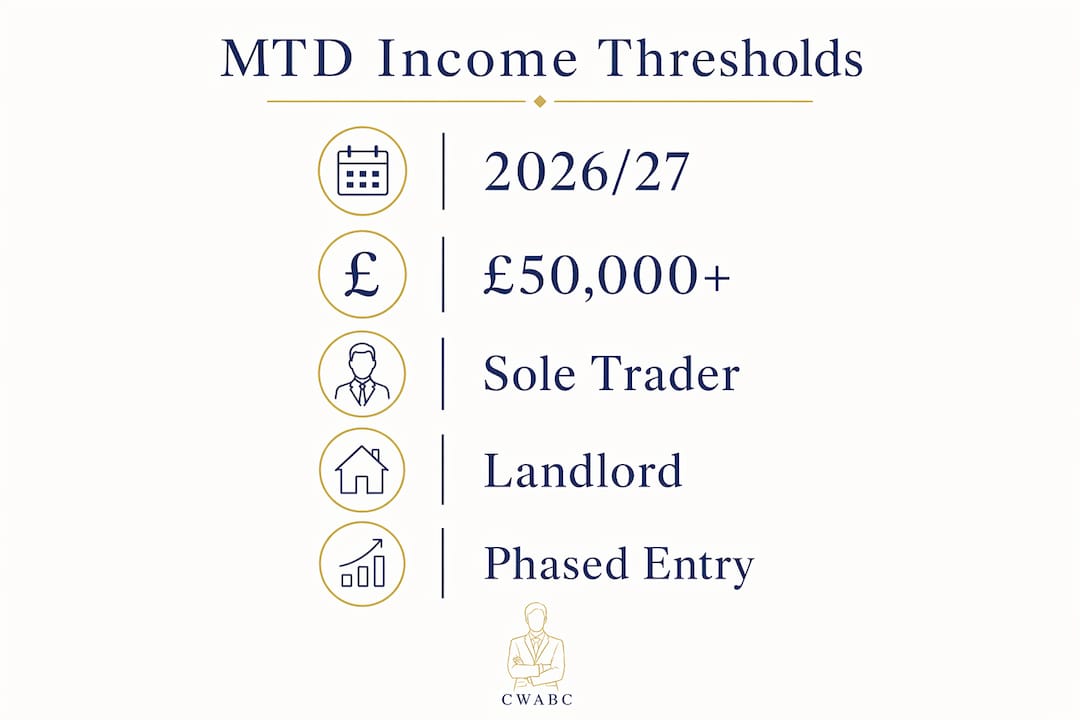
The thresholds for MTD for ITSA compliance are phased in over three years. The table below shows when each group enters the scheme.
| Tax year | Qualifying income threshold | Who enters scope |
|---|---|---|
| 2026/27 | Over £50,000 | Sole traders and landlords |
| 2027/28 | Over £30,000 | Additional sole traders and landlords |
| 2028/29 | Over £20,000 | Further sole traders and landlords |
The reduction from £50,000 to £20,000 will bring approximately 970,000 additional individuals into scope by 2028. That is a significant expansion. Even if you are below the threshold today, you may cross it within the next two years as your income grows.
A few important points on eligibility:
- Gross income, not profit. Your qualifying income is calculated before expenses. Do not assume your deductions reduce you below the threshold.
- Combined sources count. If you earn £30,000 from self-employment and £25,000 from rental income, your combined qualifying income is £55,000. You are in scope from 2026.
- Exemptions exist. HMRC assesses digital exclusion exemptions on a case-by-case basis. These apply where you genuinely cannot use digital tools due to age, disability, or lack of internet access. Both temporary and permanent exemptions are available.
- How to apply for exemption. Contact HMRC directly to request a digital exclusion assessment. You will need to explain your circumstances. Approval is not automatic.
Pro Tip: If you are unsure whether your income qualifies, add up your gross self-employment turnover and gross rental receipts before any expenses. That combined figure is what HMRC uses.
What are the quarterly update deadlines under MTD for ITSA?
Quarterly submissions are due four times per year, and the deadlines are fixed. Missing them will matter more once the penalty-free grace period ends.
The four quarterly deadlines each year are:
- 7 August (covering 6 april to 5 july)
- 7 November (covering 6 july to 5 october)
- 7 February (covering 6 october to 5 january)
- 7 May (covering 6 january to 5 april)
The first quarterly update for the 2026/27 tax year is due by 7 august 2026. That is the first real test of whether your digital records and software are working correctly.
Each quarterly update is a summary of your income and expenses for that period. HMRC describes these as light-touch updates, not detailed mini tax returns. You are not calculating your tax bill each quarter. You are simply sending a digital summary so HMRC has a running picture of your income throughout the year.
The final declaration
After the four quarterly updates, you submit a final declaration by 31 january following the end of the tax year. This replaces the traditional Self Assessment return. The final declaration is where you confirm all income, claim allowances and reliefs, and settle your tax liability. For the 2026/27 tax year, the final declaration is due by 31 january 2028.
Penalties and the grace period
HMRC has confirmed no penalties for late quarterly filings during the 2026/27 tax year. This grace period is designed to give sole traders and landlords time to adjust. After that, a points-based penalty system applies. Each missed quarterly submission earns one penalty point. Reach four points and HMRC issues a £200 fine. Points accumulate and do not reset quickly. The grace period is a gift. Use it to build good habits, not to delay getting started.
One more timing consideration: filing your 2025/26 Self Assessment early reduces administrative overlap as the new MTD system begins. Leaving it until january 2027 means managing both old and new obligations at the same time.
How do you choose compatible software for MTD for ITSA?
MTD-compatible software is any digital tool approved by HMRC to send quarterly updates and final declarations directly to HMRC systems. You cannot use spreadsheets alone or submit manually. The software must connect to HMRC’s systems via an authorised link.
Choosing the right software depends on your business type and how you currently manage your records. HMRC publishes a software finder tool on GOV.UK listing all approved options, including free products for straightforward cases. Sole traders with simple income streams may find a free or low-cost option entirely adequate. Landlords with multiple properties or mixed income sources often benefit from a more capable paid product.
Key steps to get your software working correctly:
- Choose HMRC-approved software. Use the HMRC software finder to confirm compatibility before committing.
- Create or log in to your Government Gateway account. You need this to authorise your software.
- Authorise your software manually. Linking software to HMRC requires a manual authorisation step through your Government Gateway or, if using an agent, via the Agent Services Account. This step is often overlooked and causes delays when the first quarterly deadline arrives.
- Set up your income and expense categories. Configure the software to match your business structure before you start recording transactions.
- Test a submission before the deadline. Run through a practice update before 7 august 2026 to confirm everything connects correctly.
If you work with a bookkeeper or accountant, they can link their Agent Services Account to your records and submit on your behalf. This is a common arrangement and removes the technical burden from you entirely. For help with accounting software setup, Cwabc supports sole traders and landlords in Kent with Xero, FreeAgent, and QuickBooks configuration.
Pro Tip: Do not wait for a letter from HMRC before setting up your software. Accountants recommend acting well before the first quarterly deadline to avoid rushed compliance at the last minute.
Exemptions, common challenges, and how to avoid them
Digital exclusion exemptions are available, but they are not a simple opt-out. HMRC assesses each application individually. A permanent exemption may be granted where someone has a severe disability preventing digital use, or lives in an area with no reliable internet access. A temporary exemption covers short-term situations such as illness or bereavement.
Partnership income is not currently in scope for MTD for ITSA, but sole trader and landlord income earned by partners in their own right still qualifies if it exceeds the threshold.
The most common challenges sole traders and landlords face during the transition include:
- Inaccurate records. Many people have never kept monthly records. Quarterly submissions require up-to-date figures, not a year-end catch-up.
- Software authorisation delays. The manual link between software and HMRC is a technical step that catches people out. Allow time to complete it before your first deadline.
- Misunderstanding the threshold. Gross income, not profit, determines eligibility. This catches many sole traders by surprise.
- Ignoring the grace period. The penalty-free 2026/27 year is not a reason to delay. Building good habits early prevents automatic fines once the points system activates.
- Forgetting the final declaration. Quarterly updates do not replace the final declaration. Both are required.
A preparation checklist for sole traders and landlords:
- Confirm your qualifying income using gross figures
- Register for MTD for ITSA via your Government Gateway account
- Select and authorise HMRC-compatible software
- Begin keeping digital records from 6 april 2026
- Submit your first quarterly update by 7 august 2026
- File your 2025/26 Self Assessment early to reduce transition overlap
Pro Tip: Treat the 2026/27 grace period as a rehearsal, not a holiday. Every quarter you file on time builds the habit that protects you from £200 fines in 2027/28 and beyond.
How to prepare for MTD for ITSA: a practical step-by-step plan
Preparation is straightforward when broken into clear steps. The goal is to arrive at 6 april 2026 with your software connected, your records organised, and your first quarterly deadline already in your calendar.
-
Check your qualifying income now. Add your gross self-employment turnover and gross rental receipts. If the combined figure exceeds £50,000, you are in scope from april 2026. If it exceeds £30,000, prepare for 2027.
-
Register for MTD for ITSA. Sign up through your Government Gateway account. If you use an agent, ask them to register on your behalf via the Agent Services Account. Accountants recommend registering well before the first quarterly deadline to avoid last-minute problems.
-
Select your software. Use the HMRC software finder on GOV.UK. Confirm the product supports quarterly updates and final declarations. If you already use accounting software, check whether it is MTD-compatible.
-
Authorise your software. Complete the manual authorisation through Government Gateway. This is a separate step from simply installing or subscribing to the software. Do not skip it.
-
Start digital record keeping from 6 april 2026. Record every income receipt and business expense digitally as it happens. Do not batch-enter transactions at the end of the quarter. Accurate, timely records make quarterly submissions straightforward.
-
Submit quarterly updates on time. File by 7 august, 7 november, 7 february, and 7 may each year. Even during the penalty-free first year, filing on time builds the discipline that protects you later.
-
File your final declaration by 31 january. After the four quarterly updates, complete your final declaration to confirm all income, claim reliefs, and settle your tax bill. For 2026/27, this is due by 31 january 2028.
-
Get professional support if needed. MTD for ITSA involves more frequent reporting than the old Self Assessment system. A bookkeeper or accountant experienced in MTD compliance can manage your quarterly submissions, keep your records accurate, and flag issues before they become penalties.
For landlords specifically, the annual tax return for landlords process changes significantly under MTD. Rental income must be recorded digitally and reported quarterly alongside any self-employment income. Getting this right from the start avoids confusion later.
Pro Tip: Set a recurring calendar reminder one week before each quarterly deadline. Seven days gives you enough time to review your records and submit without rushing.
Key takeaways
MTD for ITSA requires eligible sole traders and landlords to keep digital records and submit four quarterly updates to HMRC each year, with the first deadline falling on 7 august 2026.
| Point | Details |
|---|---|
| Qualifying income is gross, not net | HMRC measures total turnover before expenses, so do not assume costs reduce you below the threshold. |
| Thresholds reduce over three years | The £50,000 threshold drops to £30,000 in 2027 and £20,000 in 2028, bringing more taxpayers into scope. |
| Four quarterly deadlines apply | Submissions are due by 7 August, 7 November, 7 February, and 7 May each year. |
| The grace period is not a delay | No penalties apply in 2026/27, but the points-based system activates in 2027/28 with a £200 fine at four points. |
| Software authorisation is a separate step | Manually linking your software to HMRC via Government Gateway is required before you can submit any updates. |
My honest view on MTD for ITSA after working with sole traders and landlords
The single biggest mistake I see is people waiting for HMRC to tell them what to do. HMRC will not send you a personalised countdown. If your income is over the threshold, the obligation is yours to act on.
The second mistake is treating quarterly updates as mini tax returns. They are not. You are sending a summary of income and expenses, not calculating a tax bill. Once sole traders understand this, the anxiety drops considerably. It is closer to sending a monthly bank statement than filing a tax return.
What I have found genuinely useful for clients is starting digital record keeping two or three months before april 2026, even informally. By the time the first quarterly deadline arrives, the habit is already formed. The submission itself takes minutes when the records are current.
The gross income threshold confusion is real and worth repeating. A landlord with £28,000 in rental income and £24,000 from freelance work has £52,000 in qualifying income and is in scope from 2026. Many people in this position do not realise it until they are already behind.
Working with a bookkeeper or accountant who understands MTD for ITSA is not a luxury. It is the most efficient way to stay compliant without spending your evenings reconciling spreadsheets. The types of sole trader financial records required under MTD are manageable with the right system in place from the start.
— Chris
MTD for ITSA support from Cwabc
Cwabc provides bookkeeping services in Tonbridge tailored to sole traders and landlords preparing for Making Tax Digital. The team handles digital record keeping, accounting software setup, and quarterly update submissions so you can focus on your work rather than your paperwork.
Whether you need help choosing HMRC-compatible software, setting up your records from scratch, or managing ongoing quarterly filings, Cwabc offers clear, upfront pricing and local expertise. Landlords can also explore dedicated support through the landlord bookkeeping guide to understand exactly what digital reporting means for rental income. Contact Cwabc for a free, no-obligation conversation about your MTD for ITSA requirements.
FAQ
What is the income threshold for MTD for ITSA in 2026?
The threshold for 2026/27 is qualifying gross income over £50,000 from self-employment and property combined. This reduces to £30,000 in 2027/28 and £20,000 in 2028/29.
Is qualifying income calculated before or after expenses?
Qualifying income is gross turnover before expenses. HMRC does not deduct business costs when assessing whether you meet the threshold, so do not assume your expenses reduce you below it.
What happens if I miss a quarterly MTD for ITSA deadline?
No penalties apply during the 2026/27 tax year. From 2027/28, a points-based system applies where each missed submission earns one point, and four points triggers a £200 fine.
Do I still need to file a Self Assessment tax return under MTD for ITSA?
The traditional Self Assessment return is replaced by a final declaration, due by 31 january after the tax year ends. You still confirm all income and pay your tax bill, but through the new MTD process.
Can I get an exemption from MTD for ITSA?
Digital exclusion exemptions are available for those who genuinely cannot use digital tools due to disability, age, or lack of internet access. HMRC assesses each case individually, and you must apply directly to request an exemption.
Need help?
MTD for ITSA brings real changes to how sole traders and landlords report income. If you are unsure where to start or want someone to manage the process for you, contact Cwabc for a free, no-obligation conversation. We are based in Tonbridge and work with sole traders and landlords across Kent and beyond.