
When your limited company buys a residential property, the purchase price, the stamp duty, the legal fees, the lender’s charges, the mortgage and the deposit all need to land in the right place in your books. In short: the property and its directly attributable purchase costs go on the balance sheet at cost, the mortgage is recorded as a liability, any deposit you put in personally goes to your director’s loan account, and lender fees are usually treated as finance costs rather than as part of the property. I’ll walk through it with a worked completion statement you can compare with your own.
If the paperwork from your solicitor looks daunting, take a breath. It is a simple process once you know which line goes where.
TL;DR
- Record the property at cost, including directly attributable costs such as SDLT (or the devolved equivalent), legal fees and Land Registry fees.
- Lender arrangement and valuation fees are finance costs. They are normally kept separate from the property and spread over the loan.
- Record the mortgage as a liability for the amount advanced, and a deposit you paid personally as a credit to your director’s loan account.
- Reconcile the property, mortgage and director’s loan to the completion statement, the mortgage offer and your bank statements before you move on.
- Accounting treatment and tax deductibility are two different questions. A cost can sit in the property asset and still not be deductible against rental profits.
Table of Contents
- Start with the purpose: what kind of asset is it?
- What goes into the cost of the property?
- SDLT and its devolved equivalents
- An illustrative completion statement
- The journal entries, step by step
- How I reconcile the books to the paperwork
- After completion: how the property is carried in the accounts
- Accounting treatment is not the same as tax deductibility
- Common mistakes I see
- My perspective
- How I can help with a company property purchase
- FAQ
- Sources
Start with the purpose: what kind of asset is it?
Before any journal, decide what the property is for. Under FRS 102, the accounting standard used by most small UK companies, classification depends on purpose and use. Investment property is held to earn rent or for capital growth. Property, plant and equipment (PPE) is held for production, supply, rental or administration. Inventory is property held for sale in the ordinary course of business, such as a refurbish-and-sell project.
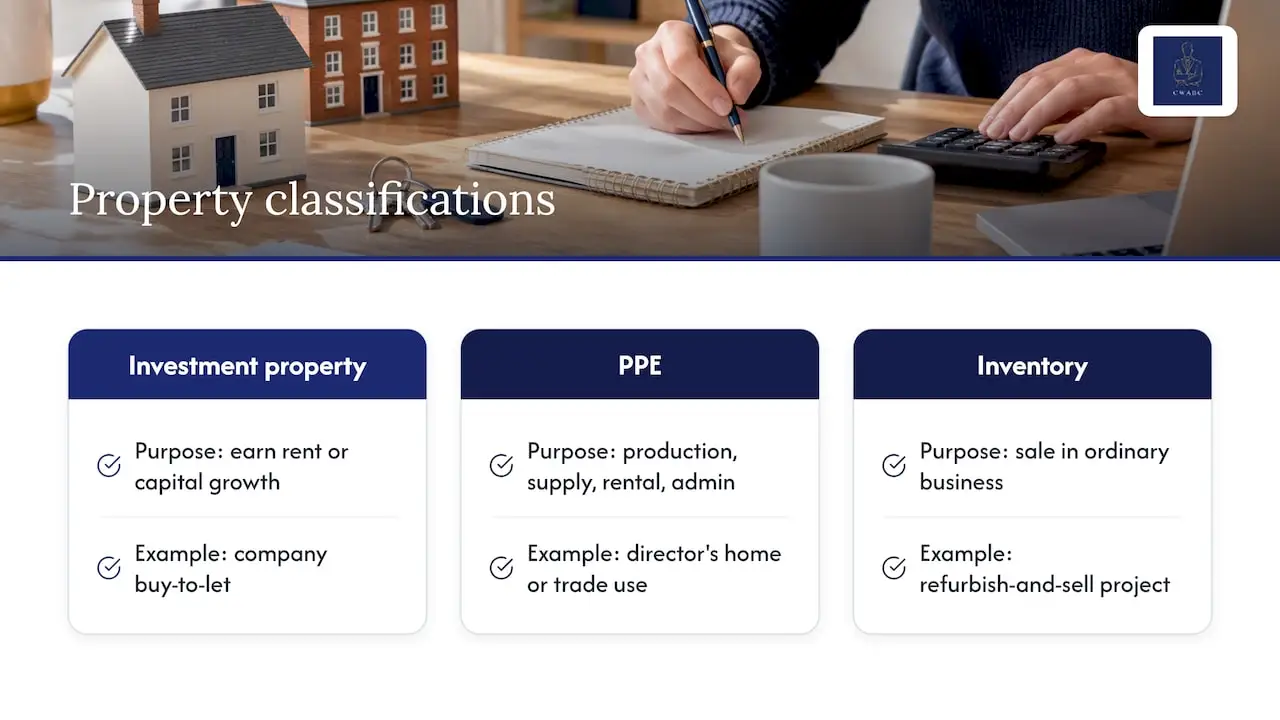
For a buy-to-let held by a company, the usual answer is investment property. A flat the company buys to flip belongs in stock (current assets). A property a director lives in or the company trades from is likely to be PPE. The ICAEW notes that judgement is often needed to decide the date of any transfer between categories, so I record my reasoning for the classification on file at the time of purchase.
This matters because the classification changes everything that follows: whether the asset is revalued, whether it is depreciated, and whether certain costs are capitalised. This article focuses on a residential investment property, as that is the most common case for my landlord clients.
Which accounting standard applies?
Small companies normally prepare accounts under FRS 102 (section 1A for the smallest) or FRS 105 for micro-entities. The treatment of investment property differs between them, so the framework is the first thing I confirm. The ICAEW explains that investment property is initially measured at cost and then remeasured to fair value at the end of each reporting period, with gains and losses going through the profit and loss account. FRS 102 has also been amended for periods beginning on or after 1 January 2026, so I check the version that applies to your year end rather than relying on an older template.
I am not going to give you a one-size-fits-all rule here. Which framework you use, and whether you adopt fair value or cost, depends on your company’s size, your lender’s requirements and your accountant’s judgement.
What goes into the cost of the property?
The general principle is that cost includes the purchase price plus costs directly attributable to acquiring the property and bringing it into use. In a typical residential purchase that means:
- the purchase price agreed in the contract
- Stamp Duty Land Tax (SDLT) in England and Northern Ireland, Land and Buildings Transaction Tax (LBTT) in Scotland, or Land Transaction Tax (LTT) in Wales
- solicitor or conveyancer fees for the purchase itself
- Land Registry registration fees
- survey and search fees that relate to the property itself
What usually stays out is anything that relates to the financing rather than the property. That includes lender arrangement fees, the lender’s valuation fee, broker fees and early repayment charges. These are finance costs and are normally accounted for separately.
Finance costs: expense, prepay or capitalise?
This is where I see most mistakes in bookkeeping that arrives at year end. Finance costs are normally written off to the profit and loss account as incurred, according to ACCA’s technical factsheet on property taxes. ACCA also notes that they can be capitalised into a current asset (property held for sale), which delays relief until the asset is sold. That is a deliberate choice for developers, not a default for a buy-to-let.
For a mortgage on a rental property, a common practical approach is described in an AccountingWEB discussion: record the arrangement fee as a prepayment first, then release it to profit or loss over the period of the finance. Their small example debits bank and prepaid finance costs and credits the loan for the total. I use the same principle in the worked example below, though the exact approach depends on your reporting framework and the size of the fee. A very small fee is often simply expensed.
Costs that need separate thought
| Cost | Typical accounting treatment | Comment |
|---|---|---|
| Purchase price | Capitalise in the property | The base cost |
| SDLT / LBTT / LTT | Capitalise in the property | A cost of acquiring the asset |
| Conveyancing fees for the purchase | Capitalise in the property | Directly attributable |
| Land Registry fee | Capitalise in the property | Registration of title |
| Lender arrangement fee | Prepayment, released over the loan term, or expensed | Finance cost |
| Lender valuation fee | Finance cost | Relates to the loan |
| Broker fee | Finance cost | Relates to the loan |
| Furniture and appliances | Separate fixed asset or expense | Not part of the building |
| Repairs found after purchase | Judgement: repair or improvement | See my guide on landlord repairs |
I keep refurbishment, furnishings and repairs out of this article because I already cover them separately. If you want the detail, my guide to the Replacement of Domestic Items Relief is the place to start.
SDLT and its devolved equivalents
Companies are treated less generously than individuals on residential purchases. GOV.UK guidance on corporate bodies says companies buying residential property are generally subject to a 5% higher rate surcharge on top of the standard SDLT rates. It also says a 17% higher rate can apply to residential properties costing more than £500,000 bought by companies, with reliefs available in certain cases, such as for property developers or rental businesses. That guidance covers England and Northern Ireland.
If the property is in Scotland or Wales, different taxes apply (LBTT and LTT), with their own rates and supplements. I do not assume that an English rule applies north of the border or west of Offa’s Dyke, and neither should you. Your conveyancer will prepare the return and confirm the figure. My job is to make sure the amount in my books matches the amount actually paid.
For accounting purposes, the SDLT paid on acquiring an investment property is normally included in its cost. That is not the same as saying it is deductible against your rental profits. I come back to that distinction below.
An illustrative completion statement
Here is a made-up example. The figures are for illustration only: they are not a real transaction, and your own SDLT figure comes from your conveyancer’s calculation, which will depend on where the property is and which reliefs apply.
A company buys a two-bedroom flat in Kent to let. The director pays the deposit and the legal costs from personal funds into the company bank account, and the company completes with a buy-to-let mortgage.
| Completion statement | £ |
|---|---|
| Purchase price | 250,000 |
| SDLT (illustrative figure from the conveyancer’s calculation) | 15,000 |
| Conveyancing fees | 1,800 |
| Land Registry fee | 270 |
| Total property costs | 267,070 |
| Lender arrangement fee | 1,500 |
| Lender valuation fee | 450 |
| Total due on completion | 269,020 |
| Less: mortgage advance | (187,500) |
| Balance paid from the company’s bank | 81,520 |
That balance of £81,520 is made up of the £62,500 deposit (the part of the price not covered by the mortgage) plus £19,020 of costs and fees.
In this example the director paid £81,520 into the company account as a loan and the solicitor then paid it out on completion.
The journal entries, step by step
There are two ways to build this up in software: a single journal at completion, or a sequence of transactions that mirror the bank. I prefer the single journal, because it is easy to review against the completion statement.
- Record the director’s funding. Bank debit £81,520, director’s loan account credit £81,520. This is a loan from the director to the company, which the company owes back. It is not company income.
- Record the completion. The journal at completion looks like this:
| Account | Debit £ | Credit £ |
|---|---|---|
| Investment property (cost) | 267,070 | |
| Prepaid finance costs | 1,950 | |
| Mortgage liability | 187,500 | |
| Bank | 81,520 | |
| Totals | 269,020 | 269,020 |
- Release the finance fees over the mortgage term, or the fixed-rate period if that is how the lender prices the loan, by debiting finance costs and crediting prepaid finance costs each period. If the fee is small or the loan is short, expensing it immediately is a perfectly reasonable alternative.
- Record each monthly mortgage payment by splitting it between interest (an expense) and capital repayment (reducing the liability). On an interest-only buy-to-let this is simple, since the payment is all interest. On a repayment mortgage, the lender’s annual statement provides the split.
This mirrors what the software providers themselves describe. Sage’s UK guidance for recording a property purchase with a mortgage debits the property account for the cost, credits the mortgage for the borrowing, and treats the deposit as a separate movement through the bank. It also advises posting monthly payments to mortgage and loan interest accounts, and consulting the lender for the split. FreeAgent’s guidance on recording a property purchase uses a journal that debits the relevant capital asset account and credits a new mortgage-liability category. It also says that a deposit paid personally by the director can be credited to the director’s loan account, while a deposit paid by the company reduces the mortgage or dummy mortgage balance.
Directors’ loan funding: get the direction right
The most common slip is mixing up who owes whom. If you put your own money into the company, the company owes you, and the balance is a liability in the company’s books. If you later take money out, you reduce what the company owes you. Only when you withdraw more than the company owes you does the account become overdrawn, and that can bring tax consequences. Those are worth checking with your accountant before year end rather than after.
I also keep the evidence trail tidy: a bank transfer in from you personally, a clear description, and a note that it is a loan with no interest unless a written agreement says otherwise. If interest is charged, that changes the tax reporting, so it needs to be agreed deliberately.
How I reconcile the books to the paperwork
A completion is only properly booked when each balance ties back to a document. When I take on a client with a new property, I work through this checklist:
- Property asset to the completion statement. The total capitalised cost should equal the purchase price plus SDLT, conveyancing, Land Registry and any other attributable costs. In the example, that is £267,070. I also check the solicitor’s invoice and the SDLT return confirmation, so each part has a document behind it.
- Mortgage liability to the mortgage offer and the lender’s statement. The amount advanced on the statement must agree with the offer and the first lender statement. If the offer says £187,500 and the completion statement shows £187,500, the liability opens at £187,500. Later, the closing balance at the year end should agree with the lender’s annual statement.
- Director’s loan to the bank transfers. Every credit to the loan account should be traceable to a transfer from you personally. Every debit should be a repayment.
- Bank to the bank statement. The completion payment to the solicitor should appear as one line, and the books should show the same net amount.
- Prepayments to a schedule. Any unreleased finance costs should be shown on a simple schedule so that the balance sheet figure can be explained at any time.
If all five agree, the purchase is properly recorded. If one does not, the difference is usually a missed fee, a timing difference around completion day or a figure that was keyed from the wrong line of the statement.
After completion: how the property is carried in the accounts
What happens next depends on your classification and framework.
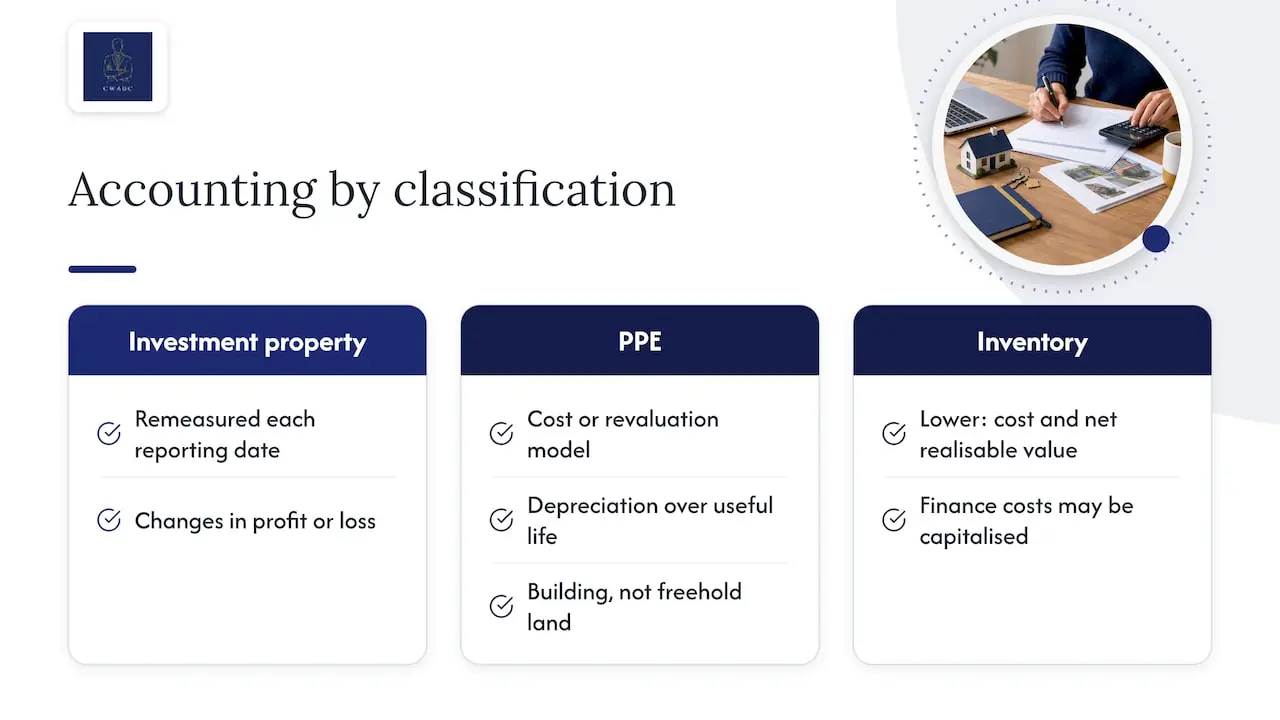
Investment property at fair value. Under FRS 102, an investment property measured at fair value is remeasured at each reporting date, with changes recognised in profit or loss. That means the accounts can show a gain or loss even though no sale has happened. It also means that capitalised costs, such as SDLT, can be reflected in the first revaluation if the market value of the flat is below what you paid in total. I record the basis of valuation, whether that is an independent surveyor’s report or a director’s estimate, so the figure can be supported.
Property, plant and equipment. For property held as PPE, FRS 102 uses the cost or revaluation model. Depreciation applies. RICS’s UK guidance explains that depreciation is a systematic charge over the useful life, normally applies to the building rather than the freehold land, and that significant components with different consumption patterns may be depreciated separately. So the land element needs separating from the building in your cost records.
Property held for sale. Stock is held at the lower of cost and net realisable value, and the costs can be treated differently, which is why finance costs may sometimes be capitalised in that case.
The different treatment across these categories is exactly why I settle the classification before anything else.
Accounting treatment is not the same as tax deductibility
This is the part that catches directors out. A cost can sit in the property asset on your balance sheet and still not reduce your Corporation Tax. A few points to keep separate:
- Capital costs. SDLT and legal fees on buying a property are capital in nature, so they are not normally deducted from rental profits. They will be relevant later, when the property is sold.
- Finance costs. Relief for interest and finance costs on a company’s borrowing follows its own rules. The accounting entry (expense now, or spread) does not by itself decide the tax result, so I review each fee type when preparing the Corporation Tax computation. ACCA’s factsheet is a useful reference on timing of relief for finance costs, and it notes that the choice of treatment can matter where Corporation Tax rates are rising.
- Fair value movements. A revaluation gain in the accounts is not automatically taxed in the same period, and a loss is not automatically relieved. The tax computation adjusts for the difference.
- Fixtures and capital allowances. Capital allowances for plant and machinery can be claimed on items a business keeps to use, such as electrical or heating systems within a building, though they generally do not cover the land and buildings themselves. On a purchase, HS252 explains that a joint election under section 198 of the Capital Allowances Act 2001 is typically needed between buyer and seller to fix the value of fixtures. It is more relevant to commercial property, but it is worth asking your conveyancer about it at the start rather than discovering the point later.
- VAT. For commercial property, a company can opt to tax so that it can reclaim input VAT on the related costs. Residential lettings are generally exempt, so there is no VAT to reclaim on a normal buy-to-let. My guide to VAT on rental income explains the difference.
Limited companies are separate legal entities that pay Corporation Tax on their profits, including rental profits. My Corporation Tax guide for limited companies covers the return and payment deadlines, and my residential landlord tax guide sets out how the company and personal routes compare. I have deliberately not repeated my existing material on mortgage interest or repairs here.
Common mistakes I see
- Putting the whole completion payment into “property”. Lender fees end up inflating the asset and the finance costs are understated.
- Booking the mortgage as income or leaving it out. The bank shows less cash leaving the company than the asset cost, and the difference gets plugged in a suspense account.
- Posting the deposit as a company expense. It is part of the asset’s cost, not a running cost.
- Recording the director’s funding as sales or share capital without checking whether it is a loan or an injection of equity.
- Leaving the land and building undivided where depreciation applies.
- No audit trail. The statement, offer letter and SDLT confirmation are not saved with the journal.
All of these are easy to avoid with a structured set of records from day one. If you are weighing up whether to buy through a company at all, that is a decision for you with proper advice before you exchange contracts, because the SDLT surcharge and the tax position affect the numbers considerably.
My perspective
I have more than 30 years of finance experience, and the pattern with property purchases is always the same. The purchase itself goes through smoothly, then the paperwork lands in my inbox weeks later as a bundle of PDFs with a bank balance that doesn’t quite add up.
My approach is to treat the completion statement as the master document. Every line goes somewhere deliberate: the property, the mortgage, the finance costs or the director’s loan. I then reconcile each balance to its supporting document, so that at year end there is nothing to untangle.
I work in Xero, QuickBooks and FreeAgent, so the journals above can be set up in whichever system you already use. You deal with me directly, and I explain each entry in plain English so that you understand your own numbers, not just the totals.
I will also tell you where a decision belongs to you, your conveyancer or your lender, rather than guess. Accounting treatment, tax and legal structure each have their own rules, and I would rather be clear about which is which.
Chris
How I can help with a company property purchase
If your company is buying, or has just bought, a property, I can set up the books so that the asset, mortgage and director’s loan are right from the start. That includes recording the completion, reconciling to your documents and preparing the accounts and Corporation Tax return that follow. I work with landlords and company directors across Tonbridge, Sevenoaks and the rest of Kent, and remotely across the UK.

The best starting point is my rental reporting and bookkeeping service, or you can read about my wider bookkeeping services and accounting software setup. Fees are agreed clearly upfront, tailored to what your company needs.
Need help?
If you have a completion statement in front of you and are not sure where each line goes, get in touch with me and I will talk you through the options calmly and practically.
FAQ
Do limited companies pay stamp duty when buying property?
Yes. A company pays SDLT in England and Northern Ireland, and LBTT or LTT in Scotland and Wales. GOV.UK says companies buying residential property generally pay a 5% surcharge on top of the standard rates, and a higher rate can apply above £500,000 unless a relief such as one for rental businesses is available. Your conveyancer calculates the exact figure.
Should I include SDLT and legal fees in the cost of the property?
Usually yes. For an investment property, SDLT, conveyancing fees and Land Registry fees are directly attributable to acquiring it, so they normally form part of its cost in the books. Lender fees are different: they relate to the loan, so they are generally kept separate as finance costs.
How do I record a deposit I paid personally?
If you paid it from your own money and the company owes you, credit it to your director’s loan account rather than treating it as company income. FreeAgent’s guidance describes this treatment. If the company paid the deposit from its own bank account, it reduces the mortgage or dummy mortgage balance instead.
Can I claim the purchase costs against my rental profits?
Not automatically. Being in the property asset is an accounting decision, while deductibility is a tax question. Capital costs such as SDLT are not normally deducted from rental profits, and finance costs follow their own tax rules. I review each cost when preparing the Corporation Tax computation.
Sources
- Transfers under FRS 102, ICAEW
- Investment property under FRS 102, ICAEW
- Technical factsheet: property taxes, ACCA
- How to record mortgage fees on mortgage, AccountingWEB
- Recording the purchase of a property using a mortgage, Sage
- Recording the purchase of a property by your business, FreeAgent
- Stamp Duty Land Tax: corporate bodies, GOV.UK
- RICS Global Standards: UK national supplement
- HS252 Capital allowances and balancing charges 2025, GOV.UK
- Exemption and partial exemption from VAT, GOV.UK
- UK taxes, Business.gov.uk
Recommended
- Stay HMRC Ready Monthly: Bookkeeping for UK Limited Company Directors
- Property income tax return: UK landlord’s 2026 guide
- Corporation tax for UK limited companies: 2026 guide
- UK landlords: HMRC checklist for repairs or capital improvements
This article provides general information based on UK tax and accounting rules at the time of publication. It is not a substitute for advice tailored to your individual circumstances. Tax legislation and HMRC guidance may change. If you need advice about your specific situation, please contact me at CW Licensed Bookkeeper & Accountant.