
Found a mistake in last year’s books? Don’t panic. In most cases the first job is to correct your bookkeeping records. Whether anything already filed with HMRC or Companies House must change is a separate decision, and I make it afterwards, once the facts are clear. This guide shows how I find, evidence and correct earlier-period errors, and how I separate a records fix from a tax or accounts question.
It is written for sole traders, landlords, small limited company directors and CICs. It is general information, not personal tax or legal advice. Your own figures always need looking at properly.
TL;DR
- Correcting your bookkeeping records and deciding whether filed accounts or tax returns need amending are two separate steps. Do the first before the second.
- Every correction needs evidence: a bank statement, invoice, loan agreement or similar. An unsupported “balancing journal” only hides the problem.
- A Self Assessment return can usually be amended online or on paper within 12 months of the filing deadline. After that, you write to HMRC.
- Whether an error needs restating in company accounts depends on materiality, which is a judgement call, and on whether the accounts are approved or filed.
- I review the discrepancy, document it and recommend corrections for you to approve. I never post a change you have not agreed.
Table of Contents
- What counts as a previous-year bookkeeping error
- Two questions, not one
- How I find errors from earlier periods
- A fictional reconciliation example
- Why I avoid unsupported balancing journals
- How I review discrepancies and recommend corrections
- Do filed accounts or tax returns need amending?
- What if the correction changes the tax owed?
- Keeping records so errors do not return
- My perspective
- Need help?
- FAQ
- Sources
What counts as a previous-year bookkeeping error
A previous-year error is a mistake in records that relate to a period that has already closed. Under FRS 102, the accounting standard most small UK companies follow, prior-period errors are omissions or misstatements caused by failing to use, or misusing, reliable information that was available when the earlier accounts were approved. That includes arithmetic slips, misapplied accounting policies, oversights and misread facts.
In small businesses, the usual causes are plain and human:
- A bank feed was reconciled to the wrong balance in the first year on the software.
- A supplier invoice arrived late and never made it into the books.
- The same receipt was entered once from the bank feed and again from a photo.
- Money moved between the business and the owner, and nobody recorded it properly.
None of this means you were careless. Books built in a hurry, by several people, or across a software switch often carry small errors forward. What matters is spotting them calmly and fixing them with evidence.
Two questions, not one
This is the point that causes most of the stress, so I keep the two questions apart.
Question one: are my bookkeeping records right? This is about your ledgers, your opening balances and your reconciliations. It is practical work, and you can do it even if the year is closed.
Question two: does anything I have already filed need to change? This covers a Self Assessment return, company accounts, a Corporation Tax return, a VAT return or a payroll submission. It depends on whether the error is material, how much tax it affects, which return it sits in and what the relevant deadline rules say.
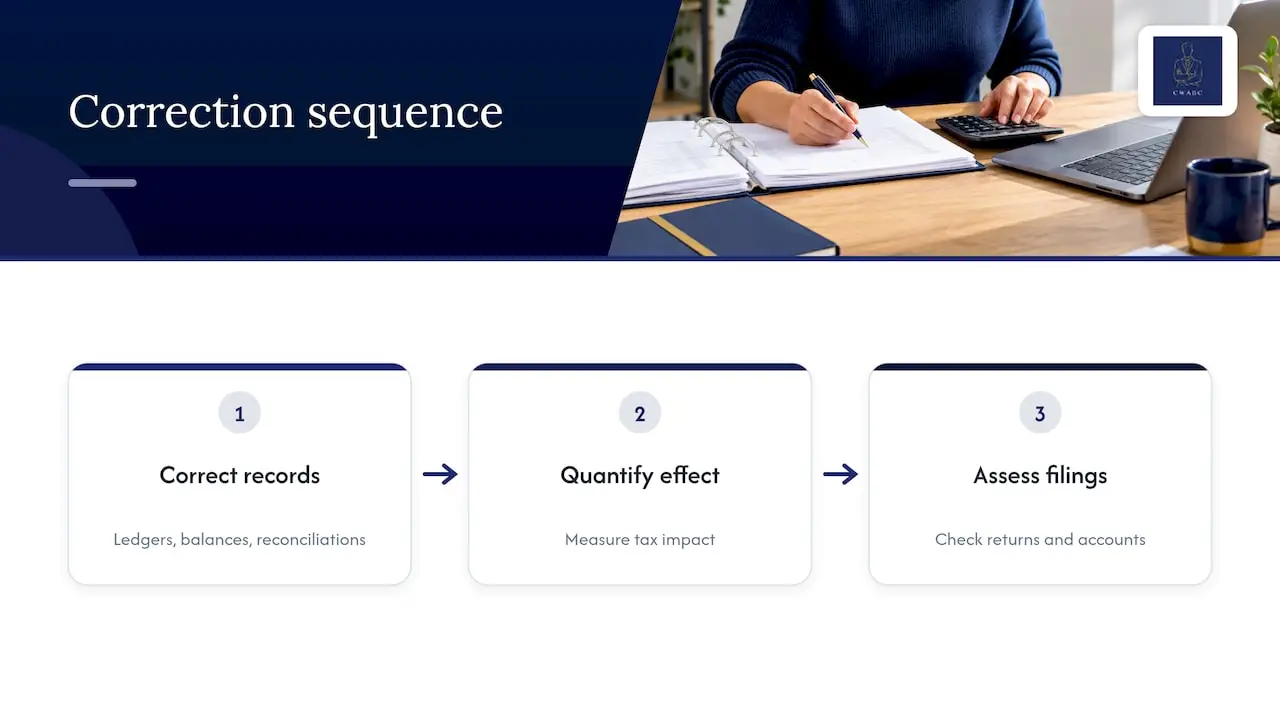
A records correction does not automatically mean an amended filing. An error can be real but too small to change a filed figure in any meaningful way. On the other hand, a tax return can need amending when the records fix looks tiny. That is why I fix the books first, quantify the effect and only then discuss filings with you.
How I find errors from earlier periods
I start with the records that cannot be argued with: bank statements, loan statements, supplier statements, invoices and prior-year accounts. Then I compare them with what the ledger says. If you are still sorting things out, my bookkeeping clean-up checklist shows the order I work in: reconcile first, then flag queries.
For each suspected error I note the amount, date, account, VAT treatment and the period it belongs to. I then compare what was posted with what should have been posted. AAT’s guidance on the four-line journal describes the method: if the debits and credits of the wrong entry were unequal, the error uses the suspense account. If they balanced, the error does not touch suspense. That distinction tells me quickly how the correction must be built.
Incorrect opening balances
Opening balances are where earlier errors most often hide. The balance brought forward in your software should equal the closing balance of the previous year’s accounts, line by line. If it does not, something was keyed in wrongly, changed after the accounts were finished or never migrated properly from an old system.
I compare the opening trial balance with the signed-off prior-year accounts and with the bank statements for the first day of the period. The usual finds are an understated bank balance, a debtor or creditor left out and a figure entered in the wrong account. I record each difference with its source, and I do not accept “it just doesn’t match” as an explanation.
Omitted assets
An omitted asset is something the business owns that never reached the books: a laptop, tools, a vehicle, a deposit paid or money owed to you by a customer. It often shows up when a purchase was posted straight to expenses or paid personally and never recorded.
I look for these by reading through payments for larger one-off items, checking deposits and reviewing unpaid sales invoices at the year end. If the item should have been capitalised, the correction affects both the balance sheet and, potentially, the tax computation. That is a question for the filing stage, not something I settle in the ledger alone.
Missing liabilities
Missing liabilities are the mirror image: bills that belonged to the period but were not recorded until later, or not at all. A supplier invoice dated before the year end but paid afterwards is the classic example. So are unpaid VAT, PAYE or CIS amounts and credit card balances.
I check payments made shortly after the period end against the invoices behind them. If the invoice relates to goods or services received before the year end, it belongs in the earlier year. I also read supplier statements, because they often show invoices the ledger has never seen.
Duplicated expenses
A duplicated expense inflates costs and understates profit. It usually happens when a bank feed entry and a manually entered bill are both posted, or when a receipt is uploaded twice. I sort expenses by supplier and amount to find matching pairs, then check whether there were two genuine payments or only one. Two bank payments of the same amount may be correct, so the bank statement decides.
Director’s loan discrepancies
The director’s loan account records money moving between a company and its director. When it is wrong, the company’s accounts and sometimes the director’s personal tax position can be affected. I trace each entry back to a bank transaction or a document: personal money paid in, expenses the director paid personally, withdrawals and repayments.
Common causes are personal spending coded as a business expense, a director paying a company bill from their own account without it being recorded and mixed-up opening balances. Because this account can carry tax consequences, I set out the corrected balance clearly and flag where you may want to take tax advice before anything is filed. I do not guess at the answer.
A fictional reconciliation example
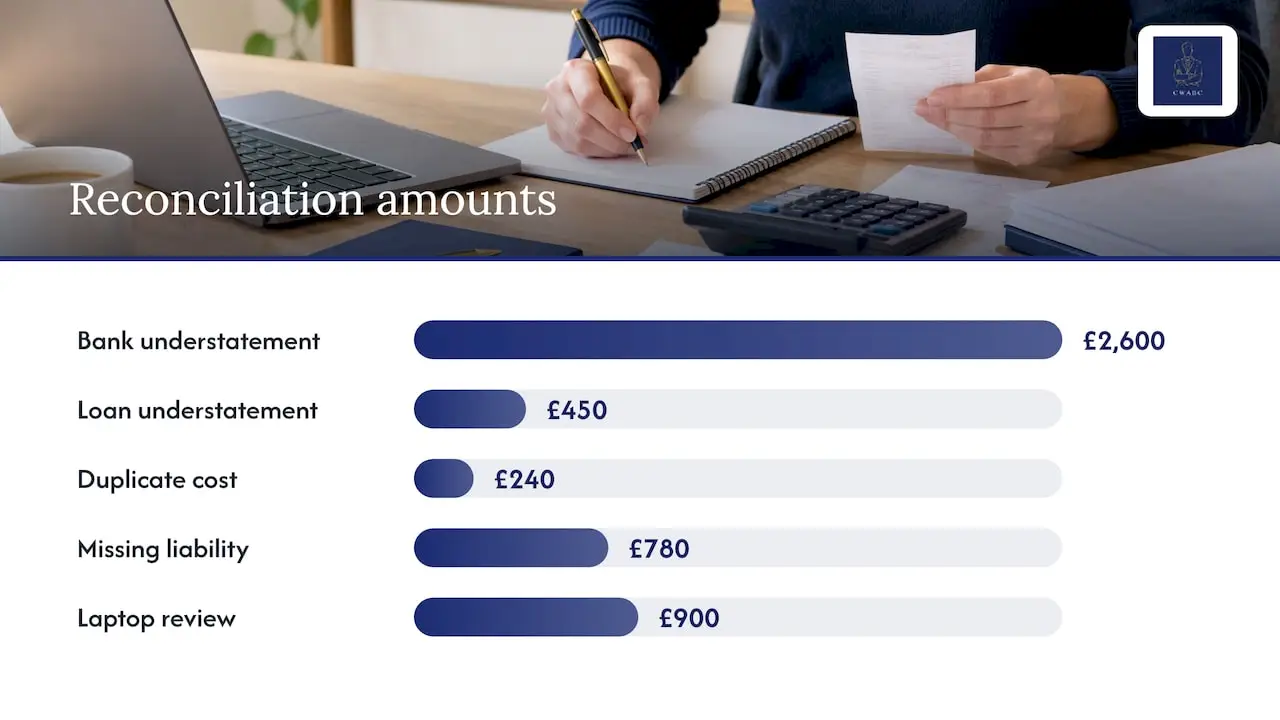
Here is an invented example, so you can see how the process works. It is not a real client, and the figures are for illustration only.
Example Trading Ltd is a fictional small limited company with a 31 March year end. It is preparing its second set of accounts and the opening balances do not agree.
| Item | Per the books | Per evidence | Difference | What the evidence is |
|---|---|---|---|---|
| Opening bank balance | £4,150 | £6,750 | £2,600 understated | Bank statement for 31 March |
| Director’s loan (owed to director) | £3,000 | £3,450 | £450 understated | Director’s payment records and bank transfers |
| Software subscription | £240 recorded twice | £240 paid once | £240 overstated costs | One bank payment, two entries |
| Supplier invoice dated 20 March, paid in April | Not recorded | £780 owed | £780 liability missing | Invoice and April bank payment |
| Laptop bought in February | Posted to expenses at £900 | Asset purchase | £900 to review | Invoice and bank payment |
This is how I would handle each line:
- Bank. The statement is clear evidence. I find why the books differ: here, imagine a transfer was posted in the wrong period. I correct the entry itself, not just the balance.
- Director’s loan. I list every movement and match it to a transfer. Two repayments the director made from a personal account were never recorded. I propose adding them, with the transfer details attached.
- Duplicate. I delete the second entry only after confirming the bank shows one payment.
- Missing liability. I record the invoice in the period it relates to, because the goods were received before the year end.
- Laptop. The question is whether it should be treated as an asset rather than an expense. I explain the options and the tax-return effect, and I recommend the treatment. You decide.
I then produce a one-page schedule showing each error, the evidence, the proposed correction and the effect on profit and balance sheet totals. The schedule goes to you for approval. Nothing is posted until you agree. Only then do we talk about whether any of this changes filed accounts or returns.
Why I avoid unsupported balancing journals
It is tempting to make a mismatch vanish with one journal that pushes the difference into suspense, retained earnings or “sundry”. The books then balance. The problem is still there.
Here is why I will not do it:
- It hides the cause. The same error is likely to recur, because nobody has found where it came from.
- It cannot be defended. If HMRC, a lender or a new accountant asks why a figure moved, you need a document behind it. “It was needed to make the numbers agree” is not one.
- It can distort profit. A plug posted to income or expenses changes your taxable profit without any real transaction behind it.
- It makes future reviews harder. The next person has to unpick the plug before they can trust anything.
If a difference genuinely cannot be explained after reasonable effort, I tell you so. I may recommend a clearly labelled, documented adjustment, with the reasoning and the evidence of the search written down, for you to approve. That is different from a silent plug. And if the amount is larger than a small rounding difference, I would rather keep digging.
How I review discrepancies and recommend corrections
My process is the same each time, and you stay in control of it.
- Gather the evidence. Bank and loan statements, invoices, prior-year accounts and filed returns.
- Reconcile. I compare the ledgers with that evidence and list every difference.
- Trace each difference. I find the transaction, date and account behind it and decide whether it is a genuine error or a timing matter.
- Classify it. Is it an opening balance error, an omission, a duplicate, a misposting or a director’s loan issue? Which period does it belong to?
- Quantify the effect. What changes in profit, in the balance sheet, in VAT and in tax?
- Recommend. I write up each proposed correction with its supporting document.
- You approve. I post only what you have agreed, and I keep the schedule as the audit trail.
This is a bookkeeping review. Where a point needs legal advice or a formal accounting judgement about filed statutory accounts, I say so plainly and suggest the right next step.
Do filed accounts or tax returns need amending?
Once the records are right, I look at what has been filed. The answer differs by document, and HMRC itself notes that amendment processes vary between taxes and are not consistent.
Company accounts
For accounts under FRS 102, materiality is the key idea. Information is material if leaving it out or misstating it could influence users’ economic decisions. Deciding that takes professional judgement. AAT’s guidance says that material errors are corrected retrospectively, restating comparative figures in the first financial statements approved after the error is found. Immaterial errors do not need a prior-period adjustment.
Timing matters as well. ICAEW explains that if accounts are still in preparation and not yet approved, the correction is made as part of normal preparation. If accounts have already gone to shareholders or been filed, the usual route is a prior-period adjustment in the next accounts. Revising the filed accounts is a separate option, and ICAEW says it is not normally required just because comparatives are restated. Directors decide, taking into account the seriousness of the error, the timing and the risk of anyone relying on misleading accounts. I help you gather the facts. I do not make that statutory decision for you.
Self Assessment
For sole traders and landlords the rule is simpler. GOV.UK says you can change a Self Assessment return online or by paper within 12 months of the filing deadline. After that, you write to HMRC to disclose the error and, if relevant, claim relief for any overpayment. I explain the practical steps in my guide to correcting tax return mistakes.
A previous-year bookkeeping error may also feed into Self Assessment through the figures I used to prepare your return. If I prepared it, I will check whether the corrected records change the numbers.
VAT and payroll
VAT errors have their own rules, and the right route depends on the size of the mistake and how it arose. My VAT return guide covers the basics, and I look at each case against HMRC’s current guidance.
Payroll is different again. For 2020/21 and later years, HMRC’s manual says employers send a further year-to-date FPS rather than an EYU. If you run payroll and have found an earlier mistake, my payroll year-end checklist is a helpful place to start.
What if the correction changes the tax owed?
Sometimes a corrected figure means more tax. That is uncomfortable, but dealing with it calmly and early usually leaves you in a better position.
HMRC’s compliance handbook says that where extra Income Tax or Capital Gains Tax is due after an amendment or correction, the initial late-payment penalty is 5% of the unpaid amount 31 days after the due date. It adds that an amendment may also suggest the original return was inaccurate, so an inaccuracy penalty could apply.
Whether it does depends on why the error happened. A tribunal decision describing HMRC’s approach sets out standard potential-loss percentages of 30%, 70% and 100% for careless, deliberate and deliberate-and-concealed behaviour, subject to reductions, including for the quality of disclosure. An honest mistake that you find and put right is a very different thing from deliberate concealment. I cannot promise how HMRC will treat any case, but I can help you present the correction clearly, with the evidence behind it. For the wider picture on penalties, see my guide to Self Assessment penalties.
Keeping records so errors do not return
Good records are the cheapest fix. A limited company must keep accounting records, including money in and out, assets, debts, invoices, contracts and bank statements, for six years from the end of the relevant financial year. The period can be longer in some situations, such as an ongoing HMRC check. Sole traders and landlords should also keep their records safely, and my work is paperless, so documents sit alongside the entries they support.
A few habits prevent most earlier-year errors:
- Reconcile every bank account monthly, not once a year.
- Check opening balances against the signed-off accounts when you start a new year or switch software.
- Attach the invoice or receipt to the entry when you post it.
- Keep personal and business money separate, or record every crossover.
- Review the director’s loan account at least quarterly.
- Ask for help when the books stop making sense, not after the deadline. My list of five signs your bookkeeping needs professional help might ring a bell.
My perspective
I have spent over 30 years in finance, and what I notice most is how much worry a bookkeeping error causes compared with how fixable it usually is. People often assume that a mistake from a previous year means trouble. Most of the time it means a careful, evidence-led tidy-up.
My approach is deliberately slow on the diagnosis and careful on the fix. I reconcile to the bank, trace each difference to a document and show you the effect in plain English before anything is changed. I keep the correction of your books separate from the question of what has been filed, because mixing the two is how people either panic or ignore a real problem.
I work with cloud software such as Xero, QuickBooks and FreeAgent, so every correction can sit next to its supporting document and stay ready for HMRC. I recommend, you approve, and I keep the audit trail. That is how I would want my own books handled.
The best time to look at a nagging discrepancy is now, while the paperwork is to hand and the details are fresh.
Chris
Need help?
If you suspect an earlier year is wrong, I can review it with you. As the sole practitioner behind CWABC, I deal with you directly: I reconcile the records, document each difference and recommend corrections for your approval. I can also tell you when something may affect a filed return, so you know what to raise with HMRC or your company’s directors.
My bookkeeping services cover catch-up and clean-up work, monthly bookkeeping and cloud software setup, for clients in Tonbridge, Hildenborough, Sevenoaks and across Kent, and remotely across the UK. If a corrected figure affects your tax return, my Self Assessment service starts from £250 for a one-off return. Pricing for other work is agreed clearly upfront and tailored to what you need.

To talk it through, get in touch here. There is no need to tidy anything first. Bring what you have, and we will work out the next step calmly.
FAQ
Can I just fix the error in this year’s books?
Sometimes, but not always. If the error is small and does not affect a filed figure in a meaningful way, correcting it in the current period may be reasonable. If it is material, accounting rules generally expect the earlier comparatives to be restated. I look at the size, the period affected and what has been filed before recommending a route.
How long do I have to amend a Self Assessment return?
GOV.UK says you can amend within 12 months of the filing deadline, online or on paper. After that, you need to write to HMRC. Check the official page for how this applies to your tax year.
Is a director’s loan discrepancy serious?
It is common and usually fixable, but it deserves care because the account can have tax consequences for the company and the director. I trace every entry to a bank transaction or document and show you the corrected balance. If tax questions arise, I flag them so you can get the right advice.
Why not post a journal to make the balances agree?
Because it hides the real cause and leaves nothing to show HMRC or a future accountant. A correction should rest on a document, such as a bank statement, an invoice or a loan record. If something cannot be explained, I record that openly and ask for your approval.
Do I need to tell HMRC about every old mistake?
Not every mistake changes a filed return. It depends on the tax, the amount and whether the error affected anything submitted. Once the records are corrected, I help you see which filings may be affected. Where a correction could change tax due, I suggest you decide the next step with the facts in front of you.
Sources
- Prior period errors and adjustments (ACCA)
- Using a four-line journal to correct errors (AAT Comment)
- FRS 102: correcting errors (AAT Comment)
- CIRD99300, HMRC internal manual
- Defective accounts and reports (ICAEW)
- Self Assessment tax returns: if you need to change your return (GOV.UK)
- Amendments to tax returns (HMRC)
- PAYE92010, HMRC PAYE manual
- CH155200, HMRC compliance handbook
- Aizio Associated Ltd v HMRC, First-tier Tribunal decision
- Running a limited company: company and accounting records (GOV.UK)
Recommended
- Avoid bookkeeping errors: a practical guide for the self-employed
- Bookkeeping Cleanup Checklist for UK Sole Traders and Companies
- Correct tax return mistakes: UK Self Assessment guide
- Accurate bookkeeping: save tax and avoid HMRC problems
This article provides general information based on UK tax and accounting rules at the time of publication. It is not a substitute for advice tailored to your individual circumstances. Tax legislation and HMRC guidance may change. If you need advice about your specific situation, please contact me at CW Licensed Bookkeeper & Accountant.