
Deadline Summary
The 7 August MTD deadline is the first quarterly update deadline for Making Tax Digital for Income Tax.
This applies to many sole traders and landlords who had qualifying income over £50,000 on their 2024 to 2025 Self Assessment tax return and therefore had to start using Making Tax Digital for Income Tax from 6 April 2026. HMRC says the first standard quarterly update period runs from 6 April 2026 to 5 July 2026. If you use calendar update periods, the first period runs from 1 April 2026 to 30 June 2026. The deadline is the same in both cases: 7 August 2026. Source: HMRC news and quarterly update guidance.
The key point is this: your quarterly update is not your tax return. It is a summary of income and expense totals from your digital records. You do not need to make full accounting or tax adjustments before sending it. HMRC also says it will not apply penalty points for late quarterly updates during the 2026 to 2027 tax year, but you still need to send the updates before you can submit your tax return.
That means this is not a deadline to ignore. It is the first real test of whether your records, software and MTD process are working.
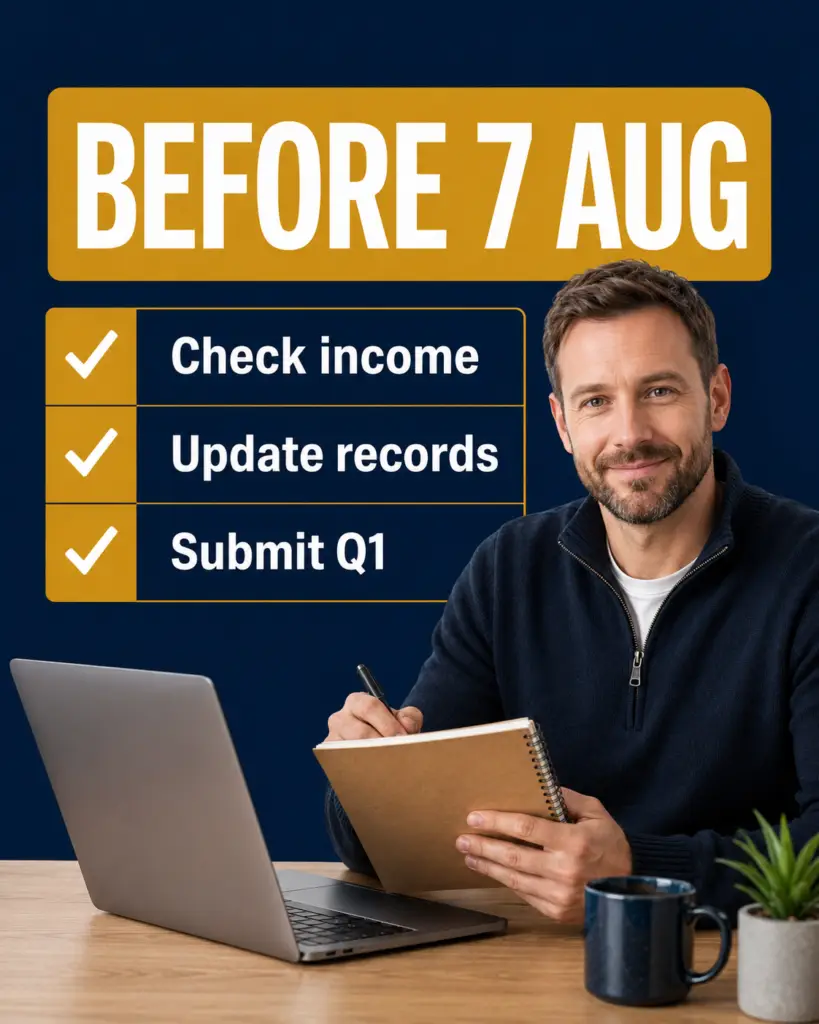
Who the 7 August MTD Deadline Affects
You are likely to be affected if all of these apply:
- You are an individual registered for Self Assessment.
- You receive income from self-employment, property, or both.
- Your qualifying income was more than £50,000 on the relevant tax return.
- You are not exempt from Making Tax Digital for Income Tax.
HMRC guidance says qualifying income is your total income from self-employment and property before expenses, also known as turnover. It can include more than one source. For example, £25,000 of rental income plus £27,000 of self-employment income would give qualifying income of £52,000. (gov.uk)
Other income, such as PAYE employment income, dividends, pension income and an individual partner’s share of partnership profit, does not usually count towards qualifying income for MTD. It may still need to be reported on your tax return, but it is not what decides whether you cross the MTD threshold. (gov.uk)
HMRC should have written to people it identified as needing to join MTD from April 2026. However, HMRC also says that if you did not receive a letter, it is still your responsibility to check whether you need to use the service and be ready on time.
What You Need To Submit By 7 August
For the first quarterly update, your compatible software sends totals for the income and expense categories used in your digital records. HMRC does not receive every invoice or receipt. It receives category totals.
Your software creates the update from your digital records. Before submitting, you should check that the figures look reasonable and that the records for the first quarter are as complete as possible.
For most people using standard update periods, the first update covers 6 April 2026 to 5 July 2026. For people using calendar update periods, it covers 1 April 2026 to 30 June 2026. The deadline for both is 7 August 2026.
If you had no income or expenses in the update period, you still need to send an update to tell HMRC.
What To Do Before 7 August
First, check whether you are in scope. Use your 2024 to 2025 Self Assessment return and look at your gross self-employment and property income before expenses. If the total was more than £50,000, you may be in the first MTD group. HMRC’s online checker can help you check if and when you need to use MTD.
Second, make sure you are signed up. HMRC guidance says that if you need to use MTD for the 2026 to 2027 tax year, you should sign up now. If you use an agent, they can sign you up instead.
Third, confirm that your software is compatible. HMRC does not provide MTD software. You need commercial software that can create and store digital records, send quarterly updates, and support your tax return submission. HMRC’s software finder lists products that have been through its recognition process, but HMRC does not recommend one provider over another.
Fourth, update your digital records. For each income or expense record, HMRC guidance says you need the amount, date, and category.
Fifth, submit the quarterly update through your software. You do not need to wait until the day of the deadline. HMRC says you can send an update any time from the end of the update period to the deadline.
What Happens If You Miss the 7 August MTD Deadline?
For 2026 to 2027, HMRC says there are no penalty points for missing a quarterly update deadline. That is reassuring, but it does not mean the update can be forgotten. You still need to keep digital records and send quarterly updates before you can submit your tax return.
The Self Assessment tax return and payment deadline remains 31 January after the end of the tax year. Quarterly updates do not replace your tax return. HMRC’s first-deadline announcement confirms that the tax return deadline remains 31 January.
After 2026 to 2027, the late submission penalty system becomes more important. HMRC says late quarterly updates after 2026 to 2027 can lead to penalty points, and reaching 4 points can lead to a £200 penalty.
So the sensible approach is not to treat the first year as optional. Use it to get your system working while the penalty position is more forgiving.
Common Problems To Fix Now
The biggest issue I expect sole traders and landlords to face is not the submission button. It is the records behind the button.
You may need help if:
- Your bookkeeping is still in a spreadsheet and you are not sure whether it links properly to MTD software.
- Your bank transactions have not been categorised.
- You have mixed personal and business spending.
- You have rental income and self-employment income together.
- You jointly own a rental property and are unsure what to report.
- You have not chosen between standard and calendar update periods.
- Your software does not support all the income sources you need.
- You have signed up but have not authorised the software correctly.
HMRC says spreadsheets can still be used, but you need software that links to them, often called bridging software, to send quarterly updates and submit the tax return.
That can work for some people. For others, it is simpler to move to cloud accounting software that handles digital records, bank feeds, receipt capture and MTD submissions in one place.
What This Means For Sole Traders
If you are a sole trader, the main job is to make sure your business income and expenses from the first quarter are recorded digitally and categorised properly.
Your quarterly update is based on totals, not final tax-adjusted profit. That means it is not the same as completing your year-end accounts. However, poor categorisation now can still make the year harder later.
Good bookkeeping now helps you:
- See whether your tax estimate is heading in the right direction.
- Reduce the clean-up work at year end.
- Keep evidence organised.
- Avoid last-minute software problems.
- Build a quarterly routine instead of one annual scramble.
If you are not sure whether your trade, side hustle or freelance income puts you into MTD, check your qualifying income and speak to an accountant before assuming you are outside the rules.
What This Means For Landlords
If you are a landlord, the key point is that property income can count towards MTD qualifying income. If you have both rental income and self-employment income, HMRC looks at the combined total before expenses. (gov.uk)
For jointly let properties, HMRC guidance says you can choose to include either property income and expenses, or property income only, in your quarterly updates. If you do not include expenses for jointly let properties in the quarterly updates, you must report them after the end of the tax year by resending your fourth quarterly update before submitting the tax return.
Landlords should pay particular attention to:
- Rental income received in the period.
- Agent fees.
- Repairs and maintenance.
- Mortgage interest records.
- Insurance.
- Service charges.
- Joint ownership records.
- Separate records for different properties where needed.
The aim is not to turn you into an accountant. The aim is to make sure the right information is in the right place before the deadline arrives.
How CWABC Can Help
I am Chris White MAAT AATQB, owner of CW Licensed Bookkeeper & Accountant, known as CWABC. I am based in Hildenborough near Tonbridge and work with sole traders, landlords and small businesses across Kent and UK-wide remotely.
My positioning is simple: the tech-savvy bookkeeper for the digital age.
If MTD has made your bookkeeping feel more complicated, I can help you get it under control. That might mean checking whether you are in scope, choosing software, setting up digital records, reviewing your first quarterly update, or building a bookkeeping process that works beyond the 7 August deadline.
This is draft-safe general guidance, not personalised tax advice. Your exact position depends on your records, income sources and circumstances. If you are unsure, get advice before the deadline passes.
FAQs
Is the 7 August 2026 MTD deadline real?
Yes. HMRC says the first quarterly update deadline for MTD for Income Tax is 7 August 2026 for people in scope from April 2026.
Who needs to send the first quarterly update?
Sole traders and landlords who had qualifying income over £50,000 and needed to start using MTD from 6 April 2026 are the main group affected.
What is qualifying income?
It is your total income from self-employment and property before expenses. Other income, such as employment income, dividends and pensions, does not usually count towards the MTD qualifying income threshold. (gov.uk)
Is the quarterly update the same as a tax return?
No. HMRC says quarterly updates are summaries of income and expense totals, not tax returns. You still need to submit a tax return and pay tax by the normal 31 January deadline.
Will I get a penalty if I miss the first quarterly update?
HMRC says it will not apply penalty points for late quarterly updates during the 2026 to 2027 tax year. However, you still need to send the updates before you can submit your tax return.
Can I still use spreadsheets?
Possibly. HMRC says you can use spreadsheets, but you need software that links to them, often called bridging software, to make MTD submissions.
Does HMRC provide free MTD software?
HMRC says it does not provide MTD software. Its software finder lists recognised products, including some free products for simple tax affairs, but HMRC does not recommend a specific provider.
What should I do if I have not signed up yet?
Check if you are in scope, choose compatible software, sign up as soon as possible, update your digital records, and send the first quarterly update by 7 August 2026.
Need help with your accounts?
I offer simple, friendly support for sole traders, landlords, and small business owners.