You only need a Self Assessment return for savings interest in certain cases. You need one if your interest is over £10,000, or if you already file a return for other reasons. Otherwise HMRC can usually collect any tax due through your PAYE tax code. Most people never pay tax on their interest, because the Personal Savings Allowance and the starting rate for savings cover it. Interest rates have risen, though, so more savers now cross those limits. I’m Chris, an AAT Licensed Accountant, and I’ll walk you through how it works so you can check HMRC’s figures calmly.
If you want a hand once you’ve read it, my Self Assessment tax return service starts from £250 one-off.
TL;DR
- Basic-rate taxpayers can earn £1,000 of interest tax-free each year. Higher-rate taxpayers get £500. Additional-rate taxpayers get nothing (GOV.UK).
- If your other income is low enough, the starting rate for savings can cover up to £5,000 of interest as well.
- If you already file a return, you declare your interest on it. If you don’t, and your interest is £10,000 or less, HMRC usually adjusts your tax code or sends a Simple Assessment letter.
- HMRC’s interest figures come from banks, and sometimes they are estimates. Check them against your own statements.
- ISA interest is tax-free and doesn’t use up any of your allowance.
Table of Contents
- How savings interest is taxed in the UK
- Which savings interest is tax-free
- When you need Self Assessment and when HMRC uses PAYE
- How HMRC adjusts your PAYE tax code
- Why HMRC’s figures can differ from what your bank paid
- A worked example: employment income and savings interest
- How to declare interest on a Self Assessment return
- Keeping records and correcting mistakes
- Landlords, sole traders and directors: why the interest matters more for you
- My view: why I look at savings interest alongside everything else
- How I can help
- Need help?
- FAQ
- Sources
How savings interest is taxed in the UK
Interest from bank and building society accounts counts as income. Banks and building societies don’t generally deduct tax from it any more. It is paid to you gross, and it is taxable in the tax year in which it is credited to your account, according to the Low Incomes Tax Reform Group (LITRG).
Three separate things can keep that interest tax-free.
- Your Personal Allowance. This is the £12,570 you can earn before income tax applies. Savings interest uses it only if your other income hasn’t already.
- The starting rate for savings. This is a band of up to £5,000 taxed at 0%.
- The Personal Savings Allowance (PSA). This is a separate tax-free slice of interest, and it depends on your tax band.
If you’re not sure which band you’re in, my guide to UK income tax bands for 2026/27 explains the thresholds.
The Personal Savings Allowance
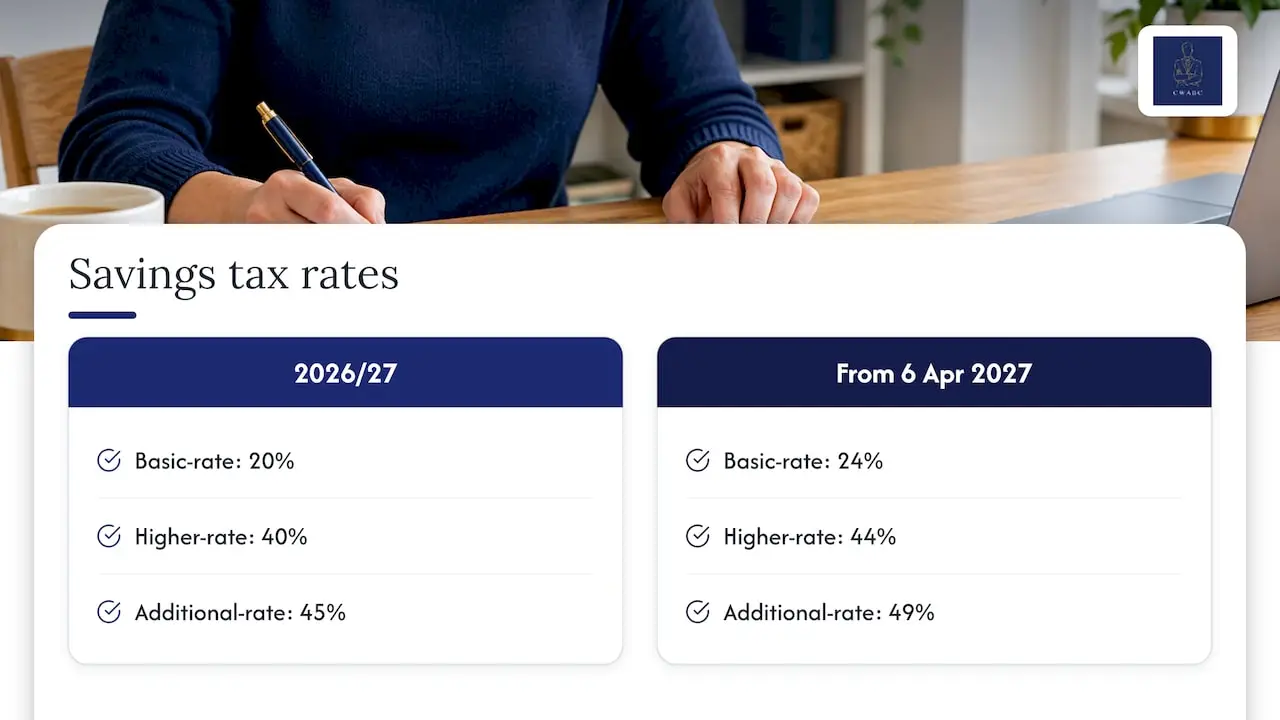
For 2026/27, GOV.UK sets the PSA at £1,000 for basic-rate taxpayers and £500 for higher-rate taxpayers. Additional-rate taxpayers have no PSA (GOV.UK, Annex A). The same page says the PSA stays at those levels from 6 April 2027.
Any interest above your allowance is taxed at your usual rate. For 2026/27 that is 20%, 40% or 45%. The allowance covers more than bank accounts. Which? lists credit union accounts, peer-to-peer lending and government or company bonds among the income it applies to.
Here is the GOV.UK example in plain terms. A basic-rate taxpayer with £1,300 of interest has £300 above the £1,000 allowance. At 20% that is £60 of tax.
The starting rate for savings
This is the part people most often miss. If your other taxable income, not counting savings interest or dividends, is under £17,570, you can get the starting rate for savings. That means up to £5,000 of interest is taxed at 0%. Every £1 of other income above your Personal Allowance reduces that £5,000 band by £1 (GOV.UK).
LITRG puts it another way for 2026/27. If your total taxable income is no more than £18,570, you would generally owe no tax on your savings income, even if it is more than £1,000. That is because the starting rate and the PSA can sit side by side.
Here are three rough profiles to show how it plays out:
| Your situation | Tax-free interest, roughly |
|---|---|
| Little or no other income, such as someone who has stopped working | Up to the Personal Allowance and starting rate, then the £1,000 PSA on top |
| Employed with a salary comfortably above £17,570, basic-rate | £1,000 PSA only |
| Higher-rate taxpayer | £500 PSA only |
| Additional-rate taxpayer | None |
The first row is a general picture, not a calculation for you. Your actual figure depends on all your income.
What changes from April 2027
GOV.UK’s Annex A was published on 5 November 2026. It says the savings tax rates rise from 6 April 2027, to 24% for basic-rate, 44% for higher-rate and 49% for additional-rate taxpayers. The starting rate limit stays at £5,000 (GOV.UK, Annex A). The allowances don’t change, but any interest above them will cost more. That is a good reason to understand your position now, not after the bill arrives.
Which savings interest is tax-free
Interest in an ISA is tax-free. GOV.UK says you don’t pay tax on interest on cash in an ISA. If you complete a tax return you don’t declare ISA interest on it, and the annual ISA allowance is £20,000 (GOV.UK).
ISA interest also doesn’t use up your PSA. NS&I gives an example of a basic-rate taxpayer with £60,000 in an ordinary account paying 2%. Moving £10,000 into a cash ISA brings her taxable interest down to exactly her £1,000 allowance.
For longer-term savings, Which? points out that the PSA protects your interest this year. Money inside an ISA stays tax-free for good, which matters most for higher earners and larger pots.
That is general information, not advice on where to put your money. If you want your savings, salary and other income looked at together, that is something I can do for you.
When you need Self Assessment and when HMRC uses PAYE
This is the question most readers actually have. The answer depends on how much interest you have and whether you already file a return.
If you already complete a return
You report your interest on it. GOV.UK says that if your interest is £10,000 or less and you are registered for Self Assessment, you include it on your return (GOV.UK). This applies to sole traders, landlords and company directors who file for other reasons. You declare interest from all your accounts, including personal ones, even if it falls within your allowance. ISA interest is the exception and is left off.
If your interest is over £10,000
MoneyHelper says that if you earn more than £10,000 from savings and investments, you need to complete a Self Assessment return. If you are in this position and have never filed, you need to tell HMRC by 5 October after the end of the tax year, or you could be fined. The tax is due by 31 January (GOV.UK). Check the GOV.UK page for the current year’s dates.
My guide to registering for Self Assessment by 5 October covers the registration step. If a deadline has slipped, Self Assessment penalties and how to stop them explains what happens next.
If your interest is £10,000 or less and you don’t file
HMRC can often deal with this without a return. If you are employed or get a pension, HMRC sends a tax calculation, usually between June and the following March. It then usually collects the tax through your tax code. If you don’t have a tax code, or it can’t be changed, HMRC may send a Simple Assessment letter instead (GOV.UK).
If you owe tax on your interest and no letter arrives by 31 March of the following tax year, GOV.UK says you must contact HMRC.
LITRG adds that you should try to tell HMRC about taxable income by 5 October after the end of the tax year. It gives 5 October 2026 for the year ending 5 April 2026 as the example. If HMRC can, it will take the extra tax from wages or private pension income by changing your PAYE code.
Here is the whole picture side by side:
| Your situation | What usually happens |
|---|---|
| You file Self Assessment already | You declare the interest on your return |
| Interest over £10,000 | You need to register and file a return |
| Employed or on a pension, interest £10,000 or less, no return | HMRC usually adjusts your tax code |
| No usable tax code | HMRC may send a Simple Assessment letter |
How HMRC adjusts your PAYE tax code
When HMRC adds tax on interest to your code, it doesn’t send you a separate bill. It reduces your tax-free pay over the year so the tax is collected through your wages or pension. That is why a code change can arrive with no warning. If your payslip shows a different code, savings interest is one possible reason.
Code changes can be based on the interest your bank reported for a past year. They can also be based on an estimate for the current one. That brings me to the next point.
Why HMRC’s figures can differ from what your bank paid
After 5 April each year, your bank or building society tells HMRC how much interest it paid you (GOV.UK). LITRG says that where HMRC hasn’t received up-to-date information, it sometimes uses estimated figures, often based on the previous tax year’s interest. Those estimates can be wrong, as the LITRG article on checking your savings interest figure explains. Typical cases are an account that has since closed, or one that held a large balance you have now withdrawn.
There are other reasons a figure may not match what you expect:
- Several accounts. The calculation will probably show the total across all your accounts. You need to add up the interest on each one and compare it to HMRC’s total.
- Forgotten accounts. Interest on dormant or low-balance accounts should still be reported.
- Fixed-term accounts. Interest that builds up over the term but is paid as a lump sum at maturity is generally not counted until it is paid. Amounts accrued but unpaid shouldn’t be in your taxable figure for that year.
- Joint accounts. GOV.UK says HMRC splits joint-account interest equally between the holders. You can contact HMRC if you think it should be split differently.
LITRG’s technical officer advises treating HMRC’s figures as a useful starting point, not as definitive. The fact that HMRC receives data from banks doesn’t remove your own duty to tell it when you need to file a return.
A worked example: employment income and savings interest
This example is fictional. It is only to show the mechanics, and it isn’t advice for any real person.
Priya is employed and earns £30,000 a year. She has no other taxable income. She has £48,000 in a standard savings account and earns £2,160 interest in the tax year. She doesn’t file a Self Assessment return.
- Starting rate: Her other income is well above £17,570, so she gets no starting rate for savings.
- Band: She is a basic-rate taxpayer, so her PSA is £1,000.
- Taxable interest: £2,160 minus £1,000 is £1,160.
- Tax due: 20% of £1,160 is £232.
After the year ends, her bank reports the interest to HMRC. HMRC then sends a calculation showing £232 owing. Because Priya is employed, HMRC will usually collect that through her tax code. Her pay slips show slightly less tax-free pay, and the £232 comes off over the year.
Now suppose HMRC had used an estimate based on the previous year, when Priya held more cash. If it assumed £3,000 of interest, the calculation would show £400 of tax, which is £168 too much. Priya would need to spot the gap by comparing the figure with her own statements, then contact HMRC.
A second, shorter case shows how a joint account works. Priya and her partner hold a joint account that earns £2,000 in interest. HMRC splits it equally, so each is treated as having £1,000. If both are basic-rate taxpayers and have no other savings, that falls inside each person’s £1,000 PSA. If Priya’s partner is a higher-rate taxpayer with a £500 allowance, £500 of their share would be taxable at 40%, which is £200.
If Priya were a sole trader instead of an employee, the interest would simply go on her Self Assessment return alongside her business profit. If you’re in that position, my Self Assessment service is designed for exactly this.
How to declare interest on a Self Assessment return
If you do file, the process is straightforward once you have the figures.
- Gather your totals. Use your bank and building society statements or annual interest certificates. Add up the gross interest from every taxable account for the tax year.
- Leave out ISA interest. It isn’t declared on a return.
- Use the right box. FreeAgent’s documentation says interest with no tax taken off goes into box 2, and interest that has had tax deducted goes into box 1. This is for the main return page (FreeAgent support).
- Check joint accounts. Enter only your share.
- Reconcile with HMRC. If you have received a tax calculation, compare its interest figure with your own total.
- File and pay. Pay any bill by 31 January following the tax year.
The most common slip I see described is forgetting interest from a second account. Another is mixing up interest earned in a business account with a personal one. If you spot a mistake after filing, my guide to correcting a Self Assessment return explains how to put it right.
Keeping records and correcting mistakes
HMRC’s guidance says individuals who aren’t running a business should keep their records for 22 months from the end of the relevant tax year. That includes bank and building society statements, statements of interest and any tax deduction certificates from your bank (HMRC records guide).
If you think the interest in your calculation is wrong, contact HMRC as soon as possible. If you have a Simple Assessment calculation, LITRG says you need to contact HMRC within 60 days to query the figures. HMRC may then issue a revised calculation. The Independent reported in August 2026 that 1.8 million people were due to receive a Simple Assessment bill. It also stresses that bank-supplied information may not always be right, and that you shouldn’t assume it is.
Good records make that check quick. My piece on which records to give your accountant lists what is worth keeping together. If you are a sole trader or landlord, accurate bookkeeping also keeps all of your income in one tidy place.
Landlords, sole traders and directors: why the interest matters more for you
If you already file a return, savings interest is one more line on a form you complete anyway. It still needs care. Interest on a business account belongs with business records. Interest on a personal account goes in the savings section. Landlords sometimes hold deposits or rental cash in savings accounts, so it is worth being clear which is which. My property income tax return guide for landlords covers the rental side.
If you will be affected by Making Tax Digital for Income Tax, your records will move to software and quarterly updates. Savings interest isn’t part of those quarterly updates, but it still needs to be reported. My page on Making Tax Digital for Income Tax support explains how I help sole traders and landlords prepare.
My view: why I look at savings interest alongside everything else
I see savings interest as a small number that causes a lot of worry. The tax itself is often modest. What upsets people is a letter or a changed tax code they didn’t expect, and no clear way to check it.
My approach is practical. I look at your salary, any self-employed or rental profit, and all your accounts together. Then I work out which allowances apply to you and what HMRC should be showing. If its figure looks like an estimate, I help you compare it with your statements so you know what to raise with HMRC.
I work with you directly, in plain English, and I use cloud accounting and secure digital workflows so your records are organised and ready for HMRC. I don’t offer guarantees about outcomes, but I do aim to take the stress out of the process and help you understand your numbers.
Chris
How I can help
If you are a sole trader, landlord or director already filing a return, I can add your savings interest in properly, check it against HMRC’s figures and keep your records in order. My Self Assessment returns start from £250 one-off. If you want to see everything I offer, from bookkeeping to payroll, you can see it on my main site. I work with clients in Tonbridge, Hildenborough, Sevenoaks and across Kent, and remotely across the UK.
If your accounts are in a mess, bookkeeping support is the foundation for all of this.
Need help?
If you’re unsure whether savings interest affects your tax return or your tax code, get in touch with me here. I’ll explain where you stand, in plain English.
FAQ
Do I need to declare savings interest if it is under my allowance?
If you complete a Self Assessment return, yes: you declare interest from all your taxable accounts, even when it falls inside your allowance. ISA interest is the exception. If you don’t file a return and your interest is within your allowances, there is usually nothing to do.
Is the £10,000 figure the tax-free limit?
No. £10,000 is the point at which you need to complete a Self Assessment return. Your tax-free amounts are your Personal Savings Allowance and, where it applies, the starting rate for savings. You may owe tax on interest well below £10,000.
Why has my tax code changed because of savings interest?
HMRC can collect tax on interest through your PAYE code if you are employed or get a pension. It does this using figures from your bank, or sometimes an estimate. Check the interest figure on your calculation against your own statements. If it is wrong, contact HMRC. For a Simple Assessment, do so within 60 days.
How is interest on a joint account taxed?
HMRC splits joint-account interest equally between the holders, so each person is taxed on their half. You can contact HMRC if you think it should be split differently. Each person’s own allowance then applies to their share.
Do I report interest from a fixed-term account before it matures?
Generally not. LITRG says interest that builds up over the term and is paid in one lump at maturity shouldn’t be counted until it is paid. Amounts accrued but unpaid shouldn’t be in your taxable figure for that year.
Sources
- GOV.UK: Annex A, rates and allowances
- GOV.UK: Tax on savings interest, how much is tax free
- GOV.UK: Tax on savings interest, overview
- GOV.UK: How you pay tax on savings interest
- GOV.UK: Individual Savings Accounts, how ISAs work
- GOV.UK: Self Assessment tax returns overview
- LITRG: Tax on savings income
- LITRG: Check the savings interest figure in your tax calculation
- MoneyHelper: How tax on savings and investments works
- NS&I: Paying tax on savings
- Which?: Tax on savings interest and investment income
- HMRC: A general guide to keeping records for your tax returns
- The Independent: Simple assessment HMRC tax bills
- FreeAgent: The Main Return page of the Self Assessment tax return
Recommended
- Correct tax return mistakes: UK Self Assessment guide
- From £100 to £1,300: UK self assessment penalties and how to stop them
- Avoid Penalties: Register by 5 Oct 2026, UK Self Assessment Checklist
- £6,000 January surprise for sole traders & landlords: Self Assessment payments
This article provides general information based on UK tax and accounting rules at the time of publication. It is not a substitute for advice tailored to your individual circumstances. Tax legislation and HMRC guidance may change. If you need advice about your specific situation, please contact me at CW Licensed Bookkeeper & Accountant.