
If your limited company has one director and no other staff, you generally have no automatic enrolment duties. The Pensions Regulator says a one-person company with a sole director is not treated as an employer for automatic enrolment, whether or not that director has an employment contract. That changes the moment another person works for the company under a contract of employment. The word that matters is “only”: one director, and nobody else on a contract.
This guide walks through where the line sits, what happens when you take on your first employee, and how legal duties differ from choosing to pay into a pension for yourself. It is general information, not personal advice, and I’ll point out where your own situation needs a closer look.
TL;DR
- A limited company with a sole director and no other employees has no automatic enrolment duties, with or without a director’s employment contract.
- Duties can start when the company has at least one other person on an employment contract, or when two or more directors have employment contracts.
- Once duties apply, you assess staff, enrol those who qualify, write to them, pay contributions and complete a declaration of compliance.
- Paying into your own pension as a director is a separate, voluntary choice, not an auto enrolment duty.
- If you receive a letter from The Pensions Regulator, reply properly. Do not ignore it.
Table of Contents
- What automatic enrolment is, in plain English
- When a single-director company falls outside the duties
- Directors with and without employment contracts
- What changes when you employ your first person
- Pension assessments: who has to be enrolled
- Postponement: a useful breathing space
- Employer responsibilities once duties apply
- What if The Pensions Regulator writes to you?
- Automatic enrolment duties versus choosing to pay into a pension
- Common mistakes I see small companies make
- A simple checklist for your own company
- Perspective
- How I can help you assess your payroll and pension position
- FAQ
- Need help?
- Sources
What automatic enrolment is, in plain English
Automatic enrolment is the UK rule that requires employers to put eligible staff into a workplace pension, rather than waiting for them to ask. Staff can then choose to opt out. The employer pays in as well.
The duty sits with the employer. So the first question is never “am I a director?” It is “does my company employ anyone who counts as a worker?” For a one-person company, the answer is often no, and that is why the rules look different from those for a company with a small team.
When a single-director company falls outside the duties
The Pensions Regulator’s guidance for business advisers on director exemptions is clear on the main point. A company with one director and nobody else is not an employer for these purposes. It also does not need to complete a declaration of compliance.
That covers two common set-ups:
- A sole director with no employment contract. You take a small salary, dividends or both, but there is no contract of employment between you and the company.
- A sole director with an employment contract. You might have signed one with your own company. Even so, with nobody else employed, the company is not treated as an employer for automatic enrolment.
Neither of these means you must avoid pensions. It simply means the law does not oblige your company to enrol you.
Please don’t assume “one director” is enough
Some websites say every single-director company is automatically exempt. That is too neat. The accurate statement is that a company with one director and no other people working under employment contracts is exempt. Take any of the following into account before you rely on it:
- You have one director, but also a part-time employee, even for a few hours a week.
- A family member is on the payroll under a contract.
- You have a second director who also has an employment contract.
- You have a cleaner, assistant or bookkeeper who is employed, rather than self-employed.
The Pensions Regulator states that the position depends on the contractual arrangements and on whether others are employed. It also notes that contracts of employment do not need to be written. They can be verbal or implied. So “we never signed anything” is not a safe answer on its own.
If you are unsure whether a person is an employee, a worker or genuinely self-employed, that is worth settling before you decide your pension position. It also matters for PAYE, which I cover in my guide to setting up PAYE as a first-time employer.
Directors with and without employment contracts
This is where most confusion starts, so here it is side by side.
| Situation | Does the company have auto enrolment duties? |
|---|---|
| One director, no contract, no other staff | No |
| One director with an employment contract, no other staff | No |
| One director with a contract, plus one or more other employees | Yes, the director and staff are assessed as workers |
| One director without a contract, plus an employee | Yes for the employee. The director is not a worker, so is not assessed |
| Two or more directors, at least two with employment contracts | Yes, those directors are treated as workers |
The Pensions Regulator’s page on directors and automatic enrolment explains that where a company has multiple directors with employment contracts, they are considered workers and the duties apply. Check the Regulator’s own page before relying on any one row for your company, because individual circumstances can differ.
A practical point: a director without an employment contract is not a worker under the rules, so does not have to be assessed or enrolled. A director with a contract may be, once the company has the right mix of people. This is why it is worth knowing exactly what paperwork exists, rather than guessing.
A worked example
Imagine a Tonbridge-based consultant who runs her own limited company. She is the only director and only shareholder. She pays herself a modest salary through payroll and takes dividends. There are no other employees. She has no automatic enrolment duties, even if she signed a director’s service agreement.
Twelve months later she hires an administrator on a permanent contract. Now the company has an employee. The company must assess its workforce, and the administrator’s age and earnings decide what happens next. This example is illustrative, not a real client.
What changes when you employ your first person
Once the company employs someone under a contract, the company becomes an employer for automatic enrolment. Do not wait for a letter. Plan for it before the first payday.
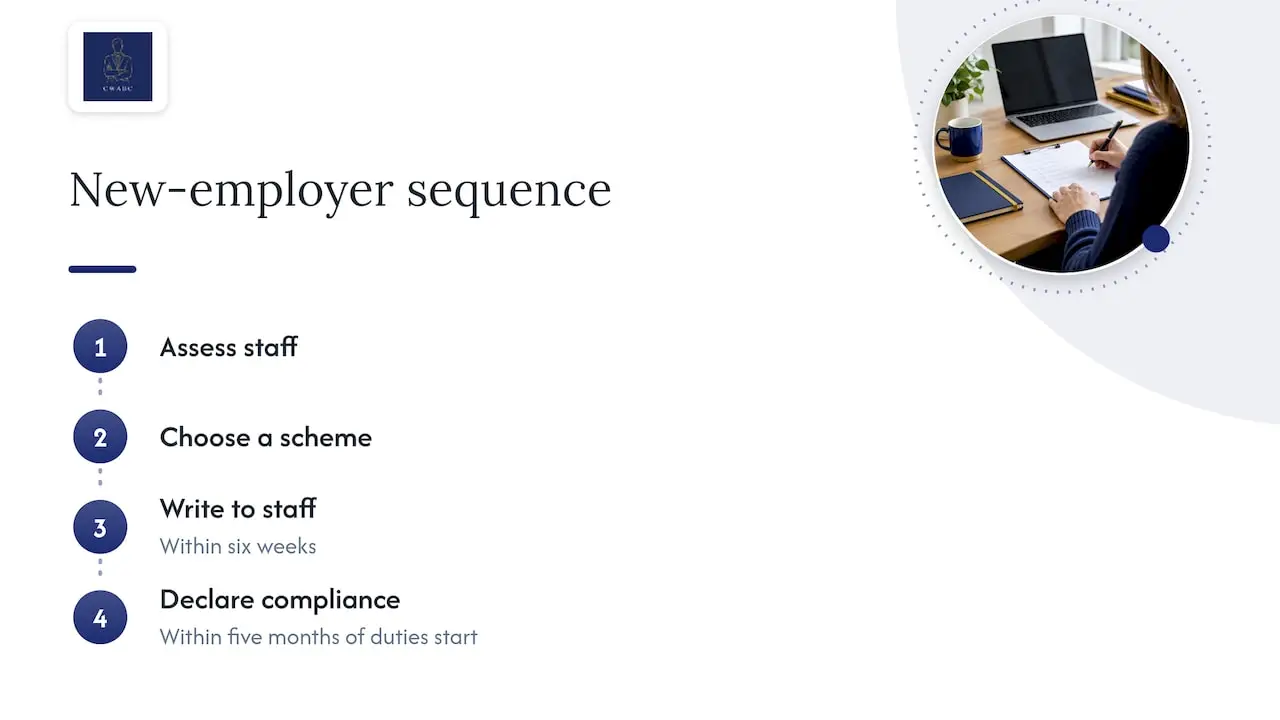
The Pensions Regulator’s guidance for new employers sets out the sequence: assess staff, choose a scheme, write to staff within six weeks, and declare compliance within five months of your duties start date. If you are hiring for the first time, that five-month window is useful, but you should not leave everything until the end of it. The declaration of compliance checklist suggests starting early because the information can take time to gather.
The declaration asks for details such as your PAYE reference, letter code, contact details, the type of pension scheme and the number of staff. Having your payroll set up properly first makes this far easier.
Telling The Pensions Regulator when things change
The Regulator expects you to tell it if your circumstances change, for instance if you take on a new member of staff under a contract of employment, or at least two directors start working under employment contracts. It says this should be done as soon as possible.
Put a note in your diary to review your pension position every time you:
- hire anyone,
- appoint another director,
- put a family member on the payroll,
- or change a director’s contract.
Pension assessments: who has to be enrolled
When you have staff, each person is assessed. The key category is the eligible jobholder. Broadly, that is someone aged between 22 and State Pension age, working in the UK, who earns above the earnings trigger. Industry technical guidance summarises the age range and the trigger in this way, and the Regulator’s own figures are below.
For the 2026/27 tax year, The Pensions Regulator publishes the earnings thresholds:
| Threshold | Annual | Monthly | Weekly |
|---|---|---|---|
| Earnings trigger | £10,000 | £833 | £192 |
| Lower level of qualifying earnings | £6,240 | £520 | £120 |
Someone who earns less than the trigger, or who is outside the age range, may still have rights to join a pension. They are just not automatically enrolled. Your assessment should record what category each person falls into, and it needs repeating when pay or circumstances change, particularly if hours and pay vary from month to month.
If you pay a director through payroll under a contract and the company has duties, include the director in the assessment too. Do not leave them out by habit.
Postponement: a useful breathing space
Employers can delay enrolling eligible workers by up to three months. This is called postponement. The Pensions Regulator explains that during the postponement period you do not need to assess the worker in the usual way.
To use it properly:
- Decide whether you will use postponement, and for which staff.
- Tell the person in writing, within the required time, that you are using it.
- Diarise the end date.
- Re-assess when the period ends and enrol the person if they are still eligible.
Postponement is a tool for cash-flow and admin planning. It does not remove the duty. Missing the end date is a common error, so I like to set a reminder at the time of hiring.
Employer responsibilities once duties apply
When the company has enrolled workers, there are ongoing jobs. In summary:
- Pay contributions on time. According to GOV.UK, you must pay at least the minimum contributions, normally by the 22nd of the month.
- Meet the minimum. GOV.UK states employers must pay at least 3% of qualifying earnings, and under most schemes qualifying earnings run between £6,240 and £50,270 a year.
- Handle opt-outs properly. Staff can opt out. You cannot pressure them either way.
- Re-enrol. You must let workers rejoin at least once a year if they have opted out, and re-enrol eligible staff at least every three years.
- Keep records. Keep your assessments, joiner details, contribution records and the letters you sent.
- Update the Regulator. Declare compliance, and keep the information current.
Small employers sometimes ask what happens if they get this wrong. The Regulator can issue penalties for non-compliance, so it is far better to build the steps into payroll from the beginning. I also cover the payroll calendar in my payroll year-end checklist for small UK employers.
What if The Pensions Regulator writes to you?
Newly registered PAYE schemes sometimes get a letter even when the company has no staff to enrol. Do not panic, and do not bin it. If you have no automatic enrolment duties, The Pensions Regulator explains on its page for employers without staff that you can use the online form to tell it you are not an employer. You will need your PAYE reference and the letter code from the letter.
Two cautions:
- The same page warns that giving false or misleading information to avoid duties can lead to fines or prosecution. Only tell the Regulator what is true.
- Keep a short note on file explaining why the company has no duties: who the directors are, whether anyone else is employed, and the date you checked.
That note is surprisingly valuable a year or two later when you or your accountant need to remember why you answered as you did.
Automatic enrolment duties versus choosing to pay into a pension
This is the distinction I most want to make clear, because the two are often muddled.
Automatic enrolment is a legal duty that applies to employers with eligible workers. It has rules on who is enrolled, minimum contributions, deadlines and reporting.
Voluntary pension contributions are a choice. As a director of a company with no automatic enrolment duties, you can still decide to save for retirement. You might set up a personal pension, or arrange for the company to pay an employer contribution. None of that is required by the auto enrolment rules, and none of it means you have become an “employer with duties”.
A few practical points follow:
- Because the choice is voluntary, the amount and timing are up to you, within the pension limits and tax rules that apply to your circumstances.
- A company contribution is a business decision. It affects profit, your tax position and your cash flow, so it should be planned alongside your salary and dividends. My article on small business director salary tax examples shows how those choices fit together.
- Pension tax relief and allowances depend on your own income and history. For that part, speak to a regulated financial adviser. I can help with the bookkeeping and tax-return side, but I do not give investment or personal financial advice.
Saying “I am exempt from auto enrolment” is not the same as saying “I don’t need a pension plan”. The first is a legal statement about your company. The second is a personal decision.
Common mistakes I see small companies make
- Assuming exemption forever. The position is right on the day you check, then a hire changes it.
- Forgetting part-time or casual staff. Someone paid a few hours a week may still be an employee.
- Treating a spouse on the payroll as a non-employee. If there is a contract, written or not, it counts.
- Ignoring the Regulator’s letter. It rarely goes away by itself.
- Missing the end of postponement. The three months pass quickly.
- Mixing up business and personal pension payments. Contributions paid from the company’s bank account need to be recorded correctly in the books.
- Not telling the Regulator about changes. If your situation changes, tell it promptly.
There is also a related trap for people with more than one company. If you have several, each is assessed on its own facts, and my guide to associated company rules is useful for the tax side of that picture.
A simple checklist for your own company
Work through this, and write down the date and your answers.
- How many directors does the company have?
- Does each director have an employment contract, written, verbal or implied?
- Does the company employ anyone else? Include part-time, casual and family members.
- Is anyone paid through PAYE as an employee?
- Has The Pensions Regulator written to the company?
- Are you planning to hire in the next six months?
- Do you want to make voluntary pension contributions for yourself?
If the first three answers show one director and nobody else on a contract, you are most likely outside the duties. If any answer points the other way, check the Regulator’s guidance or ask for help before the first payday.
Perspective
When I speak to directors of small companies, the question is rarely “what does the legislation say?” It is “am I about to get this wrong?” That worry is understandable, and it is usually fixed by a calm, step-by-step look at who is actually on the payroll.
From my own practice, the most useful thing I can do is slow the conversation down. I ask who the directors are, whether there are contracts, and what hires are coming. Then I check that against the Regulator’s published guidance and write the answer down. It takes a short time, and it saves a great deal of last-minute mess later.
I would rather you knew your position clearly than relied on a rule of thumb from a website. A single-director company often has no duties, and that is good news. But the one-person exemption stops applying the moment the facts change, and the facts change quietly when you hire.
That is why I like to link pension duties to the books and payroll from day one. When records are tidy and your payroll software is set up properly, the pension assessment becomes a routine job rather than a frightening one.
Chris
How I can help you assess your payroll and pension position
I work with small limited companies across Tonbridge, Hildenborough, Sevenoaks and the rest of Kent, and remotely throughout the UK. For a company in this position, I can:
- talk through your director and staff arrangements and help you work out whether automatic enrolment duties may apply, based on the Regulator’s guidance;
- set up payroll and PAYE so that new hires are recorded correctly from the first day;
- help you prepare for a hire, including the assessment, postponement dates and records to keep;
- help you reply to a letter from The Pensions Regulator, where the facts show you have no duties;
- keep your books accurate so company pension payments, salary and dividends are recorded properly, as part of my bookkeeping services;
- set up and support cloud software such as Xero, QuickBooks or FreeAgent, so payroll and bookkeeping sit together.
The detail is on my payroll and CIS services page, and you can see my wider range at CWABC. Pricing is tailored and agreed clearly upfront, so you know what you are paying before work starts. I do not offer regulated pension or investment advice, and I will say so if a question belongs with a financial adviser.
If you also want a tidy monthly routine for your records, my guide to bookkeeping for a limited company is a good next step.
FAQ
Does a one-director company need a workplace pension?
Not as a legal duty, if the director is the only person involved and nobody else is employed under a contract. The company is not treated as an employer for automatic enrolment. You can still choose to save for retirement personally or through the company.
Does it matter if I have an employment contract with my own company?
For a sole director with no other staff, no: the company is still not treated as an employer for these rules. It starts to matter when other employees join, or when two or more directors have employment contracts. Then the directors may be assessed as workers.
What should I do if I get a letter from The Pensions Regulator?
Check your facts first, then respond. If you have no duties, you can use the Regulator’s online form, which asks for your PAYE reference and the letter code. Only give accurate information, as false or misleading answers can lead to penalties.
What happens when I hire my first employee?
Your company becomes an employer for automatic enrolment, so you assess the employee by age and earnings, choose a scheme and write to them. You also complete the declaration of compliance within five months of your duties start date. Postponement of up to three months may be available.
Is paying into my own pension the same as auto enrolment?
No. Auto enrolment is a legal employer duty for eligible workers. Voluntary contributions are your own decision, and the tax treatment depends on your circumstances, so a regulated financial adviser is the right person for pension planning advice.
Need help?
If you are not sure whether your limited company has automatic enrolment duties, or you are about to hire and want payroll set up properly, I am happy to talk it through. Get in touch with me here and I will explain the next steps in plain English, with no obligation.
Sources
- Director exemptions from automatic enrolment, The Pensions Regulator
- Directors and automatic enrolment: do you have duties?, The Pensions Regulator
- Employer duties and defining the workforce, The Pensions Regulator
- Duties for new employers, The Pensions Regulator
- Declaration of compliance checklist, The Pensions Regulator
- Earnings thresholds, The Pensions Regulator
- Assessing staff whose hours and pay varies, The Pensions Regulator
- What if I don’t have any staff, The Pensions Regulator
- Set up and manage a workplace pension scheme, GOV.UK
- Workplace pensions: what your employer can and cannot do, GOV.UK
- Auto-enrolment: who and when, Aberdeen Techzone
Recommended
- Associated companies rules: avoid halved tax limits for UK directors
- Small business director salary tax examples: 2026 guide
- How to pay corporation tax correctly: UK director’s guide
- Set Up PAYE in 15 Minutes for First Time UK Employers
This article provides general information based on UK tax and accounting rules at the time of publication. It is not a substitute for advice tailored to your individual circumstances. Tax legislation and HMRC guidance may change. If you need advice about your specific situation, please contact me at CW Licensed Bookkeeper & Accountant.