
Ordinary residential rent is normally exempt from VAT, so you charge no VAT and cannot reclaim VAT on related costs. Holiday accommodation is normally standard-rated and can push you towards VAT registration once your turnover passes the threshold. Commercial lettings sit between the two: exempt by default, but a landlord can choose to make them taxable by opting to tax.
TL;DR:
- Residential lettings are usually exempt from VAT, meaning no VAT is charged or reclaimed on related property costs unless the use resembles holiday accommodation or short-term rentals marketed as stays.
- Holiday accommodation is generally standard-rated for VAT, and exceeding the £90,000 gross turnover threshold in any rolling 12 months requires immediate VAT registration, including platform commissions in the turnover calculation.
- Opting to tax commercial property makes rent taxable and allows VAT recovery on costs, but the decision is complex and affects future sales and use, requiring careful planning before implementation.
- Changes in property use, such as switching from holiday to residential letting or vice versa, can trigger different VAT treatments, often requiring reclassification and stopping VAT recovery on costs incurred before the change.
- Mixing exempt residential and taxable commercial or holiday supplies necessitates detailed record-keeping and partial exemption calculations to allocate VAT correctly, especially for costs serving both types of use.
Table of Contents
- Residential lettings: what ‘exempt’ means and common edge cases
- Holiday and short-term accommodation: when VAT applies and registration triggers
- Commercial property: exemption, the option to tax and long-term effects
- VAT registration threshold: what to include in the £90,000 test and timing
- Input VAT recovery and partial exemption when supplies are mixed
- Worked examples: residential let, holiday let crossing the threshold, and opting to tax
- Why trust this guide: CWABC author’s credentials and relevant services
- Clarification that abolition of the FHL income tax regime did not change VAT treatment
- How to account for VAT correctly on mixed-use properties
- How VAT interacts with business rates and other taxes for landlords
- Specific rules and exceptions for furnished holiday lettings regarding VAT
- Implications of leasing via management companies or agents on VAT treatment
- Guidance on VAT when a property’s use changes
- When to get professional help: an accountant’s viewpoint
- How I can help with VAT registration and landlord bookkeeping
- FAQ
- Sources
Residential lettings: what ‘exempt’ means and common edge cases
For most landlords, letting out a house or flat on an ordinary tenancy is an exempt supply for VAT purposes. That means you do not add VAT to the rent, and in return you cannot normally reclaim VAT charged on repairs, letting agent fees or other property costs, according to VAT Notice 742. It is a fair trade in principle: no VAT charged, no VAT recovered, and for the vast majority of residential landlords that is the end of the story.
Where it gets less straightforward is when a letting starts to look like something other than a simple tenancy. A few situations can change the VAT position:
- Serviced accommodation. If you provide hotel-style services alongside the let, cleaning, linen changes, regular housekeeping, HMRC may treat the supply as holiday accommodation rather than exempt residential letting.
- Short lets marketed as holiday stays. A flat advertised on a holiday-booking platform, even if occasionally let longer-term, can fall into the standard-rated category depending on how it is marketed and used.
- Planning or lease restrictions. A property with a planning condition or lease clause preventing permanent occupation is more likely to be treated as holiday accommodation for VAT, regardless of how you personally think of it.
Because the distinction matters, it helps to keep evidence of how a property is actually let: tenancy agreements, the wording used in marketing, and records of typical stay lengths. If a tenant is in a property on an assured shorthold tenancy with no extra services, you are almost certainly exempt. If you are promoting weekend stays with changeovers and cleaning included, you are in different territory. GOV.UK’s guidance on land and property sets out the detailed criteria, and it is worth checking against your own situation rather than assuming.
Holiday and short-term accommodation: when VAT applies and registration triggers
Holiday accommodation is normally standard-rated for VAT, which is a different world from ordinary residential letting. If you run, or are moving towards running, a furnished holiday let, cottage rental or short-stay apartment, you need to think about VAT the way any other trading business would, according to VAT Notice 709/3.
A few points matter in practice:
- Periodic and initial charges count. Booking fees, cleaning charges, and any ground rent or service charge linked to the stay are VATable once the supply itself is taxable, not just the headline nightly rate.
- The registration threshold applies to gross income, not net. When testing against the £90,000 VAT registration threshold, you must include the full amount paid by guests, including commission taken by a booking platform or online travel agent, not just what lands in your bank account after their cut.
- A narrow off-season exemption exists. HMRC accepts that a letting exceeding 28 days of continuous occupation during a genuinely quiet season can sometimes be treated as exempt, but this needs clear documentary evidence and a recognisable seasonal pattern in local holiday trade, not a convenient one-off booking.
- Monitor turnover as you go. Keep a running log of bookings, gross receipts and commissions so you can see, month by month, where you sit against the threshold rather than discovering the answer at year-end.
The registration trigger is forward-looking as well as backward-looking: you must register if your taxable turnover in the past 12 months exceeds £90,000, but also if you expect to exceed it in the next 30 days alone, as set out on the VAT registration service. For a landlord with one or two holiday cottages, this can creep up faster than expected once platform fees and seasonal peaks are added together. My guide to furnished holiday let tax rules covers the income tax side of holiday lettings in more detail, which sits alongside, but separately from, the VAT position described here.
Commercial property: exemption, the option to tax and long-term effects
Letting commercial property, shops, offices, warehouses, is normally an exempt supply by default, much like residential letting. The difference is that commercial landlords have a choice: you can elect to “opt to tax” the property, which makes your rental income standard-rated and, in exchange, lets you reclaim VAT on costs connected to that property, according to guidance on opting to tax land and buildings.
A few things to weigh before you go anywhere near that decision:
- Notification is required. An option to tax has to be formally made and notified to HMRC; it does not happen automatically just because you want to reclaim VAT.
- It usually applies to the whole interest. Once exercised, the option generally covers all supplies you make of that interest in the land, not just one tenant’s rent.
- It affects future disposals too. If you later sell the property, VAT treatment on the sale can be shaped by the earlier option, which matters hugely to pricing and to buyers who cannot reclaim VAT themselves.
- It is difficult to unwind. Reversing an option to tax is possible only in limited circumstances and is rarely straightforward.
The underlying trade-off is simple to state and genuinely tricky to apply: opt to tax, and you can reclaim input VAT on refurbishment and running costs, but you then have to charge VAT on rent, which can make the property less attractive to a tenant who cannot reclaim it themselves, such as a bank, charity or residential developer. Whether that trade-off makes sense depends on who your tenants are now, who your likely buyers might be later, and the timing of any big capital spend.
Pro Tip: Work out your likely tenant and buyer profile before you opt to tax, not after, since the decision is hard to reverse once made.
VAT registration threshold: what to include in the £90,000 test and timing
You must register for VAT once your taxable turnover exceeds £90,000 in a rolling 12-month period, or if you expect to exceed that figure in the next 30 days alone, according to GOV.UK’s VAT registration guidance. For most ordinary residential landlords this never becomes relevant, because exempt rental income does not count towards the test at all. For landlords running holiday accommodation, or commercial property where an option to tax applies, it very much does.
What counts towards the £90,000 threshold:
- Gross holiday-let income, including the full amount paid by guests before any booking platform commission is deducted.
- Rent from commercial property where you have opted to tax, since that rent becomes a taxable supply.
- Any other taxable trading activity you run, even if unrelated to property, because the threshold applies to you as a person or business, not to each individual income stream separately.
This last point catches people out. If you run a small trades business or consultancy alongside a holiday cottage, HMRC looks at your combined taxable turnover across everything you do, not just the lettings. A landlord close to the threshold on holiday income alone might tip over once a side business is added in.
Voluntary registration before you hit the threshold is also an option, and sometimes a sensible one if you are about to spend heavily on refurbishment and want to reclaim the VAT, but it brings ongoing compliance obligations, including quarterly returns, so it is not a decision to make lightly. The flat rate scheme can simplify VAT accounting for some smaller businesses, and GOV.UK sets out the current scheme details if that route might suit your situation. My guide to VAT registration ahead of the £90,000 threshold walks through the timing mechanics in more depth.
Input VAT recovery and partial exemption when supplies are mixed
The general rule is straightforward: you can only reclaim VAT on costs that relate to taxable supplies. Costs relating to exempt supplies, like most ordinary residential letting, cannot be reclaimed at all, according to guidance on partial exemption. The complication starts the moment you have both kinds of income under one VAT registration, for example a landlord with an opted-to-tax commercial unit and an exempt residential flat in the same portfolio.
When that happens, you become what HMRC calls “partly exempt,” and you need a partial exemption method to apportion input VAT fairly between taxable and exempt activities:
- Direct attribution first. Where a cost clearly relates to one property or one type of supply, attribute it directly rather than lumping it into a general pool.
- Residual costs need apportionment. Overheads that serve the whole business, accountancy fees, a shared office, general insurance, must be split using an agreed method, usually based on the proportion of taxable to total income.
- Keep segmented records. A rent roll and cost ledger broken down property by property makes the apportionment calculation far easier to defend if HMRC ever queries it.
- Timing of capital costs matters. If refurbishment costs are incurred before an option to tax is in place, that VAT is often treated as relating to exempt supplies and cannot be reclaimed later, even if you opt to tax soon afterwards.
One figure worth remembering: the VAT registration threshold stands at £90,000, and it is this figure, not your net rental profit, that decides whether registration and partial exemption rules apply to you at all.
The practical pitfall I see most often is landlords assuming that opting to tax retrospectively fixes VAT already paid on past costs. It generally does not. Getting the timing right, ideally before major capital spend rather than after, makes a real difference to how much VAT you actually recover.
Worked examples: residential let, holiday let crossing the threshold, and opting to tax
Example 1: the long-term residential let. Say you let a two-bedroom flat on a standard tenancy for £1,200 a month. That rent is exempt, so you charge no VAT and cannot reclaim VAT on the new boiler, the letting agent’s fee or the annual gas safety check. This is the position for the overwhelming majority of residential landlords, and no registration question arises at all.
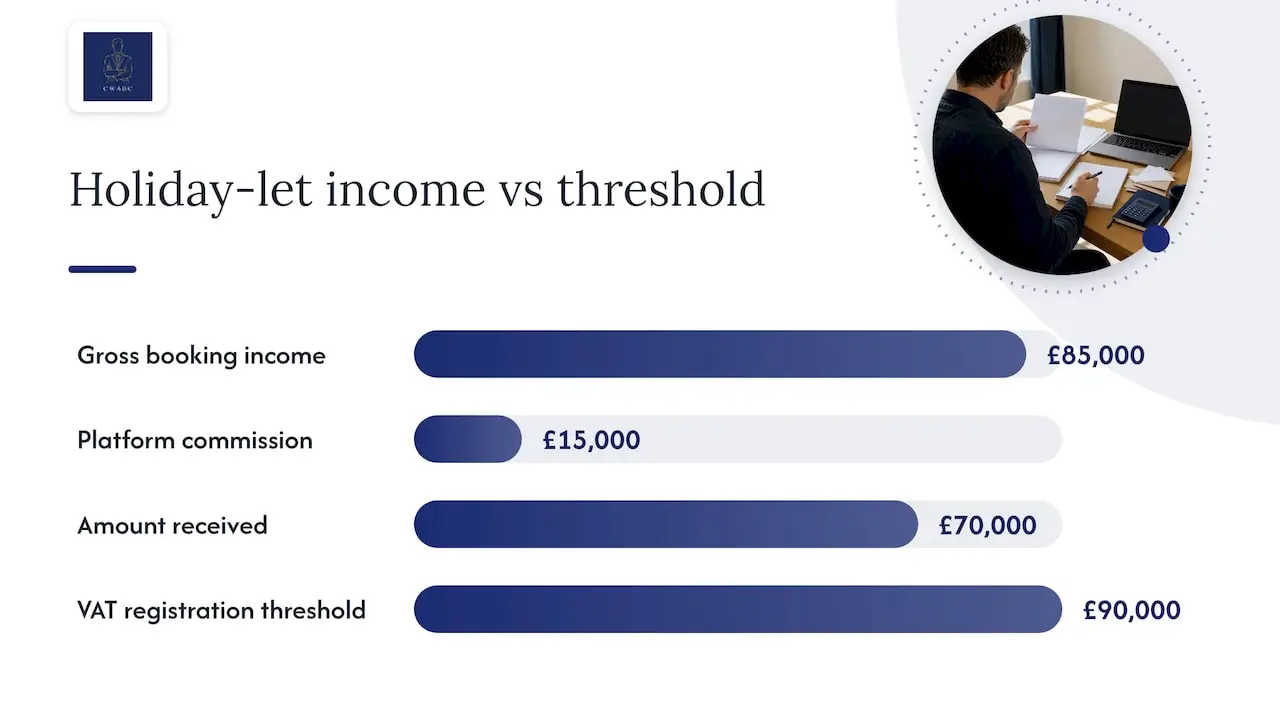
Example 2: the holiday cottage nearing the threshold. Say a cottage earns £85,000 in gross booking income over a rolling year, of which £15,000 is commission retained by an online booking platform before it ever reaches your account. The full £85,000 counts towards your taxable turnover test, not the £70,000 you actually received, because the threshold looks at the gross value of the supply. If next month’s bookings are forecast to push you past £90,000 within 30 days, you must register straight away rather than waiting for the 12-month look-back.
Example 3: the commercial landlord weighing an option to tax. Say you own an office unit and are about to spend heavily on refurbishment before re-letting. If you opt to tax, you can reclaim VAT on that refurbishment, but you must then charge VAT on the rent, which may put off a tenant who cannot reclaim it, such as a charity. Modelling both the input VAT saved and the likely tenant pool before committing is the only way to judge whether opting to tax actually pays off.
A short checklist for each scenario: keep tenancy or booking evidence that supports your VAT treatment, track gross income monthly if you are anywhere near the threshold, and get the timing of any option to tax agreed before you commit to major spending.
Why trust this guide: CWABC author’s credentials and relevant services
I am an AAT-licensed bookkeeping and accountancy practitioner working with landlords and small businesses across a range of VAT situations, from a single residential let to mixed residential, commercial and holiday portfolios.
Day to day, cloud accounting platforms including Xero, QuickBooks and FreeAgent can be used to track taxable turnover in real time, which matters enormously for holiday-let landlords watching the £90,000 threshold, and to prepare VAT returns accurately once registration applies. For landlords with mixed supplies, the same system-led approach supports the record-keeping that partial exemption calculations depend on.
Services connected directly to the issues in this guide can include VAT registration and returns, bookkeeping set up specifically for landlords, and support working through partial exemption calculations where a portfolio mixes exempt and taxable income; for specialist compliance support, see Landlord Compliance resources. For more information, visit the contact page.
Clarification that abolition of the FHL income tax regime did not change VAT treatment
The Furnished Holiday Lettings income tax regime, which gave qualifying holiday lets certain income tax advantages, was abolished. That change affects how holiday-let profits are taxed for income tax purposes, but it did nothing to the VAT position, according to GOV.UK’s clarification on the FHL regime abolition.
This is worth stating plainly because the two systems are often confused. Holiday accommodation was standard-rated for VAT before the FHL income tax regime was abolished, and it remains standard-rated afterwards. Losing FHL income tax status does not make your holiday cottage VAT-exempt, and it does not remove you from the registration threshold test if your turnover crosses £90,000.
If you run a holiday let and have been focused on the income tax changes, it is worth checking separately where you stand on VAT, because the two questions have entirely different answers and neither one tells you the answer to the other. My guide to furnished holiday let tax rules sets out the income tax changes in full, while this guide deals only with the VAT side, which has not moved.
How to account for VAT correctly on mixed-use properties
A single property used partly for long-term residential letting and partly for holiday stays, or a building combining a shop on the ground floor with a flat above, needs its VAT treatment worked out supply by supply rather than property by property.
In practice, that means separating income streams in your records from the outset: rent from the residential element stays exempt, while income from holiday use of the same space, or from an opted-to-tax commercial unit, is taxable. Costs should be attributed the same way wherever possible, a repair to the shop front relates to the taxable commercial supply, while a repair to the residential flat’s bathroom relates to the exempt supply.

Where a cost genuinely serves both elements, a shared roof repair, say, it becomes part of the residual pool that a partial exemption method apportions between taxable and exempt use. Getting this split wrong in either direction, over-claiming VAT on costs that actually relate to exempt use, or under-claiming on costs tied to taxable supplies, is one of the more common errors HMRC picks up on review. Keeping separate ledger codes for each use of the property from day one makes the apportionment far less painful at return time.
How VAT interacts with business rates and other taxes for landlords
VAT and business rates are entirely separate systems, and one does not substitute for the other. A furnished holiday let or a commercial unit can be liable for business rates based on its rateable value, regardless of whether it is also VAT-registered or VAT-exempt.
It is also worth being clear that VAT registration itself does not trigger a change in business rates liability, and paying business rates does not mean a property is automatically standard-rated for VAT. The two sit alongside income tax or corporation tax on your rental profits, and alongside Stamp Duty Land Tax on a purchase, each with its own rules and its own thresholds. A landlord juggling all of these at once can lose track of which obligation applies when, which is exactly where keeping separate, clearly labelled records for VAT, rates and income tax earns its keep. My guide to the types of landlord income taxed differently covers how these different income types and taxes fit together for a typical property portfolio.
Specific rules and exceptions for furnished holiday lettings regarding VAT
Furnished holiday lettings sit firmly in the standard-rated category for VAT in almost all circumstances, regardless of how they are treated for income tax. The main exception worth knowing is the narrow off-season relief: a stay of more than 28 continuous days during a genuinely quiet period for local holiday trade can sometimes be exempt, but HMRC expects clear evidence of a seasonal pattern, not an isolated long booking used to dodge VAT treatment on an otherwise short-stay property, according to VAT Notice 709/3.

Planning restrictions matter here too. A property with a holiday-use-only planning condition, or a lease that bars permanent residence, is more likely to be treated as holiday accommodation for VAT even outside peak season, because HMRC looks at what the property is permitted and marketed to do, not just how any one guest happens to use it.
For landlords running a handful of holiday cottages, the practical exception that matters most day to day is the registration threshold itself: below £90,000 of gross taxable turnover, VAT registration is not compulsory, though it remains available voluntarily. Above it, standard-rating applies with no further exceptions beyond the off-season relief described above.
Implications of leasing via management companies or agents on VAT treatment
Using a letting agent or management company to handle bookings does not change who is responsible for the underlying VAT position. If your holiday cottage is standard-rated, it stays standard-rated whether you take bookings directly or through an agent, and the VAT liability sits with you as the property owner, not with the agent.
Where this often trips landlords up is commission. If an agent or online booking platform takes a cut before passing on the balance, the gross amount paid by the guest, not the net amount you receive, is what counts towards your taxable turnover for the registration threshold, as referenced under GOV.UK’s VAT registration guidance. A landlord who only tracks the money landing in their account can seriously underestimate how close they are to £90,000.
There is a separate question of whether the agent itself charges VAT on its commission, which depends on the agent’s own VAT registration status and is a cost to you rather than something that changes your rental income’s VAT treatment. If you use a management company for a commercial property, the same principle applies: management fees are a cost line, while the VAT status of the rent itself depends on exemption or option to tax, not on who collects it.
Guidance on VAT when a property’s use changes
Changing a property’s use, turning a long-term rental into a holiday let, moving a residential flat into commercial use, or bringing an empty commercial unit back into letting, can shift its VAT treatment, and the change in use is the trigger, not any paperwork lag.
If a previously exempt residential letting becomes a holiday let, income from the point of change onward is standard-rated, and you need to start tracking taxable turnover from that date for the registration threshold, according to VAT Notice 709/3. Input VAT recovery on costs incurred before the change, while the property was still exempt, generally cannot be reclaimed retrospectively just because the use later changed.
The reverse move, taking a property out of holiday use and into a long-term residential tenancy, means future rent becomes exempt again, and any VAT previously reclaimed on costs tied to the taxable period may need reviewing depending on timing and the nature of the asset. For commercial property, the equivalent trigger is exercising or revoking an option to tax rather than a simple change of tenant. Any change of use is a sensible moment to review your VAT position properly rather than assume last year’s treatment still applies.
When to get professional help: an accountant’s viewpoint
The moments that genuinely warrant a proper VAT review are predictable: when your portfolio starts mixing exempt and taxable supplies, before you exercise an option to tax, and straight after any large capital works project on a commercial or holiday property.
In my experience, the landlords who get into difficulty are rarely the ones with a single straightforward residential let. They are the ones adding a holiday cottage, taking on a commercial unit, or refurbishing a building with mixed use, without stopping to model what that does to their VAT position first.
A proper review at that stage usually means running the numbers both ways, checking partial exemption calculations where supplies are mixed, and setting up bookkeeping that separates taxable and exempt income cleanly from the outset. That one conversation, done early, tends to cost far less than untangling a VAT position two years after the fact.
— Chris
How I can help with VAT registration and landlord bookkeeping
If working out where you stand on VAT across a residential, commercial or holiday portfolio feels like more than a spare-evening job, that is exactly where I come in. I offer VAT registration and returns, bookkeeping built specifically for landlords, and support working through partial exemption calculations where a portfolio mixes taxable and exempt income, all set up through cloud accounting so you can see your taxable turnover clearly rather than guessing at it near a deadline.

Pricing is agreed upfront and tailored to what your portfolio actually needs, whether that is a one-off VAT registration review or ongoing landlord bookkeeping. If you would like to talk through your situation, you can get in touch via my contact page and I will come back to you directly.
FAQ
Is there VAT on commercial rental income?
Commercial rental income is normally exempt from VAT unless the landlord has exercised an option to tax, according to guidance on opting to tax. Once opted, the rent becomes standard-rated and the landlord can usually reclaim related input VAT, but the election has long-term consequences for tenants and future sales.
Are holiday lets subject to VAT?
Yes, holiday accommodation is normally standard-rated for VAT, according to VAT Notice 709/3. If gross taxable turnover from the let, including booking commissions, exceeds the £90,000 registration threshold, the landlord must register and start charging VAT on bookings.
Do you pay VAT on residential rent?
No, ordinary long-term residential rent is generally exempt from VAT, so landlords do not charge it and cannot normally reclaim VAT on related property costs, according to VAT Notice 742. This applies to standard tenancies without additional hotel-style services.
What are the tax implications for furnished holiday lettings in 2026?
The Furnished Holiday Lettings income tax regime has been abolished, changing how holiday-let profits are taxed for income tax, but this did not alter VAT treatment. Holiday accommodation remains standard-rated for VAT exactly as before, according to GOV.UK’s clarification, and registration still depends on crossing the £90,000 turnover threshold.
Need help?
If any part of your VAT position across residential, commercial or holiday lettings needs a closer look, get in touch via my contact page and I will talk you through the options directly.