
If the figure sits within those limits, you can usually correct it on your next VAT return. If it doesn’t, or the error was deliberate, you need to notify HMRC separately in writing, and doing so promptly matters more than you might think.
TL;DR:
- Errors within £10,000 or up to 1% of the affected Box 6 figure can usually be corrected on your next VAT return without notifying HMRC separately.
- Corrections exceeding these thresholds or involving deliberate mistakes require a written notification, including supporting evidence and explanations.
- Penalties depend on conduct: reasonable care incurs no penalty, careless mistakes may attract low-level penalties, and deliberate errors face higher sanctions; early disclosure reduces penalty risk.
- You have four years from the period end to correct unintentional errors, but deliberate inaccuracies may have longer assessment periods.
- Proper record-keeping and timely action are crucial for minimizing penalties and ensuring accurate VAT correction.
Table of Contents
- Quick checklist: what to do now
- Method 1: correcting the error on your next VAT return
- Method 2: when you must notify HMRC separately
- Penalties, behaviour and disclosure: how HMRC assesses inaccuracies
- Time limits, interest and late-payment penalties explained
- Step-by-step: how to correct an error and reduce your risk going forward
- Chris White’s practical perspective: common causes and how I help
- How I can help: fixing VAT errors and preventing repeats
- Sources
- FAQ
Quick checklist: what to do now
The first 48 to 72 hours after you spot a VAT error set the tone for everything that follows. Act calmly, but act quickly, because the quality of your early record keeping affects how HMRC treats the mistake later.
Start by writing down exactly when and how the error came to light, and who found it. This single note often becomes the most useful piece of evidence you have if HMRC asks questions months later. Where possible, pause any further changes to the affected ledgers until you understand the scale of the problem.
- Note the discovery date, the person who found the error and a brief description of what went wrong.
- Work out the net error for each VAT period affected, then identify the Box 6 total for the period in which you discovered the mistake, since this feeds directly into the correction tests.
- Pull together invoices, receipts, bank statements and any system audit trail that shows what happened and when.
- Write a short, factual note explaining the likely cause, whether that’s a coding error, a misapplied VAT rate or a missed transaction.
- Think ahead about cashflow. If the correction increases your VAT liability, you may owe extra tax plus interest, so it helps to know roughly how much before you’re asked for it.
If you’re not sure yet whether the error needs a separate notification or can wait for your next return, prepare the figures anyway. Early preparation gives you options and shows HMRC you took the matter seriously from the start.
Pro Tip: Keep your workings in a single dated file, even a simple spreadsheet, so you can hand over a clear trail if HMRC asks how you reached your figures.
Method 1: correcting the error on your next VAT return
HMRC allows many errors to be corrected quietly on your next VAT return, without a separate letter or form, provided the numbers stay within set limits. This is the simpler route, and it’s the one most small businesses end up using.
According to VAT Notice 700/45, you can adjust on your next return when the net value of errors across previous returns meets either of these tests:
- The net error is £10,000 or less, regardless of your turnover.
- The net error is between £10,000 and £50,000, but does not exceed 1% of your Box 6 figure for the period in which you discovered it, and the total net error does not exceed £50,000 in any case.
Net value means errors are offset against each other first. If you underdeclared £6,000 of VAT in one quarter and overdeclared £3,000 in another, the net error is £3,000, comfortably inside the lower limit.
Here’s a worked example. Say your Box 6 figure (total sales excluding VAT) for the period of discovery is £900,000. One per cent of that is £9,000.
One net error of £8,500 against a Box 6 figure of £900,000 sits comfortably within the HMRC correction tests, meaning no separate notification is required for that figure alone.
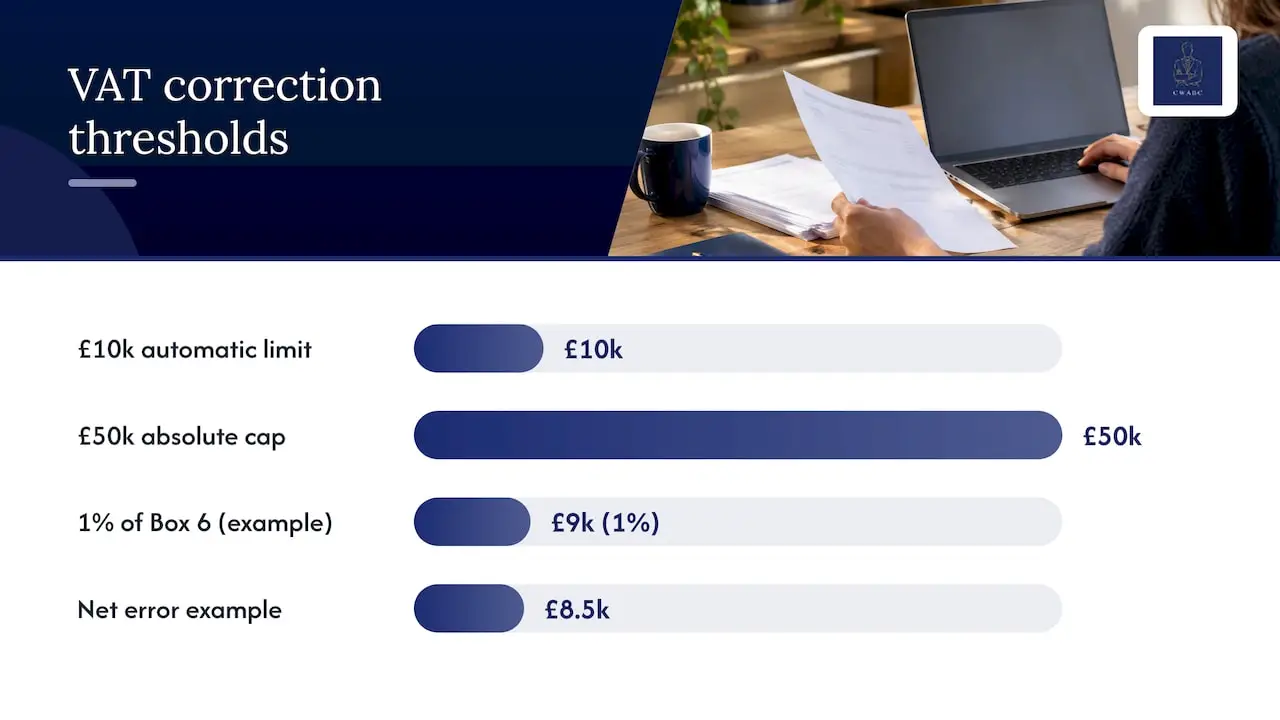
A few things catch people out here. First, adjusting through your return is a correction, not a formal disclosure for penalty purposes. If the error arose through carelessness, HMRC may still want to see that you’ve properly owned up to it, and a quiet adjustment on a VAT return doesn’t carry the same weight as a written notification when penalty mitigation is calculated. Second, you generally have four years from the end of the relevant accounting period to correct an error this way. Errors older than that usually fall outside the normal correction window, subject to the usual exceptions for deliberate behaviour.
If you’re unsure whether your figures clear these thresholds, our guide on fixing VAT return errors online walks through the mechanics in more detail.
Method 2: when you must notify HMRC separately
Some errors can’t be tucked quietly into your next return. You need to notify HMRC directly, in writing, when any of the following apply:
- The net error exceeds the £10,000 / 1% / £50,000 tests described above.
- The total net error is more than £50,000, regardless of what percentage that represents of your turnover.
- The error was deliberate, meaning you knowingly submitted incorrect figures rather than making an innocent mistake.
Your notification needs to give HMRC a clear picture, not just a number. Include the VAT periods affected, a plain explanation of how the error happened, the amount of VAT understated or overstated for each period, your calculations, and copies of the supporting evidence you gathered during your initial review.
There’s an important distinction worth understanding before you write anything: unprompted disclosure, where you come forward before HMRC has any reason to suspect a problem, is treated far more favourably than prompted disclosure, where HMRC raises the issue first, perhaps during a VAT inspection. Coming forward early, with a complete and honest account, is one of the strongest things you can do to reduce your penalty exposure.

A practical note on paperwork: the old VAT652 form is no longer in use. HMRC’s current guidance directs you to its online error correction service or a written notification following the format it sets out, so check the live GOV.UK page rather than relying on an old template you might have saved.
Penalties, behaviour and disclosure: how HMRC assesses inaccuracies
Once HMRC knows about an error, it has to decide whether a penalty applies, and if so, how much. This comes down to behaviour, not just the size of the mistake.
Reasonable care means you took the steps a prudent, organised business owner would take, checking figures, keeping records and applying VAT rules sensibly. Genuine, one-off slips made despite reasonable care generally attract no penalty at all. Careless errors happen when reasonable care wasn’t taken, perhaps a VAT rate was applied without checking, or a return was submitted without a proper review. Deliberate inaccuracies involve knowingly submitting incorrect figures, which HMRC treats far more severely.
The HMRC compliance handbook sets penalty ranges by behaviour, then adjusts them further depending on how and when you disclosed the error.
| Behaviour | Disclosure type | Typical penalty treatment |
|---|---|---|
| Reasonable care | Not applicable | No penalty |
| Careless | Unprompted | Lower end of the careless penalty band |
| Careless | Prompted | Higher end of the careless penalty band |
| Deliberate | Unprompted | Reduced, but still substantial |
| Deliberate | Prompted | Highest penalty band |
A point that trips people up: correcting the error does not automatically remove the penalty. The correction fixes the VAT position; the penalty, if one applies, is a separate question that depends on behaviour and disclosure quality. Cooperating fully, answering HMRC’s questions promptly and providing clear evidence can all help reduce a penalty once it’s been raised, and you do have the right to ask for an internal review or appeal a penalty you think is wrong. For anything beyond a straightforward careless error, it’s worth getting professional input before you respond to HMRC in writing.
Time limits, interest and late-payment penalties explained
It helps to separate three things that often get muddled together: the time limit for correcting an error, the interest charged on the correction, and any penalty for paying VAT late.
- You generally have four years from the end of the relevant accounting period to correct an error, with longer periods possible where HMRC suspects deliberate behaviour.
- Default interest, covered in VAT Notice 700/43, can apply when you correct an error that increases your VAT bill, and HMRC may charge this regardless of how small the amount is, since the previous small-value exemption has been withdrawn.
- Late-payment interest and penalties are a different mechanism entirely, triggered when you simply pay VAT late rather than correct a past error.
HMRC charges late-payment interest at the Bank of England base rate plus 4%, and separate penalty surcharges can apply from 15 days overdue, rising again at 30 days and accruing daily after that. This is distinct from the default interest charged on an error correction, which is calculated as commercial restitution for the time HMRC was out of pocket, not as a penalty for lateness.
One practical warning worth repeating: don’t rush to pay or notify before you’ve checked your figures properly. Tribunal decisions have confirmed that an incorrect voluntary payment can affect your ability to claim statutory interest later if it turns out you overpaid. Take the time to verify the error first.
If a correction increases what you owe, plan for the cash impact early. HMRC does offer time-to-pay arrangements in genuine hardship cases, but you’ll need to ask before the debt becomes unmanageable, not after.
Step-by-step: how to correct an error and reduce your risk going forward
Once you understand which route applies, the actual process follows a fairly consistent pattern.
- Establish the facts. Record the discovery date, who found the error and a short account of what happened, while the details are still fresh.
- Quantify the error. Work out the net value by period and check it against your Box 6 figure for the period of discovery, exactly as described in the return adjustment tests above.
- Assemble your evidence. Gather invoices, system reports and bank records, and write a contemporaneous note explaining the cause and any steps you’ve already taken to fix it.
- Choose your route. If you’re within the £10,000 / 1% / £50,000 limits, adjust your next return. If not, prepare a written notification covering the affected periods, the cause, the VAT amounts involved, your workings and your supporting documents.
- Settle up. Pay the VAT due plus any interest, or contact HMRC about a time-to-pay arrangement if the amount is significant. Keep proof of payment and every piece of correspondence.
- Close the loop. Reconcile your VAT control account, review what went wrong in your bookkeeping system, and put a simple check in place, such as a second review before filing, so the same mistake doesn’t happen again.
Pro Tip: A short written procedure for who checks VAT figures before filing, even a single page, is often enough to stop the same error recurring next quarter.
If your accounting software setup contributed to the error, our guide on moving from spreadsheets to cloud accounting covers common configuration issues that trip up VAT coding.
Chris White’s practical perspective: common causes and how I help
Most VAT errors I come across trace back to a handful of recurring causes: a Making Tax Digital setup that wasn’t configured correctly from day one, a VAT rate applied to the wrong product or service, a coding mistake in the bookkeeping software, or an invoice that simply got missed during a busy quarter.
Fixing the number is only half the job. Professional help can assist in working out exactly how the error happened, preparing the calculations HMRC expects to see, drafting the notification where one is needed and correcting the underlying control so it doesn’t happen again. My VAT return explained guide covers the Box 6 mechanics in plain terms if you want the background first.
— Chris
How I can help: fixing VAT errors and preventing repeats
Finding a VAT error is stressful enough without having to decode HMRC’s own guidance at the same time. I offer a straightforward first step: a review of the figures and the affected returns, so you know exactly which route applies and what the correction will cost before you commit to anything.

From there, I can prepare the workings, draft a notification if one’s required, and sort out the bookkeeping issue that caused the error in the first place.
- VAT returns: ongoing preparation and filing, with error checks built into the process.
- Bookkeeping services: a clean-up of your ledgers if the error points to a wider system problem.
- Accounting software setup and training: sorting out the Xero, QuickBooks or FreeAgent configuration behind a recurring VAT coding mistake.
- Making Tax Digital support: making sure your digital links and record keeping meet current requirements.
Get in touch through my contact page and I’ll talk you through what the next few weeks need to look like.
FAQ
How can I correct VAT errors with HMRC?
You correct small errors directly on your next VAT return if they fall within the £10,000, 1% and £50,000 tests set out in VAT Notice 700/45. Larger or deliberate errors need a separate written notification to HMRC rather than a return adjustment.
What are the penalties for VAT errors corrected by HMRC?
Penalties depend on behaviour rather than the correction itself: reasonable care usually means no penalty, careless errors sit within a percentage band, and deliberate inaccuracies attract higher percentages, as set out in HMRC’s compliance handbook. Disclosing the error before HMRC asks about it generally reduces the penalty compared with being prompted.
How far back can you correct a VAT error?
You can usually correct errors going back up to four years from the end of the relevant accounting period, under the time limits in VAT Notice 700/45. Deliberate inaccuracies can allow HMRC a longer assessment window.
How do I correct a mistake on my VAT return?
The old VAT652 form is no longer used; HMRC’s current guidance explains the routes available now.
Need help?
If you’ve spotted a VAT error and aren’t sure which route to take, get in touch through my contact page and I’ll help you work out the correction and what it means for your VAT position.