Sole traders, business partners, and shareholders who are also officers or employees of their “personal company” can qualify for Business Asset Disposal Relief, provided they meet the two-year ownership test. From 6 April 2026, qualifying gains are taxed at 18%, up from 14% between 6 April 2025 and 5 April 2026, and 10% before that. Relief applies only up to a lifetime limit of £1 million.
TL;DR:
- To qualify for Business Asset Disposal Relief, sole traders and partners need to own their business for at least two years, while shareholders must meet strict voting and economic interest tests.
- The applicable tax rate rises from 14% to 18% on or after April 6, 2026, with a lifetime limit of £1 million on gains for qualifying disposals.
- Completing the claim correctly requires precise timing, proof of ownership, and verification that the business is a trading entity, with special rules for associated asset sales.
- Selling shares through EMI schemes can exempt you from the 5% ownership requirement if the options were exercised at least two years before sale, assuming other conditions are met.
- Ensuring all criteria, such as ownership period, trading status, and linked disposals, are fully supported with records before signing sales agreements is critical to avoiding HMRC disputes.
Table of Contents
- Who is eligible: sole traders, partners, shareholders and trustees
- The core qualifying tests: ownership, trading and timing
- Share disposals: the 5% tests and EMI exceptions
- Associated disposals: why a single asset sale rarely qualifies alone
- Rates, the lifetime limit and anti-forestalling for 2026-27
- How to claim, deadlines and records to keep
- Practical pitfalls and a simple worked example
- When to get an accountant: how I can help
- Plan early, don’t rely on assumptions
- How I can help with a BADR check and claim
- Sources
- FAQ
Who is eligible: sole traders, partners, shareholders and trustees
If you run your own business as a sole trader, or you’re a partner in a partnership, you generally qualify for Business Asset Disposal Relief when you sell all or part of that business, provided you’ve owned it for at least two years before the sale.
Shareholders face a stricter test. Some trustees can claim relief too, but only in narrow circumstances tied to a beneficiary’s own qualifying interest in the business.
- Sole traders and partners: two years’ ownership, straightforward.
- Shareholders: 5% holding, officer or employee status, personal company test.
- Trustees: relief only where a qualifying beneficiary meets the conditions themselves.
- Companies and most discretionary trusts: excluded entirely from claiming.
The core qualifying tests: ownership, trading and timing
Three tests sit behind every Business Asset Disposal Relief claim, and missing any one of them can sink an otherwise sensible claim.
- The two-year qualifying period. You must have owned the business, shares, or assets for at least two years up to the date of disposal, according to HMRC’s HS275 helpsheet. This period ends on the actual completion date, not the date contracts were signed or heads of terms agreed.
- The trading test. The business, or the company whose shares you’re selling, must be a trading company, not one mainly holding investments. A holding company qualifies if the group as a whole is “substantially” trading.
- The three-year cessation window. If you’ve closed the business rather than sold it, you still have up to three years from cessation to make the qualifying disposal and claim relief, provided you met the ownership and trading conditions right up to closure.
Get any of these dates wrong and HMRC can, and does, challenge the claim later.
Share disposals: the 5% tests and EMI exceptions
Selling shares brings extra hurdles beyond simple ownership length. From 29 October 2018, HMRC added economic interest tests on top of the basic voting rights check, closing a loophole where shareholders held nominal voting power without real financial stake.
- You need at least 5% of ordinary share capital and 5% of voting rights.
- You also need entitlement to at least 5% of profits available for distribution and 5% of assets on a winding up, under the personal company rules.
- You must be an officer (such as a director) or an employee of the company throughout the two-year period. There’s no minimum-hours test, but the role must be genuine.
- Shares acquired through an Enterprise Management Incentive (EMI) scheme have their own route: you don’t need the 5% holding if the shares were acquired through EMI options exercised at least two years before disposal, though the officer or employee condition still applies.
Shareholder agreements matter here. If the articles or a side agreement quietly strip your entitlement to capital on a winding up, you may fail the economic interest test even while holding exactly 5% of the votes on paper.
Associated disposals: why a single asset sale rarely qualifies alone
Selling a business asset on its own, separately from selling the business or your shares, does not automatically bring Business Asset Disposal Relief. It only qualifies as an “associated disposal” if it’s genuinely linked to a material disposal of your interest in the business.
- The material disposal must itself meet the qualifying tests (typically at least 5% of shares or your partnership interest).
- There must be no arrangements to reacquire the asset or an interest in it after the sale.
- A property let out to your own trading company doesn’t qualify simply because you also happen to be a shareholder; the timing and connection to your withdrawal from the business both matter.
A common non-qualifying scenario is selling an investment property held personally, separate from any business exit. That’s a standalone capital gain taxed at normal rates, not a BADR disposal.
Pro Tip: If you’re selling business premises separately from your shares, do it at the same time as, or shortly after, your material disposal, and keep dated evidence linking the two. A gap of several years without a connecting event usually fails the associated disposal test.
Rates, the lifetime limit and anti-forestalling for 2026-27
The rate that applies depends entirely on your disposal date. Gains from disposals made on or before 5 April 2025 were taxed at 10%. Disposals between 6 April 2025 and 5 April 2026 attract 14%. From 6 April 2026 onwards, the rate rises to 18%, as set out in Finance Act 2025.
The lifetime limit stands at £1 million for qualifying gains on disposals made on or after 11 March 2020, confirmed in HS275. There’s no transitional uplift for gains that straddle the rate changes; you simply apply whichever rate was in force on the actual completion date. That makes the disposal date itself a live issue. HMRC scrutinises deals structured, or delayed, purely to catch a lower rate, so completion timing needs to reflect genuine commercial reality, not tax planning dressed up as coincidence.
How to claim, deadlines and records to keep
Business Asset Disposal Relief isn’t given automatically; you have to claim it. Most people do this through their Self Assessment tax return for the year of disposal, though a separate written claim is available where needed.
The deadline is fixed and unforgiving: you must claim by the first anniversary of 31 January following the end of the tax year in which the disposal happened. For a disposal in the 2026-27 tax year, that means claiming by 31 January 2029, as HMRC’s claim guidance confirms.
Keep the following to hand before you claim:
- Sale contracts and completion statements showing the exact disposal date.
- Share certificates or partnership agreements evidencing your holding and dates acquired.
- Company accounts or board minutes confirming officer or employee status.
- Records of any earlier BADR claims, so you can track your remaining lifetime limit.
Practical pitfalls and a simple worked example
The mistakes I see most often are avoidable: misdating the disposal, overlooking the associated disposal rules on a linked property sale, and failing to keep evidence of the economic interest tests introduced in October 2018. Informal shareholder arrangements that don’t confer real entitlement to capital are a recurring trap.
Her gain is £900,000. Because the disposal falls after 6 April 2026, and assuming all qualifying conditions are met, relief would apply at 18% on the full £900,000, since it sits within her £1 million lifetime limit. This is illustrative only; it doesn’t confirm eligibility or guarantee any tax outcome for a real disposal.
| Check before selling | Why it matters |
|---|---|
| Confirm the exact completion date | Determines which rate applies |
| Verify 5% holding and economic interest | Both tests must pass, not just voting rights |
| Review any linked asset sales | Associated disposal rules may apply |
| Total up prior BADR claims | Confirms remaining lifetime limit |
When to get an accountant: how I can help
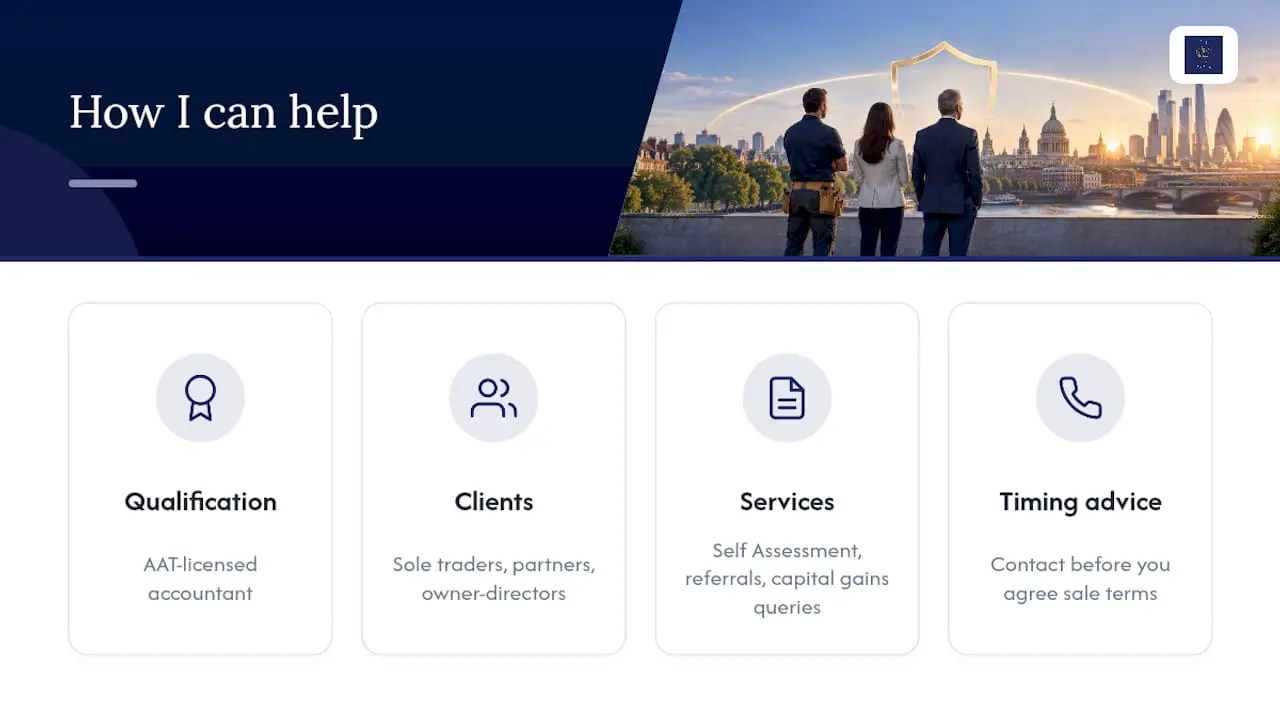
I’m AAT-licensed and support sole traders, partners and owner-directors across Tonbridge, Sevenoaks, Kent and remotely with Self Assessment Tax Returns and referral partnerships and capital gains queries. Checking the personal company tests and associated disposal conditions before you sign anything is where most claims are won or lost. If you’re weighing up a sale, get in touch before you agree terms, not after.
Plan early, don’t rely on assumptions
The biggest risk I see isn’t ignorance of the rate, it’s assumption. Evidence and dates decide claims, not intent. Get a professional review before you agree a sale, not once it’s already signed.
— Chris
How I can help with a BADR check and claim
Selling or closing a business is stressful enough without second-guessing whether you’ll actually get the relief you’re expecting. I offer a straightforward first review that checks your qualifying period, personal company tests, and any associated disposals against HMRC’s current rules, so you know where you stand before you commit to anything.
A first review typically covers a checklist against the ownership and trading tests, a look at your shareholder agreement or partnership terms, and clear guidance on timing relative to the 2026-27 rate change. I also help with the claim itself through Self Assessment Tax Returns, and with broader capital gains and accounting support if your situation involves property, shares, or a mix of both. If you’re planning a sale in the near future, get in touch before you sign anything, so we can check the numbers and the dates line up.
FAQ
Who is eligible for Business Asset Disposal Relief?
Some trustees qualify too, in narrow circumstances tied to a beneficiary’s own interest.
Is BADR still 10%?
No. The 10% rate only applied to disposals made on or before 5 April 2025. The rate rose to 14% for disposals between 6 April 2025 and 5 April 2026, and it rises again to 18% for disposals from 6 April 2026 onwards.
What is the lifetime limit for BADR in 2026-27?
The lifetime limit remains £1 million for qualifying gains on disposals made on or after 11 March 2020, as confirmed by HMRC. Once you’ve used up £1 million across all your qualifying claims, further gains are taxed at the standard Capital Gains Tax rates.
What are the requirements to qualify for Business Asset Disposal Relief?
Associated disposals need a genuinine link to a qualifying material disposal, with no arrangement to reacquire the asset afterwards.
Does selling a rental property qualify for BADR?
Usually not. A standalone investment property sale is a normal capital gain, not a Business Asset Disposal Relief claim, unless it’s genuinely tied to a qualifying material disposal of your business interest. If you’re a landlord weighing up a sale, it’s worth reading about landlord capital gains tax considerations separately from BADR.