The Rent a Room Scheme lets you earn up to £7,500 a year, tax free, from letting furnished rooms in your own home, dropping to £3,750 each if you share the income with a partner or joint owner. Below that allowance, the exemption is automatic. If you exceed it, you must complete a Self Assessment return and choose how the excess is taxed. This guide walks through eligibility, the two calculation methods, reporting deadlines, and a worked example.
TL;DR:
- If your gross receipts exceed £7,500, you must complete a Self Assessment return and compare actual expenses versus the flat allowance to choose the most tax-efficient method.
- Sharing the property with a partner reduces the individual allowance to £3,750, but household combined relief might benefit multiple owners.
- Expenses such as utilities, insurance, and repairs can make Method A more advantageous than the flat £7,500 deduction, especially if costs are high.
- For joint ownership, each person can claim their own allowance, making combined relief potentially higher than a single owner’s limit.
- Good record-keeping of all receipts and shared costs simplifies choosing the best taxation method and reduces errors during HMRC inspections.
Table of Contents
- How the rent a room scheme works
- Who qualifies for the rent a room scheme?
- What happens if receipts exceed the allowance?
- When and how do you report to HMRC?
- A worked example: Method A vs Method B
- Why this isn’t the same as buy-to-let income
- Practitioner checklist for room-letting bookkeeping
- What the rules actually mean for you
- How I can help with your rent a room bookkeeping
- Where to check the rules yourself
- Sources
- FAQ
How the rent a room scheme works
The scheme covers furnished accommodation let in your own only or main home, whether that’s a spare bedroom to a lodger or several rooms to different tenants. It does not stretch to unfurnished lettings or to a self-contained flat with its own front door, because HMRC treats those as ordinary property income rather than room-sharing programmes run from inside your own household.
Gross receipts count for more than just the rent cheque. When working out whether you’re inside the £7,500 allowance, add together:
- Rent paid by the lodger or tenant
- Payments for meals, cleaning or laundry
- Charges for other services you provide, such as Wi-Fi or utilities
- Any balancing charges on furniture or equipment used in the letting
This total applies even if you only let the room for part of the year. Take on a lodger in October and the £7,500 threshold still applies in full for that tax year, not a pro-rated slice of it, according to HMRC’s overview of the scheme.
Who qualifies for the rent a room scheme?
You qualify if you’re a resident owner or tenant letting furnished rooms in the home you actually live in as your only or main residence. Landlords running the scheme through a company don’t qualify. It’s built for individuals, not for corporate structures.
Several common setups fall outside the rules, and it’s worth checking yours against this list before you assume the allowance applies:
- Unfurnished rooms, since the relief only covers furnished lettings
- Self-contained flats with separate access, even within the same building
- Rooms used mainly as a home office or for storage rather than for a lodger to live in
Where two or more people own the property jointly, each owner’s allowance drops to £3,750 rather than the full £7,500 being available to only one of them. Curiously, this can work in a household’s favour: LITRG notes that where a property has multiple owners, each can claim relief up to their own half-limit, meaning the combined household exemption can exceed what a sole owner would get.
Pro Tip: If you’re planning to take in more than one lodger, check whether your mortgage lender or insurer needs to be told first. Rent a Room tax treatment is separate from those obligations, and getting one right doesn’t cover the other.
What happens if receipts exceed the allowance?
Once gross receipts go over £7,500 (or £3,750 each if shared), you have a genuine choice about how the excess is taxed, and picking the wrong one can cost you money.
- Method A taxes you on actual profit, meaning receipts minus allowable expenses such as a share of utilities, insurance, repairs, and wear and tear on furnishings.
- Method B taxes you on gross receipts minus the flat £7,500 (or £3,750) allowance, with no expense deductions permitted at all.
HMRC’s HS223 helpsheet sets out both methods, and Method A applies by default unless you actively elect for Method B. That default matters: if your real expenses are modest, Method A can leave more of your income untaxed than the flat allowance would.
HMRC’s own guidance is blunt about the decision rule. Don’t reach for Method B automatically. Compare your deductible expenses against the £7,500 allowance first, because if expenses exceed the allowance, Method A usually produces a lower tax bill. Method B only wins when your costs are low and the flat deduction is more generous than what you could actually claim.
If you want to use Method B, you notify HMRC through your Self Assessment return. Once made, that election needs formally withdrawing if you later want to switch back to Method A.
When and how do you report to HMRC?
You need to complete a Self Assessment return if your gross receipts exceed the allowance, or if you want to opt out of the automatic exemption (for example, to claim a loss when expenses are unusually high). Below the allowance, no return is needed specifically for this income, as the exemption applies automatically.
A few deadlines and practical points are worth keeping in your diary:
- Elections to use Method B, or to opt out of the scheme, must be made within the relevant time limits.
- If you move house during the year and let rooms in both your old and new homes, HS223 confirms you add the receipts from both properties together for that tax year when checking the £7,500 limit.
- Keep evidence of gross receipts and any services provided, since HMRC can ask to see how you arrived at your figures.
My guide to property income tax returns covers exactly where this income sits on the property pages of your return.
A worked example: Method A vs Method B
Say you let a furnished room and receive £9,600 in rent over the year, plus £600 for shared meals and Wi-Fi, giving gross receipts of £10,200. Your actual costs, including a share of utility bills, contents insurance, and minor repairs, come to £1,400.
- Method A: £10,200 receipts minus £1,400 expenses equals £8,800 taxable profit.
- Method B: £10,200 receipts minus the £7,500 allowance equals £2,700 taxable.
Here, Method B clearly wins, since your real expenses of £1,400 are well below the £7,500 flat deduction. Flip that scenario, with expenses of £3,000 instead, and Method A drops taxable profit to £7,200, beating Method B’s £2,700 result the other way. The decision rule stays the same either way: compare actual expenses against the allowance before you elect anything. If you’re sharing the letting income with a partner, run the sums using £3,750 each rather than £7,500 for one person.
Why this isn’t the same as buy-to-let income
Rent a Room relief only applies to your own main residence. Let a separate investment property, whether that’s a second home, a flat you own down the road, or a room in a house you don’t personally live in, and you’re in ordinary property income territory instead, with different rules on allowable expenses and reporting.
A few red flags suggest Rent a Room treatment is the wrong fit:
- You’ve moved out and let the whole property, rather than living there alongside your lodger
- The letting is a separate, self-contained unit with its own access and facilities
- You’re running multiple lettings across different properties as a portfolio, which points towards standard buy-to-let treatment and its own expense rules
Mixing the two up is a genuine risk. Treating buy-to-let income as if it qualified for the £7,500 allowance can understate your tax bill and trigger a correction later, with interest attached. Flat Insurance’s guide to live-in landlords is a useful reference for the practical and legal distinctions between letting a room in your own home and running an investment property. My rental income tax guide covers how the standard property income calculation works if that’s the route your situation actually needs.
Practitioner checklist for room-letting bookkeeping
Good records make the Method A versus Method B decision straightforward instead of stressful. I’d suggest tagging your rent-a-room receipts separately from any other rental or business income the moment they land, whether you’re using a spreadsheet or a proper cloud ledger.
Keep a running log of shared costs, including your utility bills, contents insurance, and any repairs connected to the let room, even in years where you’re comfortably under the £7,500 allowance. HMRC’s digital record-keeping guidance sets out the standard it expects, and getting into that habit now saves a scramble later if your receipts creep over the threshold. My landlord bookkeeping guide walks through a simple system that works for one room or several.
Pro Tip: Get an accountant involved as soon as your expenses start creeping close to the allowance, rather than after year end. Once the tax year’s closed, your choice of method for that year is far harder to change.
What the rules actually mean for you
The conventional advice on this scheme tends to stop at “under £7,500, you’re fine,” and that’s technically true but practically incomplete. The real decision most people face isn’t whether they qualify. It’s which method to use once they’ve gone over the limit, and that choice gets treated as an afterthought far too often.
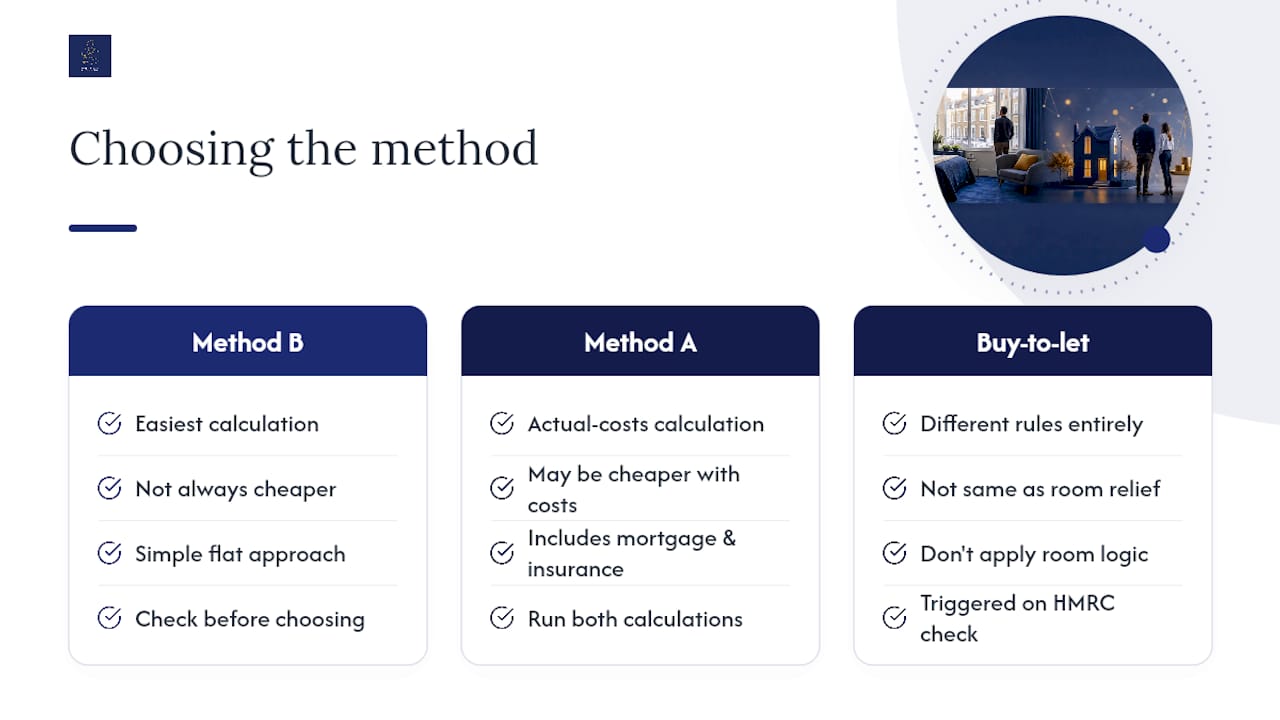
My view is that Method B’s simplicity is oversold. It’s the easier sum, no question, but easier isn’t the same as cheaper. Anyone with a mortgage, contents insurance, and a lodger sharing their utility bills should run both calculations before ticking a box on their return, because those costs add up faster than people expect.
The other gap I see regularly is conflating this relief with buy-to-let. They’re governed by entirely different rules, and applying room-letting logic to a separate investment property is a mistake that surfaces at the worst possible time, usually during an HMRC check. If you’re letting rooms in your own home, prioritise getting your record-keeping straight first. The tax decision follows naturally once you actually know your numbers.
— Chris
How I can help with your rent a room bookkeeping
If you’re weighing up Method A against Method B, or you’ve simply lost track of what counts as gross receipts once meals and Wi-Fi get added in, that’s the sort of untangling an accountant can do day to day for landlords and homeowners.
I offer rental bookkeeping set up properly from the start, Self Assessment preparation that gets your figures onto the right pages of your return, and support getting Making Tax Digital ready before it becomes compulsory for your situation. For anyone still juggling a spreadsheet or a shoebox of receipts, moving to a proper cloud accounting system such as Xero, QuickBooks or FreeAgent makes comparing Method A and Method B each year a five-minute job instead of a weekend one. My landlord bookkeeping guide is a good starting point if you want to see how that system works in practice. If you’d rather talk it through directly, get in touch and I’ll take it from there.
Where to check the rules yourself
For the official word, go straight to the source rather than relying on secondhand summaries:
- Gov
- HMRC HS223 Rent a Room Scheme helpsheet
- HMRC Property Income Manual, PIM4001 and PIM4030
- MoneyHelper: Rent a Room scheme explained
This article is general information, not a substitute for advice from a qualified financial advisor. Consult a qualified financial professional about your own circumstances before acting on anything here.
Sources
FAQ
How do I qualify for the Rent a Room Scheme?
You qualify by letting a furnished room in your own only or main home as an individual, not through a company; separate flats and unfurnished lettings are excluded.
How much rent should I charge for a room in the UK?
There’s no fixed figure, but many homeowners aim to stay near or under the £7,500 annual allowance (£3,750 if shared) to keep the income tax free without extra reporting.
Do I need to tell HMRC if I rent a room?
Only if your gross receipts exceed £7,500 (or £3,750 each if shared), or if you want to opt out of the automatic exemption; below that, no return is needed for this income.
Is the Rent a Room Scheme worth it?
For most people letting a single room in their own home, yes, since the allowance covers the income tax free automatically, though anyone with expenses above the threshold should compare Method A and Method B before assuming the flat allowance is best.