
The VAT deregistration threshold is just below the registration threshold, which is around £90,000. If your taxable turnover drops below the deregistration threshold, you can ask HMRC to cancel your registration, but nothing happens automatically. You need to apply, either through your VAT online account or by post using form VAT7, before the paperwork stops.
TL;DR:
- Moving from a recent turnover of over £90,000 to a forecast below £88,000 justifies voluntary deregistration if backed by solid evidence like lost contracts or reduced trading hours.
- The forward-looking deregistration threshold is set deliberately below the registration level to prevent businesses from bouncing in and out of VAT registration unnecessarily.
- Businesses must apply either online or by post before their deregistration takes effect, and they should continue VAT filing until HMRC confirms the official cancellation date.
- Deregistering assets or stock on which input VAT was reclaimed may trigger an exit charge unless the VAT due falls below the £1,000 threshold.
- Opting out of VAT registration is more beneficial for consumer-facing businesses than VAT-registered companies, especially when factoring in upcoming capital expenditures.
Table of Contents
- Understanding the VAT registration and deregistration thresholds
- Who can deregister: compulsory and voluntary grounds
- How to apply for VAT deregistration and get the timing right
- Final VAT return, VAT on assets and what to keep afterwards
- Weighing the commercial pros and cons before you deregister
- A worked example and quick action checklist
- What I see go wrong, and what actually helps
- Why the standard advice on deregistering falls short
- How I can help with VAT deregistration
- Sources
Understanding the VAT registration and deregistration thresholds
The two figures work together but measure different things. The registration threshold catches you when your taxable turnover, VAT exclusive, exceeds a certain level over any rolling 12 month period, not just your accounting year. The deregistration threshold looks forward instead: HMRC wants a credible forecast that your taxable turnover for the next 12 months will stay under a lower level.
The small gap between the registration and deregistration thresholds is intentional. It stops businesses hovering right at the line from bouncing in and out of VAT registration every few months, which would create unnecessary administrative churn for both sides. The gap has applied since these thresholds last moved on 1 April 2024, and it has held steady since.
A few practical points worth flagging:
- Taxable turnover means VAT-exclusive sales of standard, reduced and zero-rated goods and services, not your total income.
- The registration test is backward-looking (the last 12 months); the deregistration test is forward-looking (the next 12 months).
- Non-established taxable persons (overseas businesses with no UK establishment) do not get the usual threshold protection and must register regardless of turnover.
Who can deregister: compulsory and voluntary grounds
Deregistration falls into two distinct categories, and mixing them up is one of the more common errors I see.
- Compulsory deregistration applies when you stop trading altogether, sell or transfer the whole business as a going concern, join a VAT group, or change legal structure (say, moving from sole trader to limited company). In each case you must tell HMRC within 30 days of the change; missing that window can trigger penalties.
- Voluntary deregistration applies when you expect taxable turnover to fall below £88,000 over the next year, when your supplies are mainly zero-rated (so registration brought little benefit), or when you registered voluntarily in the first place and now want out.
HMRC will not simply take your word for it. VAT Notice 700/11 sets out what evidence it expects, and retailers face extra scrutiny: if you deregister voluntarily, you are expected to reduce shelf prices by the VAT element rather than pocket the difference. Common objections from HMRC include forecasts that look optimistic against recent trading history, or a pattern of seasonal spikes that suggest turnover will bounce back over £88,000 within the year.
How to apply for VAT deregistration and get the timing right
Most businesses apply online through their VAT account, and it is usually the faster route. Postal applications use form VAT7, which is still necessary for certain cases, such as some partnership changes or where online access is not available.
Whichever route you use, HMRC generally wants:
- A clear reason for deregistering (ceased trading, turnover forecast, business sale, and so on).
- A 12 month forward-looking turnover forecast, with supporting evidence such as lost contracts, reduced trading hours, or a signed sale agreement.
- Your VAT registration number and the date you want deregistration to take effect.
Online applications are often processed in around three weeks, though postal applications can take longer. For compulsory cancellations, HMRC applies a 30-day notification rule and will set the effective date of cancellation (EDC) based on when you stopped being eligible to register.
Pro Tip: Keep filing and paying VAT as normal until HMRC formally confirms your effective date of cancellation. Stopping early because you assume approval is coming is a mistake that can leave you exposed to penalties for late or missing returns.
Final VAT return, VAT on assets and what to keep afterwards
Once HMRC confirms your effective date of cancellation, you submit one last VAT return covering the period up to that date, then stop charging VAT from that day onward. That sounds straightforward until you reach the deemed supply rules.
If you hold business assets or stock on which you reclaimed input VAT, deregistering can trigger an “exit charge.” You may need to account for output VAT on the value of goods still owned at the point of deregistration, unless the total VAT due on those assets falls below the £1,000 de minimis threshold set out in VAT Notice 700/11. This catches equipment, unsold stock and, in some cases, commercial property.
Afterwards:
- Keep VAT records for six years, even though you are no longer registered.
- Continue any Making Tax Digital record-keeping habits if you expect to re-register later.
- Think carefully before large capital purchases in the run-up to deregistering, since you will lose the ability to reclaim input VAT on them once you are out.
Weighing the commercial pros and cons before you deregister
Deregistering removes a genuine administrative burden: no more quarterly returns, no VAT compliance checks on invoices, one less deadline to track. But whether it actually benefits your business depends heavily on who buys from you.
If most of your customers are VAT-registered businesses, they reclaim the VAT you charge anyway, so deregistering rarely wins you new work; it just costs you the ability to recover VAT on your own purchases. If you sell mainly to consumers, removing VAT from your prices can make you meaningfully more competitive, particularly in price-sensitive sectors.
Before deciding, model the cashflow impact properly:
- Total the input VAT you currently reclaim on stock, tools, rent and overheads over a typical year.
- Compare that against what you would save in bookkeeping time and adviser fees.
- Factor in any planned capital expenditure. Staying registered to recover VAT on a big purchase can outweigh the admin saving from deregistering.
Pro Tip: If you are within 12 months of a significant purchase, such as a van, machinery or a shopfit, staying registered to recover that input VAT often works out better financially than deregistering early.
Once you decide, update your pricing, invoice templates and any customer-facing terms so nobody is confused about why VAT has disappeared from your invoices.
A worked example and quick action checklist
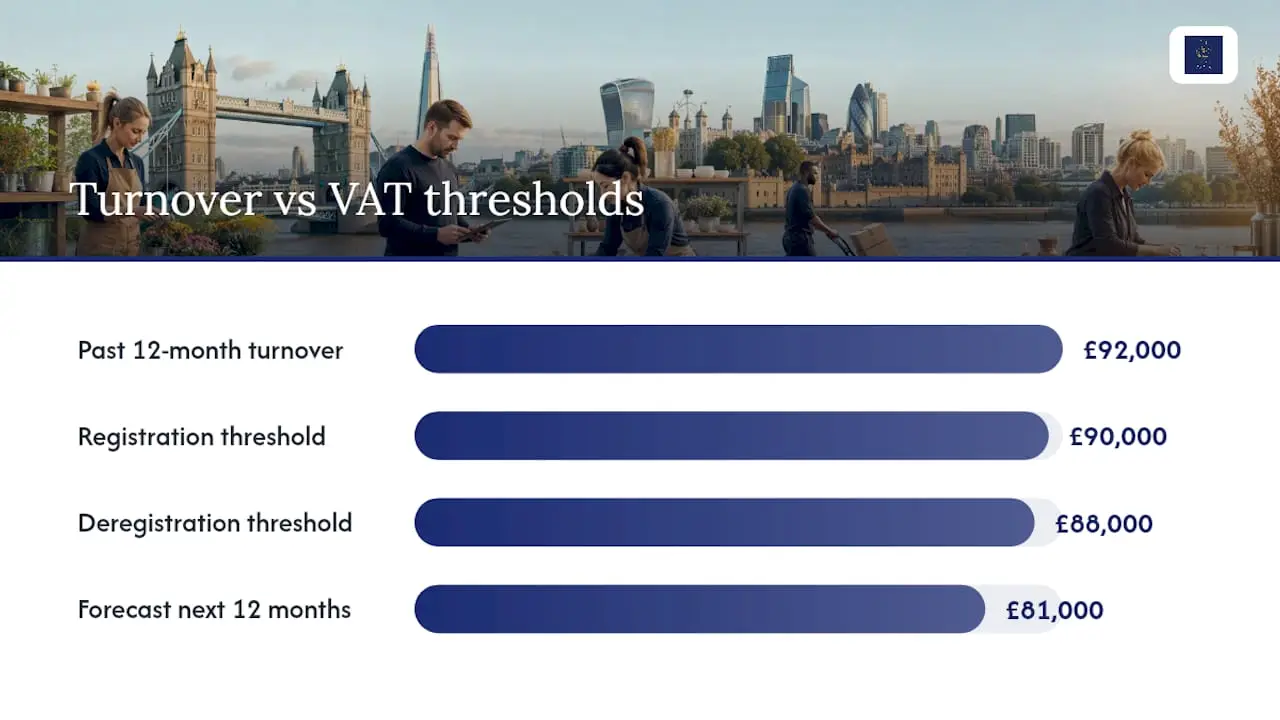
Picture a sole trader whose turnover over the last 12 months came to £92,000, comfortably above the £90,000 registration line. Trade has slowed, though, and the forecast for the next 12 months sits at £81,000, well under the £88,000 deregistration threshold. That is a legitimate basis for voluntary deregistration, provided the forecast is backed by evidence, such as a lost retail contract or reduced opening hours.
Once HMRC agrees an effective date of cancellation, the trader submits a final return to that date, checks whether stock or equipment on hand triggers a deemed supply charge, and then updates pricing before the next invoice goes out.
- Build a realistic 12 month turnover forecast with supporting evidence.
- Choose your application route: online VAT account or postal VAT7.
- Keep filing VAT returns until HMRC confirms the effective date.
- Check stock and assets for any VAT due under the deemed supply rules.
- Revise pricing and invoice templates ahead of the change.
- Retain VAT records for six years after deregistration.
| Step | Action | Why it matters |
|---|---|---|
| Forecast | 12 month turnover projection with evidence | HMRC needs proof, not just a hunch |
| Apply | Online VAT account or VAT7 by post | Sets the process in motion |
| Keep filing | Continue returns until EDC confirmed | Avoids late filing penalties |
| Check assets | Review stock and equipment for deemed supply | Prevents a surprise VAT bill |
What I see go wrong, and what actually helps
The mistake I come across most often is business owners assuming that because last year’s turnover dropped, they are automatically clear to deregister. HMRC’s test looks forward, not back, so a single quiet quarter proves very little on its own. The second common slip is forgetting about VAT on assets entirely, then being surprised by a final return that includes an unexpected output VAT charge on unsold stock or equipment still on the books.
What tends to work well: build your forecast from actual, current-year figures rather than extrapolating from a bad month, and use cloud accounting software to pull a clean, dated turnover trend rather than reconstructing it from memory. If you are a sole trader unsure where your numbers sit against the thresholds, that trend data is exactly what supports a deregistration application.
Before any meeting with an adviser, bring your last 12 months of VAT returns, a rough forecast for the year ahead, and a list of any significant assets or stock you are still holding. That single sheet answers most of the questions I need to ask anyway.
Why the standard advice on deregistering falls short
Most guidance treats deregistration as a pure numbers exercise: turnover drops below £88,000, form filled in, job done. In practice, the decision is as much commercial as it is administrative, and that gets underweighted constantly.
The bigger question is rarely “am I eligible” but “should I bother,” and the honest answer depends on your customer mix far more than your turnover trend. A tradesperson billing mostly VAT-registered contractors gains almost nothing from deregistering, since input VAT recovery on tools and materials often outweighs the saved admin. A consumer-facing retailer in a price-sensitive market can genuinely benefit from dropping prices by the VAT element.
Where conventional advice really falls down is on timing around capital spend. I have seen businesses rush to deregister the same month they were planning a major equipment purchase, losing input VAT recovery worth far more than the admin saving they were chasing. Forecast first, check your asset position second, and only then decide whether the paperwork is worth submitting.
— Chris
How I can help with VAT deregistration
Working out whether deregistering genuinely suits your business, rather than just whether you are eligible, is where a second pair of eyes pays off. I support with VAT returns, turnover forecasting, and deregistration applications handled properly from the first forecast through to the final return.

A typical session covers recent turnover trends, a realistic forward forecast, and a check on any stock or assets that might trigger VAT at deregistration. If you are weighing this decision, or need help with an existing VAT return, get in touch through my contact page and I will talk you through the next steps.