
The VAT Flat Rate Scheme trades bookkeeping simplicity for a fixed slice of your turnover paid to HMRC, and whether that trade works in your favour depends entirely on how much VAT you’d normally reclaim on purchases. Watch three figures: the £150,000 VAT-exclusive turnover limit to join, the VAT-inclusive limit that forces you out, and the limited cost trader rate that catches most low-expense service businesses. Capital assets over the threshold stay reclaimable as normal.
TL;DR:
- The scheme’s benefit depends on low VAT reclaimable expenses; higher input VAT on equipment or supplies can make standard VAT accounting more advantageous.
- Businesses with significant stock or goods purchases typically gain more from FRS, while pure service providers often find it less beneficial due to the limited cost trader rules.
- If your VAT-inclusive turnover exceeds £230,000 in any rolling 12 months, you must leave the scheme within 30 days to avoid tax treatment issues.
- Choosing the correct sector rate and running both flat rate and standard VAT calculations with actual data ensures accurate comparison before joining or staying in the scheme.
- The scheme favors simple, goods-heavy businesses with modest reclaimable VAT but can be a drain for low-expense service companies; running a tailored analysis is essential.
Table of Contents
- How does the flat rate VAT scheme actually work?
- Who can join, and how does the £150,000 limit work?
- What’s the real calculation, and does it beat standard VAT?
- Why does the limited cost trader rate catch so many service businesses?
- Where do I find my sector rate, and how does the first-year discount work?
- How do I apply, and what changes on my VAT return?
- When is the flat rate VAT scheme actually worth it?
- How I run an FRS comparison for a small business
- What’s the one rule of thumb I give small business owners?
- Get help comparing flat rate VAT against standard accounting
- Useful sources to check current rates and thresholds
How does the flat rate VAT scheme actually work?
Instead of tracking VAT on every purchase and reclaiming it, you apply a single percentage set by HMRC to your gross, VAT-inclusive turnover. Whatever you charge customers stays yours, minus that flat rate payment. You never file a separate reclaim for everyday running costs; the sector percentage already assumes a typical level of expense for your trade.
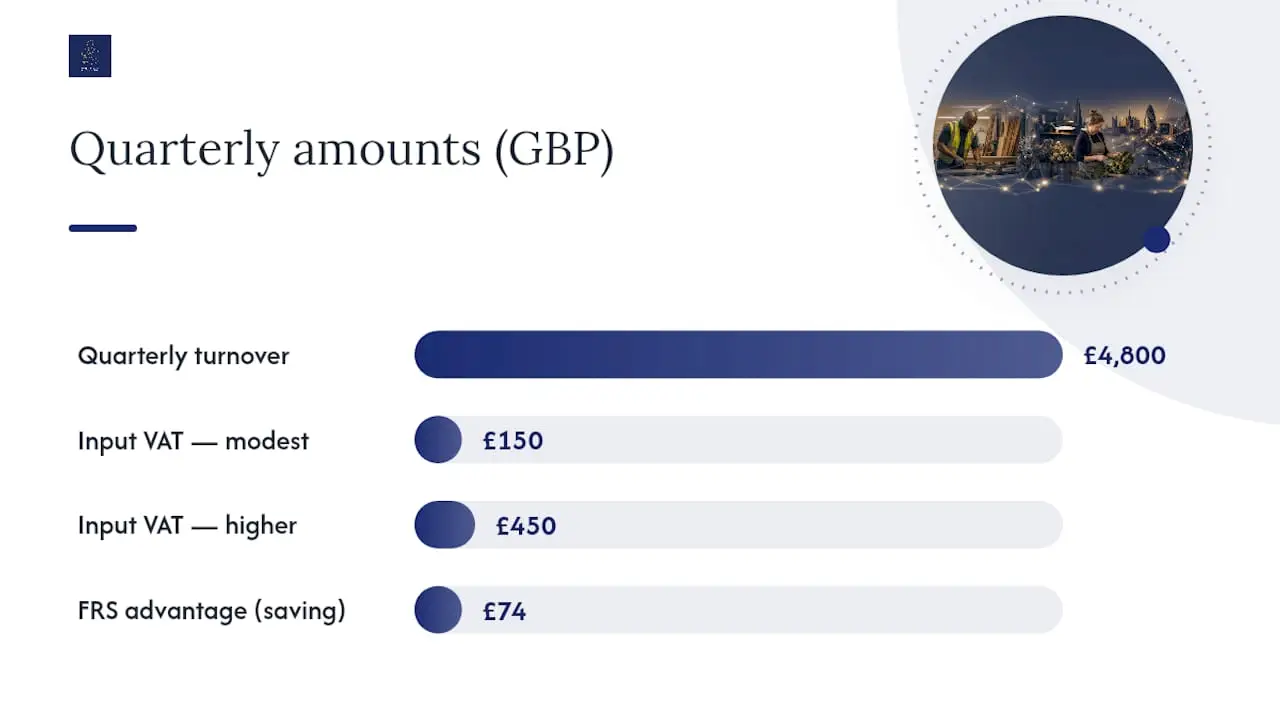
Say you invoice a client £1,200 including VAT. Under standard VAT accounting, you’d record £1,000 net sales and £200 output VAT, then deduct whatever input VAT you’d paid on materials, software or fuel. The remaining £56 that would have gone to HMRC under standard rules stays in your pocket, unless your input VAT would have been higher than that.
The scheme calculates flat rate turnover more broadly than you might expect. According to VAT Notice 733, flat rate turnover includes:
- Standard-rated, reduced-rated and zero-rated sales, all at their VAT-inclusive value
- Exempt income in many cases, depending on the nature of the supply
- Any sales you’ve made that fall within the scope of UK VAT during the accounting period
What stays outside the flat rate calculation:
- Sales of capital assets you’ve already accounted for separately
- Income from outside the scope of VAT altogether, such as certain grants
- Private or non-business income unrelated to your trade
There’s one meaningful exception to the “no separate input VAT” rule. Buy a £2,400 laptop and you can still claim the VAT element back, even while your day-to-day sales sit under the flat rate.
Reverse charge rules add a wrinkle worth flagging early. If you’re a contractor caught by the domestic reverse charge for construction services, or you import services from overseas suppliers, those transactions are usually excluded from your flat rate turnover and need separate VAT treatment. This is one of the areas where FRS stops being simple, and it’s worth checking against your own invoicing before assuming the flat percentage covers everything.
Who can join, and how does the £150,000 limit work?
You can join the Flat Rate Scheme if your estimated taxable turnover for the next 12 months is £150,000 or less, excluding VAT (https://www.gov.uk/vat-flat-rate-scheme/who-can-join). This is the figure that trips people up most often, because it’s a different number from the general VAT registration threshold, and it’s calculated differently too.
- Check your taxable turnover, not your total income. Taxable turnover means VATable sales, excluding VAT itself, over the coming year, not your total business income or profit.
- Confirm you’re not linked to another business. You cannot join if you’re associated with another business also using the scheme, or if you’ve left the scheme in the last 12 months.
- Rule out certain sectors and structures. Some businesses, including those already using another VAT special scheme, are excluded, so it’s worth checking your specific circumstances against current HMRC guidance rather than assuming eligibility.
- Compare this to your VAT registration position separately. The general VAT registration threshold is a different figure entirely, and being registered for VAT doesn’t automatically mean you’re within the FRS joining limit. My guide to the sole trader VAT threshold explains how registration itself works, which is worth reading alongside this one.
Leaving the scheme has its own trigger, and it catches people out because it’s based on a different measure again. You must leave if your VAT-inclusive turnover for the previous 12 months exceeds £230,000, or if you expect it to exceed that figure in the next 30 days alone, under VAT Notice 733. Notification to HMRC is required within 30 days of the date you knew, or should have known, that you’d breach the limit.
A seasonal retailer who has a spike in December sales, for example, needs to check their rolling 12-month VAT-inclusive turnover after each strong month, not just at their year end. Leaving late doesn’t just risk a telling-off; it can affect how HMRC treats VAT already charged during the period you should have left.
What’s the real calculation, and does it beat standard VAT?
HMRC recognises three accepted ways to work out your flat rate turnover, and the one you choose can shift your figures slightly:
- Basic (accruals) method: based on invoices issued and received during the VAT period, the most common default.
- Cash-based method: based on money actually received and paid, useful if your customers pay slowly.
- Retailer’s method: designed for businesses using retail schemes, based on daily gross takings.
Most sole traders and small limited companies use the basic method unless cash flow timing makes the cash-based version clearly more accurate for them.
That £74 advantage only holds because this designer has modest expenses, roughly £150 of input VAT on a £4,800 quarter. Push the input VAT up to £450, perhaps because they’ve bought new equipment or subcontracted heavily, and standard accounting suddenly wins by a wide margin. This is the entire game with FRS: it rewards businesses with low reclaimable VAT and penalises those with high ones.
Pro Tip: Run both calculations on your actual last four quarters before deciding, not a hypothetical month. Seasonal dips in expenses can make FRS look better than it really is over a full year.
The VAT return guide I’ve written separately walks through how these figures land on your actual return boxes, which is worth a look once you’ve settled on a method.
Why does the limited cost trader rate catch so many service businesses?
This is where FRS often stops paying off, and it’s the single most common reason I see clients drop the scheme. HMRC applies a limited cost trader test every VAT period: if your VAT-inclusive spend on “relevant goods” is less than 2% of your flat rate turnover, or less than £1,000 a year, pro-rated for shorter periods, you must use the limited cost trader flat rate instead of your sector percentage, according to practitioner analysis of the limited cost trader trap.
“Relevant goods” has a narrower definition than most people assume:
- Includes stock, materials and consumables used directly in your business
- Excludes services of any kind, including subscriptions and software
- Excludes capital expenditure, food and drink, and vehicle costs including fuel
- Excludes anything bought for resale that you then lease out rather than sell
A freelance consultant, marketing contractor or IT support business typically spends almost nothing on physical goods. Their main costs are software subscriptions, professional insurance and perhaps a co-working desk, none of which count as relevant goods.
For many contractors, this makes the limited cost trader rate barely better than standard accounting, and sometimes worse once you factor in any input VAT they would otherwise have reclaimed.
Practitioner guidance on the limited cost trader rules notes that businesses are frequently caught out because they assume their sector percentage still applies once they’ve joined FRS, without rechecking the test every quarter as their spending pattern shifts.
Where do I find my sector rate, and how does the first-year discount work?
HMRC publishes a full table of sector percentages within VAT Notice 733, covering everything from catering (12.5%) to computer and IT consultancy (14.5%) and general building or construction services (9.5%, or 5.5% for labour-only).
A few practical rules for choosing the right sector:
- Pick the category that most closely describes what your business does now, not what it did when you first registered.
- If you offer several services, use the rate for whichever activity makes up the greater share of your turnover.
- Review your sector choice annually, since HMRC expects you to switch if your main trade changes.
- If no category fits well, “any other activity not listed elsewhere” carries its own default rate.
New VAT registrants get a further 1% off their sector percentage for the first 12 months after registration, not from when they join FRS specifically, confirmed under VAT Notice 733’s first-year discount rules.
How do I apply, and what changes on my VAT return?
Joining is more straightforward than most VAT admin, but the timing and record-keeping still matter.
- Apply through your VAT online account, or by post using form VAT600FRS if you’re joining after you’ve already registered for VAT, following HMRC’s application guidance.
- State your chosen sector and start date. You can normally start from the beginning of your next VAT period, or backdate in limited circumstances if HMRC agrees.
- Keep records even though your calculation is simplified. You still need a VAT account, copies of invoices issued, and evidence of any capital asset purchases over £2,000 that you’re reclaiming separately.
- File your VAT return as normal through Making Tax Digital software. The flat rate calculation replaces the input VAT figure in Box 4, but you still need MTD-compatible software recording digital links between your sales records and your return.
Pro Tip: Don’t assume FRS means you can drop proper bookkeeping. HMRC’s own guidance on the flat rate scheme overview makes clear you still need supporting records for any inspection, even though your VAT arithmetic is simpler.
If you’re setting up software from scratch to handle this, my page on accounting software setup in Kent covers how Xero, FreeAgent and QuickBooks each handle flat rate VAT coding, which varies more between platforms than you’d expect.
When is the flat rate VAT scheme actually worth it?
Run these comparisons before deciding, ideally against your last full year of figures rather than a single strong or weak month.
- Compare your typical input VAT to the gap between your sector rate and 20%. If your reclaimable VAT on purchases regularly exceeds that gap, standard accounting wins.
- Check your goods intensity. Trades and retail businesses buying stock or materials regularly tend to do better on FRS than pure service businesses.
- Factor in capital spending plans. A big equipment purchase can still get its input VAT reclaimed under FRS, so don’t let one-off capital costs put you off the scheme entirely.
- Weigh the admin saving against the financial one. Simpler VAT returns have real value if bookkeeping time costs you client work, even if the pure VAT numbers are close to break-even.
- Test quarterly if your income is seasonal. A one-off strong quarter doesn’t tell you whether FRS suits your whole year.
| Business type | FRS tendency | Why |
|---|---|---|
| Builder or tradesperson buying materials | Often beneficial | Higher relevant goods spend keeps sector rate rather than 16.5% |
| Retailer holding stock | Often beneficial | Regular goods purchases usually clear the limited cost trader test |
| Freelance consultant or IT contractor | Often not beneficial | Low goods spend triggers limited cost trader rate |
| Landlord with mixed rental and trading income | Needs individual check | Depends heavily on which income counts as flat rate turnover |
Practitioner commentary from mid-2026 on the FRS landscape stresses that the scheme “remains administratively useful but that the financial benefit varies with expense type,” which is exactly why a blanket recommendation either way is the wrong approach, according to a June 2026 practical VAT update.
How I run an FRS comparison for a small business
When a client asks whether they should be on the flat rate scheme, I ask for the same core data every time: 12 months of VAT-inclusive sales broken down by month, a category-level breakdown of expenses split between goods and services, and details of any capital purchases over £2,000 in that period. Without that split, you genuinely can’t tell whether the limited cost trader rate will apply.
Software subscriptions get miscoded as materials more often than you’d think, and that single error can flip a limited cost trader calculation.
Getting this right isn’t about knowing the rules in theory. It’s about pulling twelve months of real numbers, splitting them the way HMRC actually tests them, and running both the flat rate and standard calculations side by side. Guesswork in either direction tends to cost money.
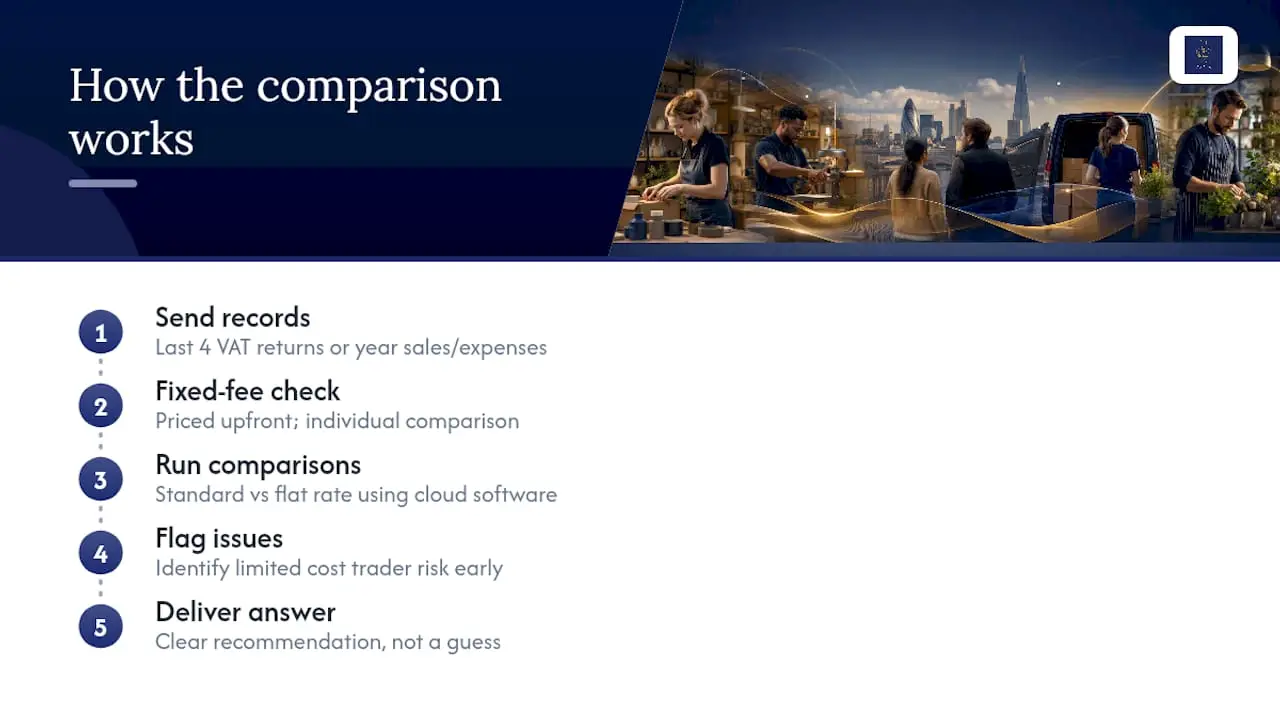
If you’d like a bespoke comparison, send me your last four VAT returns or a year of sales and purchase records, and I’ll model both approaches against your actual figures rather than a generic percentage.
What’s the one rule of thumb I give small business owners?
That single test decides more FRS outcomes than any sector percentage table ever will.
Beyond that, my honest view is that the scheme rewards businesses that were already simple, goods-heavy trades with modest reclaimable VAT, more than it transforms complicated ones. It’s a genuinely useful tool for the right business, and a quiet drain on cash for the wrong one. Don’t guess; run the comparison, or ask someone to run it for you.
— Chris
Get help comparing flat rate VAT against standard accounting
Working out whether the flat rate scheme suits your business properly means comparing two sets of VAT calculations against your real trading figures, not a rough sector percentage taken off a table. That’s exactly the kind of check I offer as part of fixed-fee VAT support at CWABC in Tonbridge, so you get a clear answer rather than a guess, and it’s priced upfront before I start.

I handle VAT returns, FRS comparisons and Making Tax Digital setup directly, using cloud software like Xero, FreeAgent and QuickBooks so your figures stay accurate and ready for HMRC without you needing to chase paperwork. My VAT returns service covers both standard and flat rate accounting, and I’ll flag early if the limited cost trader rules are likely to affect you.
To get started, send me your last four VAT returns, or a year of sales and expense records if you’re not yet registered, and I’ll put together an individual comparison rather than a generic recommendation. You can also read more about ongoing support on my Tonbridge accountant page before getting in touch.
Useful sources to check current rates and thresholds
Rates, thresholds and eligibility rules can shift between Budgets, so always check the primary source before making a final decision.
Need help? If you’d like an individual comparison run against your own figures rather than a general estimate, get in touch with me here and I’ll talk you through what to send over.
This article is general information, not a substitute for advice from a qualified financial advisor. Consult a qualified financial professional about your own circumstances before acting on anything here.