
Mortgage interest is no longer deductible against rental income for individual residential landlords. Since 2020, Section 24 replaces that deduction with a 20% basic-rate tax credit, applied under rules HMRC sets out in detail. For basic-rate taxpayers the change is broadly neutral, but for higher- and additional-rate landlords it can mean a materially bigger tax bill, sometimes even on a loss-making property.
TL;DR:
- The mortgage interest tax credit is capped at 20% of qualifying finance costs, which can significantly increase tax bills for higher-rate landlords with large portfolios.
- Only mortgage interest, loan interest on furnishings, and certain fees qualify, while capital repayments and costs for commercial or holiday lets are excluded.
- If a property runs at a loss or the landlord’s income is modest, the tax credit may be limited or fully carried forward, reducing effective relief.
- Landlords must carefully track interest payments separately in digital records to comply with Making Tax Digital, avoiding miscategorization that inflates expenses.
- Incorporating into a company removes the Section 24 restriction but involves upfront costs, higher mortgage rates, and additional tax considerations on profit extraction.
Table of Contents
- What the mortgage interest tax credit actually is
- Worked examples showing the real tax impact
- Reporting mortgage interest and Making Tax Digital
- Ways to reduce the tax impact and their trade-offs
- Recordkeeping checklist for year-end
- Common mistakes I see and quick fixes
- How CWABC helps landlords get this right
- Need help?
- Sources
What the mortgage interest tax credit actually is
The mortgage interest tax credit is shorthand for the tax reduction created by Section 24 of the Finance (No.2) Act 2015. Before this legislation, individual landlords deducted mortgage interest from rental income like any other business expense. Since the 2020 to 2021 tax year, that deduction has gone entirely for residential lets held personally. In its place, you get a tax reduction worth 20% of your qualifying finance costs.
Qualifying finance costs cover mortgage interest, interest on loans to buy furnishings, and fees for arranging a mortgage or loan. They do not cover capital repayments, which have never been deductible, or costs relating to commercial property or furnished holiday lets, which sit outside Section 24 entirely.
- Total finance costs for the year (plus any unused costs carried forward from earlier years)
- Property business profits for the tax year
- Adjusted total income (total income minus personal allowance and above the basic-rate band)
That “lower of” rule matters enormously. If your property makes a loss, or your adjusted total income is modest, the credit is capped by the smallest number, not your full mortgage interest bill. Any finance costs that can’t be relieved in one year carry forward to future years, but they don’t create a refund. HMRC’s case study guidance sets out exactly how this restriction phased in.
The phase-out ran over four tax years: 2017–18 allowed 75% of interest as a deduction with 25% as a credit; 2018–19 split it 50/50; 2019–20 moved to 25% deductible and 75% credit; and from 2020–21 onwards, 0% is deductible and the full amount qualifies only for the 20% basic-rate credit, as confirmed in HMRC’s guidance on restricting finance cost relief. Limited companies were never affected by any of this. Company landlords still deduct mortgage interest as a normal expense before Corporation Tax, which is one reason incorporation keeps coming up in landlord tax planning.
Worked examples showing the real tax impact
Numbers make this rule click faster than any explanation. Here are three scenarios based on the mechanics HMRC’s guidance walks through.
- Basic-rate landlord, rental profit £8,000, mortgage interest £4,000. Under the old rules, taxable profit would have been £4,000, taxed at 20%, giving £800 tax. Under Section 24, taxable profit is the full £8,000, taxed at 20% (£1,600), minus a 20% credit on the £4,000 interest (£800). Net tax is still £800. For a basic-rate taxpayer, the mechanism is broadly neutral.
- Higher-rate landlord, same figures. Taxable profit of £8,000 pushes into the 40% band, giving £3,200 tax, minus the same £800 credit. Net tax is £2,400, against £1,600 under the old rules, an extra £800 purely from the restructuring. Expressed against the £4,000 interest, that’s an effective additional tax rate of 20 percentage points on the finance cost itself.
- Joint ownership, one higher-rate and one basic-rate spouse. Splitting rental income via a declaration of trust so a larger share lands with the basic-rate partner reduces the household’s overall exposure, because more of the profit is taxed at 20% rather than 40%. This needs proper legal ownership changes, not just a verbal agreement.
The practical takeaway: taxable profit can now sit well above actual cash profit, particularly for highly geared portfolios. A landlord can be cash-flow negative after mortgage payments and still owe tax, which catches people out every January.
Reporting mortgage interest and Making Tax Digital
On the property pages of your Self Assessment return, residential finance costs go in Box 44, with brought-forward costs from previous years in Box 45. Box 26 covers other allowable property expenses, and Box 31 captures other capital allowances, so keeping these separate matters when HMRC’s system cross-checks your figures. HMRC’s property income guidance confirms exactly which costs belong where.
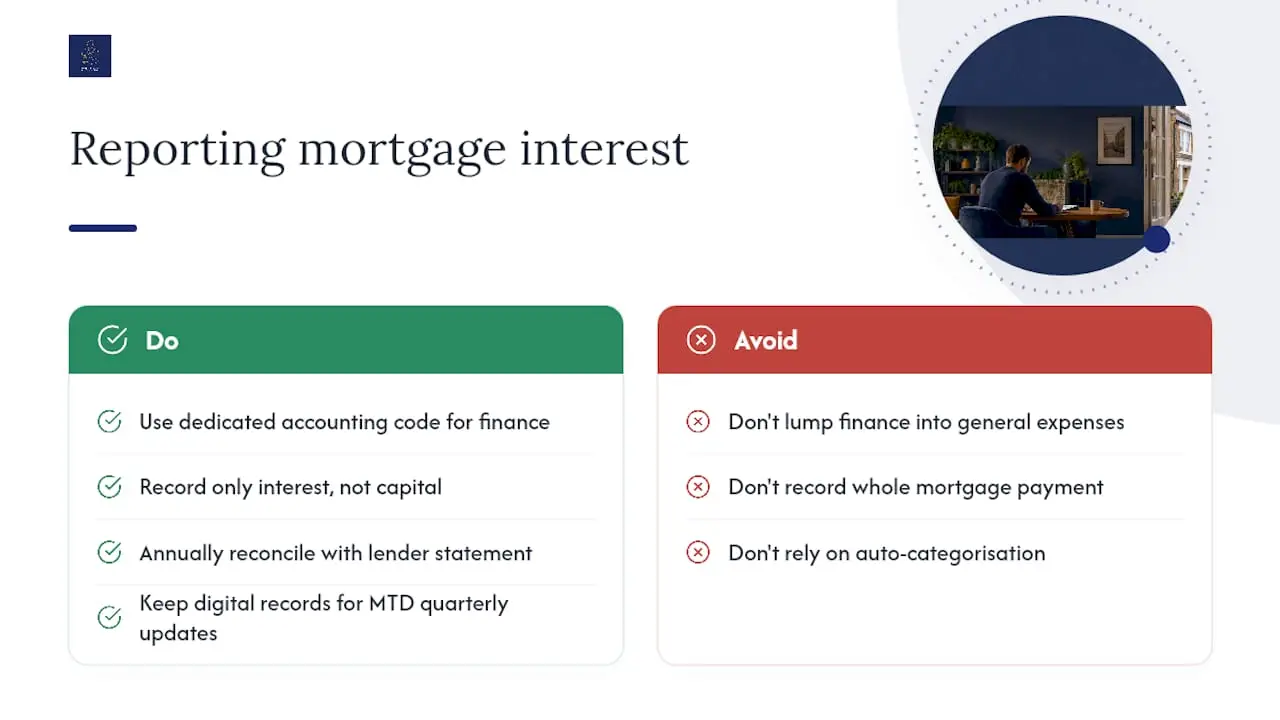
Making Tax Digital for Income Tax changes how this data needs to be kept. Landlords with qualifying income above the relevant threshold must keep digital records and submit quarterly updates, and residential finance costs must be tracked as a distinct category rather than lumped in with general property expenses, a point the Low Incomes Tax Reform Group’s MTD guidance is clear on. My guide to MTD ITSA for landlords covers the deadlines and software options in more depth.
In practice this means:
To comply with reporting requirements, landlords should use a dedicated accounting code for residential finance costs, ensure only the interest portion of mortgage payments is recorded (excluding capital repayments), and reconcile these figures with mortgage interest certificates annually.
Pro Tip: Most mortgage payments in your bank feed show the whole direct debit, capital and interest combined. If your software auto-categorises the full payment as an expense, your Box 44 figure will be wrong. Always split it against your lender’s annual interest statement.
Ways to reduce the tax impact and their trade-offs
There’s no single fix here, and every option carries a cost as well as a benefit.
- Incorporation. Companies still deduct mortgage interest before calculating Corporation Tax, so transferring a portfolio into a limited company removes the Section 24 restriction entirely. The trade-off is significant: Stamp Duty Land Tax on the transfer, potential Capital Gains Tax on a deemed disposal, commercial mortgage rates that are usually higher than personal buy-to-let deals, and tax on eventually extracting profits as dividends or salary. A full incorporation model needs to weigh all of these against the expected holding period before it makes sense.
- Pension contributions. Paying into a SIPP extends your basic-rate band, which can pull some or all of your rental profit out of the higher-rate zone and increase the value of the finance cost credit relative to tax paid. Annual allowance limits apply.
- Income splitting with a spouse or civil partner. Reallocating beneficial ownership towards the lower earner, properly documented, can reduce the household’s combined liability.
- Remortgaging. Reviewing rates and product types doesn’t change the tax treatment, but lower interest costs reduce the absolute cash impact of losing full deductibility.
Model the actual figures before acting on any of these, particularly incorporation, where the up-front costs can outweigh years of tax savings. My property income tax return guide is a useful starting point, but a decision this size warrants a proper conversation with a tax adviser.
Recordkeeping checklist for year-end
- Keep every mortgage interest certificate and remortgage document on file, separate from general property paperwork.
- Reconcile your Box 44 figure against your accounting ledger before submission, not after.
- Document how any carried-forward finance costs (Box 45) were calculated, so next year’s figure has a clear trail.
- Retain everything for at least six years in case HMRC opens an enquiry.
Pro Tip: Do this reconciliation quarterly alongside your MTD update, not just once a year. Catching a miscategorised interest payment in July is far less stressful than finding it in next January’s filing rush.
Common mistakes I see and quick fixes
Interest mis-categorisation is the error I encounter most, usually a full mortgage payment logged as one expense rather than split into capital and interest. Second most common: landlords who model incorporation on tax saved alone, ignoring SDLT and CGT. My fix is simple: a dedicated nominal code from day one, a quarterly reconciliation habit, and a basic cost model before any transfer conversation goes further. If you want a second pair of eyes on your own numbers, CWABC’s landlord bookkeeping guide is a good place to start.
— Chris
How CWABC helps landlords get this right
CWABC gives Tonbridge and Kent landlords a fixed-fee alternative to guesswork: I handle property tax returns, MTD ITSA setup, and incorporation modelling so you know your Box 44 figure is right before you file, not after HMRC queries it.

I work directly with sole trader landlords and those weighing up a move to a limited company, using Xero, QuickBooks or FreeAgent to keep finance costs correctly tagged from the first quarterly update onwards. Pricing for common landlord tasks, like an annual property tax return or an MTD software setup, is agreed upfront rather than billed by the hour. If you’d like help checking whether your current figures are right, or want to model an incorporation decision properly before committing, take a look at my property income tax return guide for landlords, or book a short diagnostic call through my contact page.
Need help?
If any of this feels harder to apply to your own portfolio than it looks on paper, get in touch through my contact page and I’ll talk you through your specific numbers.