How to budget monthly for your small business tax payments
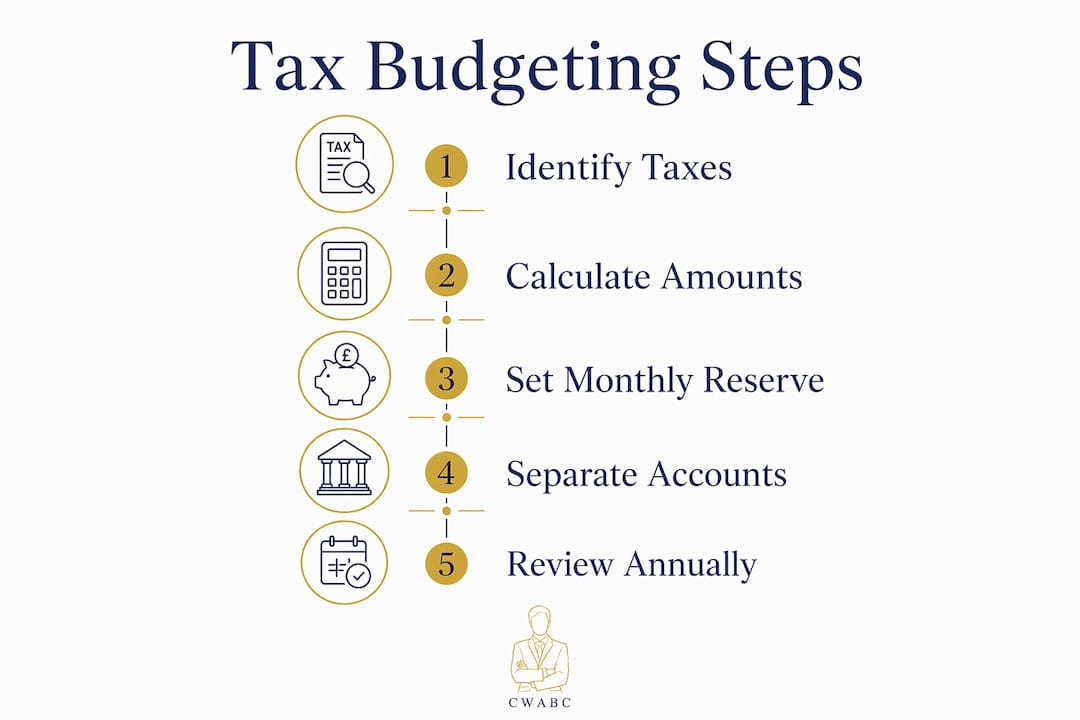
A solid small business tax payment budget plan comes down to one habit: setting aside a percentage of your income or profit every single month, before you spend it on anything else. Do that consistently, and you will never face a surprise tax bill you cannot cover.
The key deadlines to build your budget around are:
- 31 January each year: Self Assessment tax bill due, plus your first payment on account (50% of the previous year’s bill)
- 31 July each year: second payment on account (the remaining 50%)
- Corporation Tax: due nine months and one day after your company’s accounting year end
- VAT returns: typically quarterly, with payment due one month and seven days after each quarter end
Missing any of these triggers interest charges and penalties from HMRC, so knowing the dates is half the battle.
Pro Tip: Keep your VAT funds in a completely separate bank account from your Income Tax or Corporation Tax reserves. VAT money is never yours to spend. Mixing it with general funds is one of the most common causes of cash flow crises for small businesses.
Understanding the different taxes and how to budget for each one
Every UK small business owner needs to understand which taxes apply to their structure before they can build a realistic budget. The types of tax obligations differ depending on whether you trade as a sole trader, a partnership, or a limited company.
Income Tax and National Insurance for sole traders
Sole traders pay Income Tax on their profits through Self Assessment. For 2025–26, the Income Tax bands correspond to a personal allowance, followed by basic, higher, and additional rates that increase with income ranges as documented here.

On top of Income Tax, sole traders pay Class 4 National Insurance at a lower rate on profits up to a threshold, and a higher rate above. As a rough guide, budgeting around a quarter to a third of your net profit each month covers most sole traders in the basic rate band once both taxes are included.
Corporation Tax for limited companies
Limited companies pay Corporation Tax on their profits. The current Corporation Tax rates apply a lower percentage rate up to a small profits limit, a higher main rate beyond an upper threshold, with marginal relief in between as detailed here.
Most small limited companies fall into the 19% band, so setting aside 20% of monthly profit gives a small buffer.
VAT budgeting
Once your rolling 12-month turnover exceeds £90,000, you must register for VAT within 30 days. On the standard scheme, you collect 20% VAT on sales and reclaim VAT on eligible purchases. Budget by setting aside the net difference each month: VAT collected minus VAT reclaimed.
On the Flat Rate Scheme, you pay a fixed percentage of your gross turnover to HMRC rather than tracking every transaction. The percentage varies by trade sector, so check your applicable rate and budget accordingly.
| Tax type | Who pays | Rate to budget | Key deadline |
|---|---|---|---|
| Income Tax | Sole traders, partnerships | 20–30% of profit (band dependent) | 31 January |
| National Insurance (Class 4) | Sole traders | 10% up to threshold; 2% above | 31 January |
| Corporation Tax | Limited companies | 19% of profit | 9 months + 1 day after year end |
| VAT (standard) | VAT-registered businesses | Net VAT collected | Quarterly |
| VAT (Flat Rate) | Eligible VAT-registered businesses | Sector-specific % of gross turnover | Quarterly |
Tax reliefs and allowances can meaningfully reduce what you owe. Worth knowing:
- Annual Investment Allowance (AIA): up to £1,000,000 deduction on qualifying plant and machinery, available to sole traders and limited companies
- Full Expensing: 100% first-year deduction for companies on most new main-rate assets
- Personal Allowance: the £12,570 tax-free threshold reduces your Income Tax liability
- Pension contributions: attract tax relief and can reduce your taxable profit
Practical tips for monthly tax budgeting and cash flow
Discipline is the core of good cash flow management. The moment income arrives in your account, transfer your tax reserve to a separate savings account. Treat it as untouchable.
A few techniques that genuinely help:
- Smooth your income estimates: if your income varies month to month, base your monthly reserve on a three-month rolling average rather than the current month alone
- Adjust in low-profit months: if profits dip, reduce your reserve proportionally rather than skipping it entirely
- Use MTD-compliant software: Making Tax Digital (MTD) requires VAT-registered businesses to keep digital records and submit returns using compatible software. Tools such as Xero, FreeAgent, and QuickBooks all integrate with HMRC and give you a running view of your tax accruals throughout the year. Getting your accounting software set up correctly from the start saves a great deal of stress later
- Review quarterly: check your reserve balance against your estimated liability at each VAT quarter end, not just at year end
When an unexpected tax charge arrives, such as a larger-than-expected payment on account, do not panic. HMRC’s Budget Payment Plan lets sole traders make weekly or monthly Direct Debit payments towards their next Self Assessment bill, reducing the lump sum due in January. If you genuinely cannot pay on time, HMRC’s Time to Pay arrangement allows you to spread overdue tax in monthly instalments.
Pro Tip: Review your tax budget every April when the new tax year starts. If your business grew last year, your payments on account will increase too. Adjusting your monthly reserve at the start of the year prevents a shortfall building up quietly over twelve months.
Worked examples: calculating your monthly tax reserve
These examples use 2026 UK tax rates to show how the numbers work in practice.
Example 1: Sole trader with £40,000 annual profit
Annual profit: £40,000
Taxable profit after Personal Allowance: £40,000 minus £12,570 = £27,430
Income Tax at 20%: £5,486
Class 4 NI at 10%: £27,430 × 10% = £2,743
Total annual tax: £8,229
Monthly reserve needed corresponds approximately to one-twelfth of the annual tax liability for budgeting purposes.
Remember: in your first full year of Self Assessment, HMRC will ask for payments on account in two installments within the tax year. Budget for these advance payments early to avoid cash flow issues.
Example 2: Limited company with £60,000 profit
Annual profit: £60,000
Corporation Tax at the small profits rate applies to profits up to the relevant threshold; amounts above this may be subject to marginal relief and higher rates.
Monthly reserve needed: £950
Because this profit sits above £50,000, marginal relief may apply depending on associated company rules. A licensed accountant can calculate the exact figure.
Example 3: VAT budgeting on the standard scheme
Monthly sales (VAT-inclusive): £12,000
VAT collected at 20%: £2,000
VAT on purchases reclaimed: £400
Net VAT to set aside monthly: £1,600
On the Flat Rate Scheme, a business in, say, the management consultancy sector pays a fixed percentage of gross turnover to HMRC. The applicable rate varies by sector, so always confirm your rate with HMRC or your accountant before budgeting.
| Scenario | Annual tax liability | Monthly reserve |
|---|---|---|
| Sole trader, Example profit | Estimated annual tax liability | Estimated monthly reserve |
| Limited company, Example profit | Estimated annual tax liability | Estimated monthly reserve |
| VAT (standard scheme, example) | Estimated annual VAT liability | Estimated monthly reserve |
Pro Tip: Open a dedicated business savings account and name it “Tax Reserve.” Seeing the label every time you log in to your banking app is a surprisingly effective reminder not to dip into it.
Cwabc can help you build a tax budget that actually works
Getting the numbers right on your own is possible, but it takes time you probably do not have. Cwabc is a licensed bookkeeper and accountant based in Tonbridge, working with sole traders, landlords, and small business owners across Kent who want clear, jargon-free support with their finances.
Whether you need help setting up MTD-compliant accounting services in Tonbridge, calculating your monthly tax reserves, or simply understanding what you owe and when, Cwabc offers straightforward, upfront pricing with no surprises. The focus is on getting your systems right from the start so that compliance looks after itself, and you can focus on running your business. If you are not sure whether you need professional support yet, the guide on signs you need an accountant is a good place to start.
Key takeaways
A reliable small business tax payment budget plan requires setting aside a fixed percentage of profit every month, aligned to UK tax deadlines, so that no bill ever catches you off guard.
| Point | Details |
|---|---|
| Set aside monthly reserves | Sole traders in the basic rate band should budget roughly 25–30% of net profit to cover Income Tax and Class 4 NI. |
| Know your Corporation Tax rate | Limited companies pay 19% on profits up to £50,000 and 25% on profits above £250,000, with marginal relief applying in between. |
| Keep VAT funds separate | Set aside net VAT collected each month in a dedicated account to avoid cash flow problems at quarter end. |
| Use HMRC’s Budget Payment Plan | Sole traders can spread Self Assessment payments via weekly or monthly Direct Debits, reducing the january lump sum. |
| Cwabc supports your tax budgeting | Cwabc provides licensed bookkeeping and accountancy in Tonbridge, helping small businesses stay compliant and in control year-round. |
Need help?
Ready to take the stress out of tax budgeting? Get in touch with Cwabc for a free, no-obligation conversation. We will help you build a clear, practical plan that keeps your business compliant and your cash flow healthy throughout the year.