
Choosing an accountant in Tonbridge means identifying ten key qualities that guarantee expert bookkeeping, tax management, and regulatory compliance. The right accountant does far more than file your tax return once a year. For sole traders, landlords, and small business owners across Tonbridge, the stakes are rising. Making Tax Digital (MTD), the government’s programme requiring digital record-keeping and quarterly submissions to HMRC, is expanding its reach significantly. Getting your accountant selection right now protects you from compliance headaches and unexpected costs later.
What professional qualifications should a Tonbridge accountant have?
Certified or chartered accountants are bound by ethical codes and carry advanced knowledge, making them the most reliable choice for individuals and small businesses. Professional body membership signals that an accountant meets rigorous standards and is subject to ongoing oversight. That matters because it gives you recourse if something goes wrong.
The main UK accounting qualifications to look for are:
| Qualification | Awarding body | Best suited for |
|---|---|---|
| ACA / FCA | ICAEW | Complex business accounts and audits |
| ACCA | ACCA Global | General practice, tax, and audit |
| AAT | AAT | Bookkeeping and accounts preparation |
| ATT | ATT | Personal and business tax compliance |
| Licensed Bookkeeper | ICB or IAB | Day-to-day bookkeeping and VAT |
Each qualification carries its own ethical code and continuing professional development requirements. An accountant who holds AAT membership, for example, must complete annual training and adhere to AAT’s professional standards. That ongoing education matters especially now, with MTD rules changing rapidly.
Pro Tip: Ask any prospective accountant which professional body they belong to, then verify their membership directly on that body’s public register. ICAEW, AAT, and ACCA all offer free online member searches.
MTD readiness is itself a mark of professional competence. An accountant who cannot explain compatible software options or quarterly submission workflows is not keeping pace with current requirements. Treat MTD knowledge as a baseline, not a bonus.

How to assess an accountant’s knowledge of UK tax laws and Making Tax Digital
Making Tax Digital for Income Tax Self Assessment (MTD for ITSA) is HMRC’s requirement for self-employed individuals and landlords to keep digital records and submit quarterly updates. The MTD threshold will reduce from £30,000 to £20,000 from april 2028, bringing approximately 970,000 more individuals into scope. That means many Tonbridge sole traders and landlords who feel safely outside MTD today will be caught by it within two years.
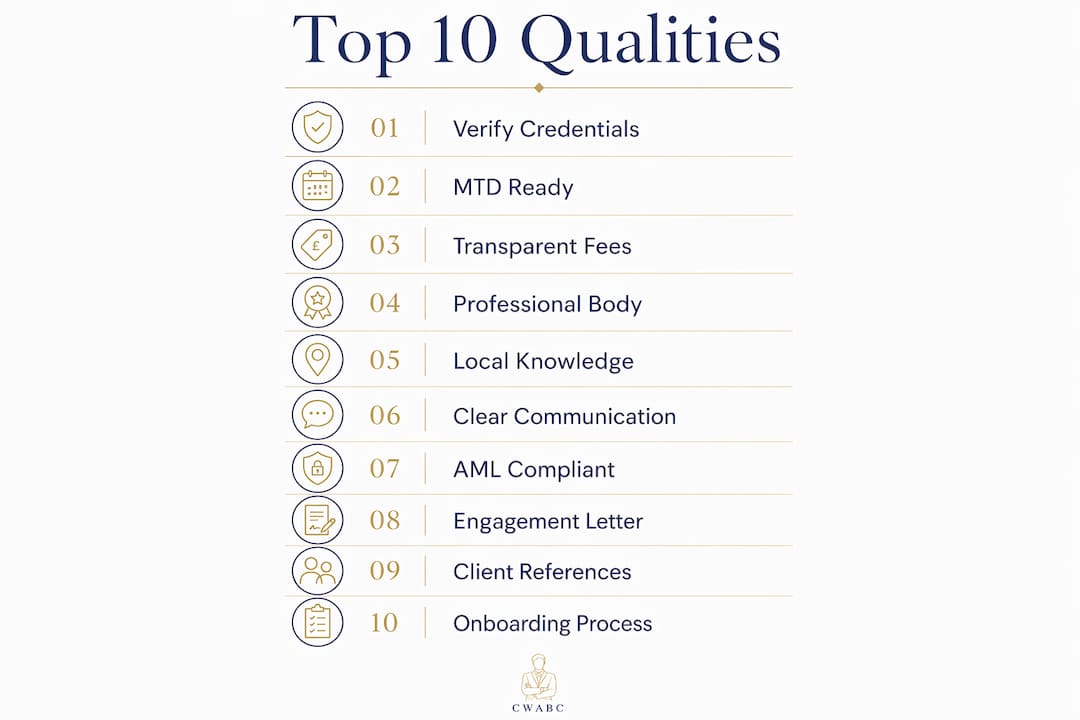
A good accountant does not wait until april 2028 to start preparing. Good accountants build MTD workflows that naturally produce accurate quarterly digital updates, rather than scrambling to rework annual records at year end. That distinction separates a proactive accountant from a reactive one.
Use this checklist when assessing any accountant’s MTD readiness:
- Can they name at least two HMRC-recognised MTD-compatible software options, such as Xero, QuickBooks, or FreeAgent?
- Do they offer to review your current record-keeping and map it to a quarterly submission workflow?
- Can they explain when HMRC will contact you to confirm your MTD sign-up date?
- Do they understand the difference between quarterly updates and the final end-of-period statement?
- Have they already transitioned other clients onto MTD-compliant systems?
- Do they proactively check whether your income level triggers MTD obligations, rather than waiting for you to ask?
HMRC expects reasonable care with digital records and matching quarterly updates under MTD. Your accountant carries a direct role in meeting those standards on your behalf. You can review the full MTD requirements checklist to understand exactly what compliant record-keeping looks like.
Pro Tip: Ask your prospective accountant: “How would you set up my records to produce quarterly MTD submissions without extra work at year end?” A strong answer describes a live, ongoing workflow. A weak answer describes an annual tidy-up.
Why transparency in fees and written engagement letters protects you
Fee transparency and a clear understanding of what is included protect you from surprise bills and scope creep. Verifying fee structures and confirming what is covered, including whether audit representation is included, prevents unexpected charges that can strain a small business budget.
Accountants typically charge using one of three structures: hourly rates, fixed monthly fees, or annual packages. Fixed fees work best for most sole traders and landlords because they make budgeting predictable. Hourly rates can escalate quickly if your affairs become complicated mid-year.
An engagement letter is the written agreement that defines exactly what your accountant will do, what you are responsible for, and what the fees cover. Engagement letters should be tailored and updated regularly to prevent scope creep. Without one, you have no written record of what was agreed, which creates risk on both sides.
Before signing with any accountant, ask these questions to clarify fees and scope:
- Is your fee fixed, or can it increase during the year? Under what circumstances?
- What specific services are included? List them explicitly: self-assessment, VAT returns, payroll, bookkeeping.
- Are HMRC enquiry or investigation costs covered, or charged separately?
- How do you handle work that falls outside the original scope?
- Will I receive a written engagement letter before work begins?
- How often do you review and update the engagement letter?
A reputable accountant answers all six questions calmly and clearly. Hesitation or vague answers on any of these points is a warning sign worth taking seriously.
How to verify an accountant’s professional accountability and client references
Professional accountability means an accountant operates under an ethical code, accepts supervision from their professional body, and can face disciplinary action if they fall short. A tax return preparer must sign the return and take responsibility for its accuracy. In the UK context, this principle applies equally: your accountant should be willing to put their name to their work.
AML obligations remain critical for accountants. Anti-money laundering compliance requires documented risk assessments, ongoing oversight, and practical evidence of control effectiveness, not just a written policy sitting in a drawer. When you engage an accountant, they are legally required to verify your identity and assess the risk your business presents. An accountant who skips this step is not compliant, and that puts you at risk too.
Use these steps to verify any accountant’s standing before you commit:
- Search their name on the ICAEW, AAT, ACCA, or ICB public register to confirm active membership.
- Ask whether they hold a current AML supervision certificate and who their AML supervisor is.
- Request two or three client references, ideally from businesses similar in size and type to yours.
- Ask references specifically about responsiveness, accuracy, and how the accountant handled a problem or unexpected situation.
- Check whether any disciplinary history appears on their professional body’s public records.
- Confirm they have experience working with Tonbridge businesses or clients in Kent, since local knowledge of the area’s business mix genuinely helps.
Local experience matters more than it sounds. An accountant familiar with the Tonbridge area understands the types of businesses common here, from tradespeople and landlords to retail and hospitality. That context shapes the quality of advice they give you.
Which communication qualities make an accountant a good fit?
The best accountant for you is one whose communication style matches how you prefer to work. Some clients want a face-to-face meeting in Tonbridge twice a year. Others prefer quick email exchanges and a video call when something complex comes up. Neither approach is wrong, but a mismatch creates friction and missed deadlines.
Responsiveness is non-negotiable. Your accountant should commit to a clear response time for routine queries, typically within two working days. During busy periods such as january and july, when self-assessment deadlines cluster, response times can stretch. Ask upfront how they manage client communication during peak periods.
Ask these questions to assess communication fit before you sign up:
- What is your preferred method of communication, and what response time can I expect?
- Do you offer face-to-face meetings in Tonbridge, or is everything handled remotely?
- Who do I contact if you are unavailable? Is there a backup contact?
- How do you explain complex tax issues to clients who are not financial experts?
Pro Tip: Pay attention to how the accountant communicates during your very first conversation. If they use jargon without explaining it, or give vague answers to direct questions, that pattern will continue throughout your working relationship.
Onboarding quality is another reliable signal. An accountant who sends you a clear welcome pack, explains the next steps, and sets up your records properly from day one is demonstrating the same care they will apply to your tax affairs all year round. Ask what their onboarding process looks like before you commit.
Key takeaways
Choosing the right accountant in Tonbridge requires checking qualifications, MTD readiness, fee transparency, professional accountability, and communication style before you sign any agreement.
| Point | Details |
|---|---|
| Verify qualifications | Confirm membership of ICAEW, AAT, ACCA, or ICB via their public registers. |
| Assess MTD readiness | Ask how they build quarterly digital workflows, not just annual summaries. |
| Demand a written engagement letter | Insist on a tailored letter that defines scope, fees, and responsibilities clearly. |
| Check AML compliance | Confirm they hold active AML supervision and carry out proper client identity checks. |
| Match communication styles | Agree response times and preferred contact methods before work begins. |
What I have learned from working with Tonbridge clients
Most people searching for the best accountants in Tonbridge focus almost entirely on price. That is understandable. But in my experience, the clients who regret their choice almost always chose on cost alone and discovered too late that their accountant was not keeping pace with regulatory changes.
MTD readiness is the clearest dividing line right now. An accountant who is still thinking in annual cycles is not equipped to serve you well as the rules tighten. The MTD for ITSA rules are not a distant concern. They are already affecting clients with income above £50,000, and the threshold is falling. The accountants who are genuinely ready have already moved their clients onto compatible software and built quarterly habits into their workflows.
AML compliance is another area where I see a real gap between what accountants say and what they actually do. Effective AML compliance requires documented risk rating changes and ongoing oversight, not just a policy document. If an accountant cannot tell you who their AML supervisor is, that is a red flag.
Fee transparency builds trust faster than anything else. When a client knows exactly what they are paying and what is included, they stop worrying about the bill and start focusing on their business. That shift in mindset is genuinely valuable. The hidden costs of unclear pricing go well beyond the invoice itself.
My honest advice: treat your accountant selection like hiring a member of staff. Check their credentials, speak to their existing clients, and pay attention to how they communicate from the very first conversation. The right accountant does not just keep you compliant. They give you confidence in your numbers.
— Chris
Cwabc’s accounting services in Tonbridge: built around these ten qualities
Cwabc is a licensed bookkeeper and accountant based in Tonbridge, working specifically with sole traders and landlords who want clear, jargon-free financial support.
Cwabc’s approach covers every quality on this list: verified professional credentials, active MTD-compatible software support using tools like Xero, FreeAgent, and QuickBooks, written engagement letters with upfront fixed pricing, and AML-compliant client onboarding. If you are ready to work with a local accountant who explains everything plainly and keeps your records compliant all year round, explore Cwabc’s bookkeeping and accounting services in Tonbridge. You can also review Cwabc’s accounting services overview to see the full range of support available for small businesses and individuals in Kent.
FAQ
What qualifications should I look for in a Tonbridge accountant?
Look for membership of ICAEW, ACCA, AAT, or ICB, as these bodies require ongoing training and enforce ethical codes. Verify membership directly on each body’s public register before committing.
What is Making Tax Digital and why does my accountant need to know about it?
Making Tax Digital for Income Tax requires self-employed individuals and landlords to keep digital records and submit quarterly updates to HMRC. The income threshold drops to £20,000 in april 2028, so your accountant must be ready to manage this now, not later.
How do I know if an accountant’s fees are fair and transparent?
Ask for a written engagement letter that lists every service included and confirms whether the fee is fixed or variable. Fee transparency means no surprise bills for work you assumed was covered.
Do I need to check an accountant’s AML compliance?
Yes. Accountants in the UK are legally required to verify your identity and maintain anti-money laundering controls. Ask who their AML supervisor is and confirm they carry out proper client risk assessments before you sign up.
What questions should I ask an accountant before hiring them?
Ask about their qualifications, MTD software experience, fee structure, engagement letter process, and how they communicate with clients during busy periods. You can find a broader set of questions to ask in Cwabc’s Tonbridge tax guide.