Sole trader HMRC registration is the formal process of notifying HMRC that you are self-employed and liable to pay income tax and National Insurance on your profits. Self-employed income over £1,000 in a tax year triggers mandatory registration and a Self Assessment tax return. This guide covers sole trader HMRC registration explained in plain terms: who must register, how to do it, which accounting method to choose, and what the 2026 Making Tax Digital changes mean for you. Whether you are just starting out or catching up on compliance, this is everything you need to know in one place.
Who needs to register as a sole trader with HMRC?
The registration trigger is income, not intent. Earning over £1,000 from self-employment in a single tax year makes registration compulsory. That £1,000 figure is known as the trading allowance, and it exists to exempt casual or occasional earners from filing obligations.
The trading allowance covers situations like selling handmade goods occasionally or doing a few hours of freelance work. Once you cross that threshold, the exemption no longer applies and you must register for Self Assessment.
Other circumstances also require registration, even if your self-employment income is modest:
- You earned over £1,000 from self-employment in the tax year
- You need to prove your self-employed status, for example to claim Tax-Free Childcare
- You have income from property, savings, or investments above certain limits
- You are a company director with untaxed income
- Your total income from all sources exceeds the Personal Allowance and is not taxed at source
The critical point: The £1,000 trading allowance is based on gross income, not profit. If you earned £1,200 but spent £800 on materials, you still need to register because your income exceeded £1,000 before expenses.
What is the registration deadline?
You must register by 5 October after the end of the tax year in which you became self-employed. The UK tax year runs from 6 April to 5 April. So if you started trading in, say, August 2025, your registration deadline is 5 October 2026. Missing this date can result in a penalty, though HMRC may waive it if your tax bill is paid on time.
Registering early is always the better choice. It gives you time to set up your Government Gateway account, understand your obligations, and avoid a last-minute scramble before the January Self Assessment filing deadline.
How to register as a sole trader: step-by-step
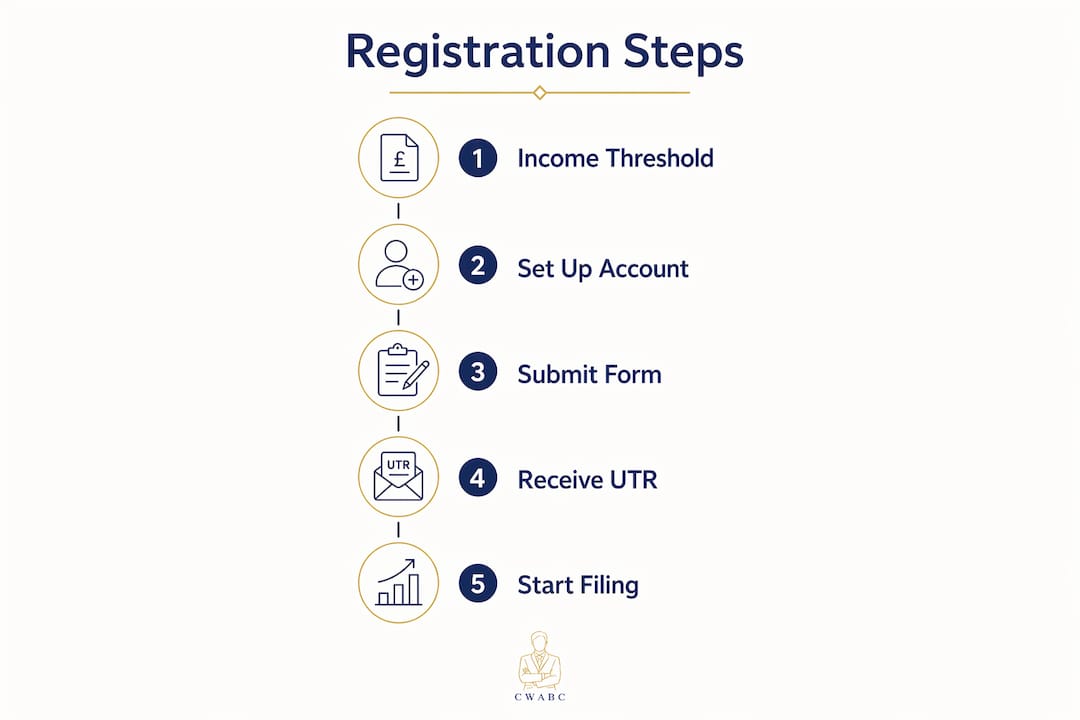
Registering online via HMRC’s Government Gateway takes around 10 minutes and is free. You can also register by post using form CWF1, though online is faster and more straightforward. Here is the process from start to finish.
-
Create a Government Gateway account. Go to the HMRC website and select “Create sign-in details.” You will receive a User ID by email. Keep this safe because you will need it every time you log in to HMRC services.
-
Sign in and select Self Assessment. Once logged in, choose “Self Assessment” from the list of services and select “I am registering because I am self-employed.”
-
Complete the registration form. You will need your National Insurance number, your business name (this can simply be your own name), the date you started trading, and a brief description of the nature of your business.
-
Submit and wait for your UTR. HMRC will post your Unique Taxpayer Reference (UTR) to your registered address within 10 working days, or up to 21 days if you are abroad. Your UTR is a 10-digit number that identifies you for all future tax correspondence.
-
Activate your Self Assessment account. Once your UTR arrives, return to the Government Gateway and activate your Self Assessment account using the activation code HMRC sends separately.
Pro Tip: Keep a note of your UTR, Government Gateway User ID, and the date you registered. You will need all three when filing your first Self Assessment return, and losing them causes unnecessary delays.
Registration covers both income tax through Self Assessment and National Insurance contributions. Class 2 and Class 4 National Insurance both apply once your profits exceed £12,570. Class 2 is a flat weekly rate, while Class 4 is a percentage of profits above the threshold. Both are calculated and paid through your Self Assessment return, so there is no separate process to worry about.

Cash basis vs traditional accounting: which should you choose?
How you calculate your taxable profits is one of the most consequential decisions you make as a sole trader. HMRC’s HS222 helpsheet sets out the two main accounting methods: cash basis and traditional (accrual) accounting. The choice affects when income and expenses are recognised, which directly changes how much tax you owe and when.
HMRC distinguishes income recognition according to the accounting basis you select. This is not a minor administrative detail. It can shift hundreds or thousands of pounds of taxable profit between tax years.
| Feature | Cash Basis | Traditional (Accrual) |
|---|---|---|
| Income recognised | When money is received | When invoice is raised |
| Expenses recognised | When payment is made | When cost is incurred |
| Best suited to | Small, straightforward businesses | Larger or more complex businesses |
| Stock and debtors | Not required | Required |
| Loan interest deduction | Capped at £500 | Uncapped |
| Record keeping | Simpler | More detailed |
Cash basis is the default for most new sole traders. It is simpler because you only record money that has actually moved in or out of your account. You do not need to track invoices raised but not yet paid, or bills received but not yet settled.
Traditional accounting, sometimes called accrual accounting, matches income and expenses to the period they relate to, regardless of when cash changes hands. This gives a more accurate picture of business performance but requires more detailed record keeping. If you work with large clients who pay on 60 or 90-day terms, traditional accounting can create a mismatch between your tax bill and your actual cash position.
Pro Tip: If you are unsure which method suits your business, read the cash basis accounting guide before filing your first return. Switching methods later is possible but requires adjustments that can be confusing.
Most sole traders starting out benefit from cash basis. It reduces the risk of paying tax on income you have not yet received, and the record keeping is far more manageable. As your business grows and you take on staff or hold significant stock, traditional accounting becomes more appropriate.
Reporting thresholds and obligations that affect sole traders
Registration is the beginning, not the end. As your business grows, additional reporting obligations come into play. Understanding these thresholds now saves you from surprises later.
The £90,000 turnover threshold
Sole traders with turnover of £90,000 or more must complete the Self-employment (full) pages in their Self Assessment tax return rather than the shorter summary pages. This threshold is based on gross turnover before expenses, not profit. Many traders who track only their bank balance are caught off guard by this because their gross income looks higher than their net position suggests.
The full pages require more detailed information about your accounts, including figures for stock, debtors, and creditors. If you are approaching this threshold, setting up proper bookkeeping software now will make the transition much less stressful.
Making tax digital for income tax from april 2026
From April 2026, sole traders with combined gross income above £50,000 must comply with Making Tax Digital for Income Tax Self Assessment (MTD ITSA). This is a significant change to how sole traders report their income to HMRC.
MTD ITSA requires quarterly digital submissions using compatible software, replacing the single annual Self Assessment return for those affected. This means updating your records at least four times a year and submitting summaries of income and expenses to HMRC digitally. A final end-of-year declaration then confirms the annual figures.
If your gross income is between £30,000 and £50,000, MTD ITSA applies from April 2027. The types of businesses affected by MTD include sole traders and landlords, so if you have rental income alongside self-employment income, both count towards the threshold.
VAT and employer registration
Two further thresholds matter as your business scales:
- VAT registration: The current VAT registration threshold is £90,000 in taxable turnover over a rolling 12-month period. Once you exceed this, you must register for VAT within 30 days. The sole trader VAT threshold has its own set of rules and implications worth understanding separately.
- Employer registration: If you take on staff, you must register as an employer with HMRC before your first payday. This is a separate process from your sole trader registration.
Penalties for late registration
Penalties may be charged for late registration but HMRC can waive them if your tax is paid on time. The penalty is calculated as a percentage of the tax owed for the period you were unregistered. Registering late and paying promptly is far better than not registering at all. HMRC’s penalty regime for failure to notify is based on the behaviour involved, with higher penalties for deliberate non-disclosure.
Key takeaways
Sole trader HMRC registration is mandatory once self-employment income exceeds £1,000, and getting it right from the start protects you from penalties and positions you well for MTD compliance in 2026.
| Point | Details |
|---|---|
| Registration threshold | Self-employment income over £1,000 in a tax year triggers mandatory HMRC registration. |
| Registration deadline | Register by 5 October after the tax year you started trading to avoid penalties. |
| Accounting method choice | Cash basis suits most new sole traders; traditional accounting suits more complex businesses. |
| MTD ITSA from April 2026 | Sole traders with gross income above £50,000 must submit quarterly digital reports to HMRC. |
| £90,000 reporting threshold | Turnover at or above £90,000 requires completion of the Self-employment full pages in Self Assessment. |
What i have learned from helping sole traders register with HMRC
The most common mistake I see is people confusing being self-employed with being registered. You can be legally self-employed from day one of trading, but HMRC does not know you exist until you register. Those are two completely separate things, and the gap between them is where penalties quietly accumulate.
The second thing I notice is how often the accounting method choice gets ignored. Most people just pick whatever their software defaults to without understanding the implications. Choosing cash basis when your business has significant outstanding invoices at year-end can understate your tax liability. Choosing traditional accounting when you are a one-person service business adds complexity with no real benefit. The HS222 helpsheet is genuinely useful here, but most people never read it.
MTD ITSA is the change I spend the most time talking about right now. Sole traders who have managed fine with a spreadsheet and an annual return for years are going to find the quarterly submission requirement a real adjustment. The key is not to wait until April 2026 to set up compatible software and get your records in order. Starting now means you have time to build the habit gradually rather than scrambling to catch up.
My honest view is that HMRC registration is not the hard part. The hard part is everything that comes after: choosing the right accounting method, keeping records that support your return, understanding which thresholds apply to you, and adapting to MTD. Getting those foundations right from the start is what separates a stress-free tax year from a chaotic one.
— Chris
How Cwabc supports sole traders in tonbridge and beyond
Starting out as a sole trader brings enough to think about without worrying whether your HMRC registration is correct or your records are MTD-ready. Cwabc, based in Tonbridge, works specifically with sole traders and landlords to take that weight off your shoulders.
From setting up your bookkeeping system to filing your Self Assessment return accurately and on time, Cwabc handles the detail so you can focus on your business. With Making Tax Digital coming into force from April 2026, now is the right time to get your records and software in place. Explore the bookkeeping services in Tonbridge that Cwabc offers, or browse the bookkeeping FAQs to get quick answers to common questions. Clear pricing, no jargon, and local expertise you can rely on.
FAQ
When must i register as a sole trader with HMRC?
You must register by 5 October after the end of the tax year in which your self-employment income exceeded £1,000. For example, if you started trading in the 2025/26 tax year, your deadline is 5 October 2026.
What is the £1,000 trading allowance?
The trading allowance exempts self-employment income under £1,000 from registration and tax filing. Once your gross income from self-employment exceeds £1,000, the allowance no longer applies and you must register with HMRC.
Do i need to register for VAT when i register as a sole trader?
VAT registration is separate from sole trader registration and only becomes compulsory when your taxable turnover exceeds £90,000 in a rolling 12-month period. You can register voluntarily before reaching that threshold if it suits your business.
What is a UTR and why do i need one?
A Unique Taxpayer Reference (UTR) is a 10-digit number HMRC assigns when you register for Self Assessment. You need it to file tax returns, correspond with HMRC, and access your online tax account.
How does making tax digital affect my sole trader registration?
MTD ITSA does not change the registration process itself, but from April 2026 sole traders with gross income above £50,000 must submit quarterly digital updates to HMRC using compatible software rather than a single annual return. Setting up the right software before the deadline makes the transition straightforward.