The VAT Cash Accounting Scheme lets you pay VAT to HMRC (His Majesty’s Revenue and Customs) when your customers actually pay you, rather than when you send the invoice. You reclaim VAT on your costs on the same basis: when you pay your suppliers. If you offer credit terms, or you have ever been paid late, it can take real pressure off your cash flow.
It is not right for everyone, and it has a few rules that catch people out. In this guide I explain how it works in plain English, who can use it, how to join and leave, a worked example with numbers, and how it differs from standard VAT accounting and the Flat Rate Scheme. I have written it to sit alongside my general guides, so I will not repeat how VAT registration or a VAT return works from scratch.
TL;DR
- Cash accounting means you account for VAT on the date money changes hands, not the invoice date, on both sales and purchases.
- You can use it if you are VAT registered and expect VAT taxable turnover of £1.35 million or less in the next 12 months. You must leave if it goes over £1.6 million.
- It protects you from paying VAT on invoices that are never paid, but it can delay your VAT reclaims, so it can be a poor fit if you usually reclaim more than you charge.
- You cannot use it at the same time as the Flat Rate Scheme.
- I can help you work out which method suits your business, using your own figures rather than a rule of thumb.
Table of Contents
- What the VAT Cash Accounting Scheme actually does
- Who can use it: eligibility
- A simple worked example
- What happens with unpaid invoices and bad debts
- Advantages and disadvantages
- Cash accounting, standard accounting and the Flat Rate Scheme
- How to join the scheme
- Leaving the scheme
- Common mistakes to avoid
- My perspective: choose the method from your numbers, not your instincts
- How I can help you choose and run the right VAT method
- FAQ
- Need help with your VAT?
- Sources
What the VAT Cash Accounting Scheme actually does
Under standard VAT accounting, you owe VAT on a sale when you issue a VAT invoice, and you can reclaim VAT on a purchase when you receive a VAT invoice. Whether money has moved is irrelevant. HMRC’s guidance on the scheme sets out the difference: with cash accounting, VAT on sales is accounted for when customers pay, and VAT on purchases is reclaimed when you pay your suppliers.
In practical terms, the VAT figures on your return come from your bank and payment records rather than your invoice dates. On the return itself, box 1 (VAT due on sales) and box 4 (VAT reclaimed on purchases) are based on payments received and made under this scheme.
If you feel a bit lost with the vocabulary, you are in good company. Two terms are worth fixing in your head:
- Output VAT is the VAT you charge your customers.
- Input VAT is the VAT you pay on your business costs and can usually reclaim.
Cash accounting changes when both of these land on your return. It does not change how much VAT is due overall, or the rate you charge.
Why the scheme exists
HMRC’s own manual describes it as a measure introduced to ease the burden on small businesses, particularly those that give customers extended credit. It also gives what amounts to automatic bad debt relief, because you never account for VAT on money you have not received.
Who can use it: eligibility
You can use the scheme if your business is VAT registered and your estimated VAT taxable turnover is £1.35 million or less in the next 12 months. VAT taxable turnover is everything you sell that is not VAT exempt. That includes zero-rated sales, which still count as taxable.
HMRC also expects you to meet some conditions around your VAT record. In its guidance for the scheme, these include:
- you have no VAT returns outstanding;
- you have not been convicted of a VAT offence, or assessed to a penalty for VAT evasion involving dishonest conduct, in the last year;
- you do not owe HMRC money, or you have an arrangement in place to clear what you owe;
- HMRC has not withdrawn or refused your access to the scheme.
So if you are behind with returns or payments, fix that first. If you are unsure where you stand, that is something I can check with you before you decide anything.
Transactions that are always excluded
Even when your business qualifies, some individual transactions must stay on standard accounting. According to GOV.UK’s eligibility page, these include:
- invoices where the payment terms are 6 months or more;
- invoices raised in advance;
- goods bought or sold under hire purchase, conditional sale, credit sale or lease purchase;
- goods imported into Northern Ireland from the EU;
- goods moved out of a customs warehouse.
For most small service businesses and sole traders, none of these will come up often. They matter more for traders who sell equipment on finance, or who invoice a long way ahead. If you do have a one-off transaction of this kind, it simply stays on the invoice basis while the rest of your sales follow cash accounting.
A simple worked example
Numbers make this click faster than any definition. Here is a small, made-up example. It is purely illustrative, not a real client.
Imagine a graphic designer who is VAT registered and files quarterly returns for the periods January to March and April to June. The standard rate of VAT is 20%.
- In March, she invoices a client £6,000 plus £1,200 VAT (£7,200 in total). The client pays in May.
- In March, she also invoices a second client £2,000 plus £400 VAT, which is paid promptly in March.
- In April, she pays a supplier £2,400 plus £480 VAT for software and equipment. The supplier invoice is dated in March.
Here is how the VAT lands in each method.
| Item | Standard accounting: Jan to Mar return | Cash accounting: Jan to Mar return | Cash accounting: Apr to Jun return |
|---|---|---|---|
| Output VAT, £6,000 invoice (paid May) | £1,200 | £0 | £1,200 |
| Output VAT, £2,000 invoice (paid March) | £400 | £400 | £0 |
| Input VAT, supplier invoice (paid April) | £480 reclaimed | £0 | £480 reclaimed |
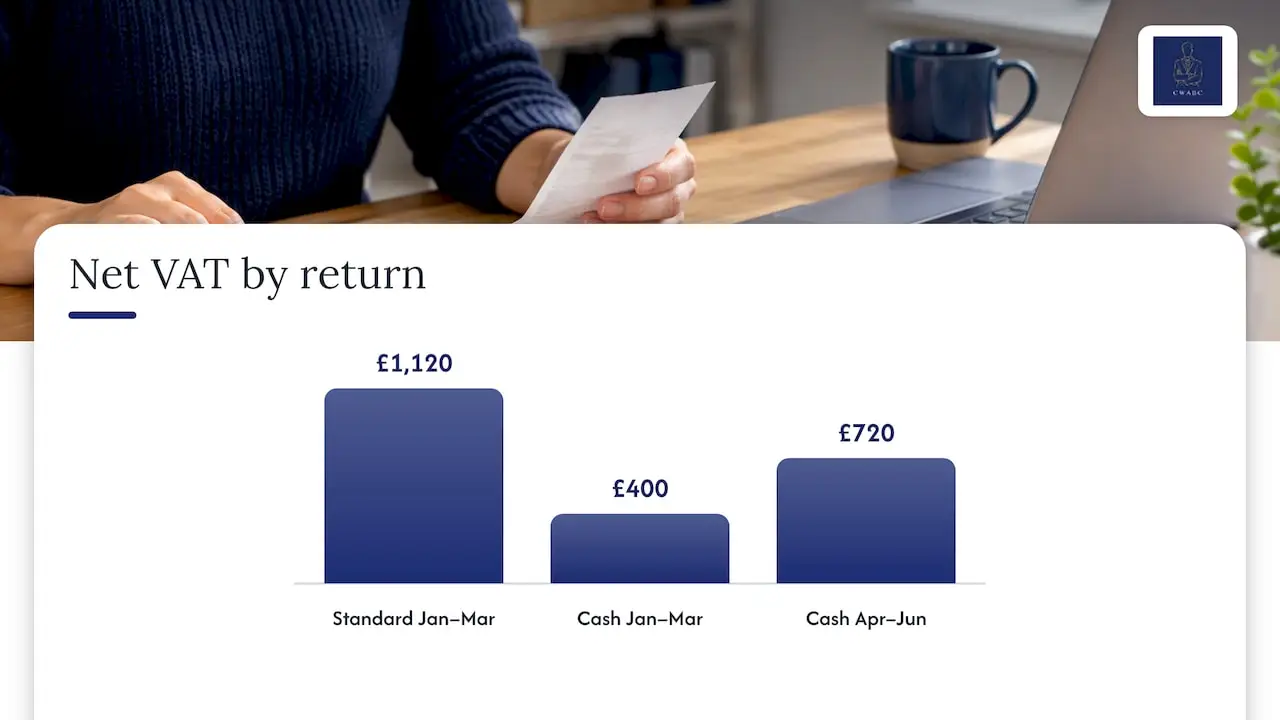
| Net VAT for the period | £1,120 to pay | £400 to pay | £720 to pay |
Under standard accounting, she owes HMRC £1,120 for January to March, even though her biggest client has not paid her yet. She would have to find that money from elsewhere. Under cash accounting, she pays £400 for that quarter, and the remaining £720 falls due on the next return, after the client has paid.
The total VAT over both quarters is identical: £1,120 either way. What changes is the timing, and that is the whole point of the scheme.
Part payments
If a customer pays you in instalments, you account for the VAT on each instalment as it arrives. In the example above, if the client had paid £3,600 in April and the rest in July, half the VAT (£600) would go on the April to June return and the other half on the following one. Your records need to show clearly which payments belong to which invoices, because HMRC’s guidance says you must keep records that cross-refer payments to the matching invoices.
What happens with unpaid invoices and bad debts
This is where many small businesses see the biggest benefit. Suppose a customer never pays that £7,200 invoice. Under standard accounting, you would already have accounted for £1,200 of output VAT. You would have to wait and then claim bad debt relief, which has its own conditions and a waiting period.
Under cash accounting, you never paid that VAT in the first place, so there is nothing to claim back. HMRC’s manual describes this as automatic bad debt relief.
There is a mirror image to be aware of. If you do not pay a supplier, you cannot reclaim the input VAT on that invoice until you do. For a business that regularly stretches supplier payments, that is a small cost of using the scheme, not a flaw.
Advantages and disadvantages
No VAT scheme is good or bad in the abstract. It depends on how money moves through your business.
Where cash accounting tends to help
- You give customers credit. If you invoice on 30 or 60 day terms, you are not funding the VAT before you are paid.
- You sometimes have late or non-paying customers. You do not pay VAT on money you never received.
- Your cash flow is tight. Matching VAT to cash in the bank makes the VAT bill easier to plan for.
- You are growing. A big new contract with slow payment can otherwise put a heavy VAT bill on your next return before the money arrives.
Where it can work against you
HMRC says the scheme may offer no benefit if you are usually paid as soon as you make a sale, you often reclaim more VAT than you pay, or you make continuous supplies of services. Let me unpack that:
- Paid immediately. If customers pay by card at the till or on the day of invoice, the dates are nearly identical under both methods, so you gain nothing.
- Regular VAT repayments. If you buy lots of stock or equipment, or you sell mostly zero-rated items, you may be reclaiming more than you charge. Under cash accounting, your reclaims wait until you have paid suppliers. If you pay suppliers slowly while customers pay fast, you could be worse off.
- More record-keeping. You need to track payments against invoices, not just invoices. Good software makes this easy. A shoebox or spreadsheet does not.
A quick comparison
| Question | Cash accounting helps if… | Cash accounting does not help if… |
|---|---|---|
| Customers’ payment speed | They pay you 30 to 90 days after invoice | They pay on the day of sale |
| VAT position | You usually owe VAT each quarter | You regularly reclaim more than you charge |
| Supplier payments | You pay suppliers promptly | You pay suppliers much later than customers pay you |
| Admin | Your software matches payments to invoices | Records are patchy or kept by hand |
Cash accounting, standard accounting and the Flat Rate Scheme
These three are often confused, so here is the short version.
| Standard VAT accounting | Cash Accounting Scheme | Flat Rate Scheme | |
|---|---|---|---|
| VAT on sales due when | The VAT invoice is issued | The customer pays | Based on a cash-basis turnover method |
| VAT on purchases reclaimed when | The supplier invoice is received | You pay the supplier | Generally not reclaimed (with limited exceptions) |
| How VAT is calculated | Output VAT minus input VAT | Output VAT minus input VAT, on payments | A fixed percentage of turnover |
| Bad debts | Relief available, with conditions | Effectively automatic | Not applicable in the same way |
| Joining limit | None beyond being VAT registered | £1.35 million expected taxable turnover | Separate, lower limit set by HMRC |
The key point: you cannot use cash accounting while you are on the Flat Rate Scheme, because the Flat Rate Scheme has its own cash-based turnover method. They are alternatives, not add-ons. Under the Flat Rate Scheme you pay HMRC a fixed percentage of your turnover and usually do not reclaim input VAT on purchases. It can save time, but it can also cost you money if you buy a lot of VAT-bearing goods. I go through its traps in my practical test of the Flat Rate VAT Scheme.
A useful way to think about it:
- Standard accounting is the default and the simplest to understand, but you fund VAT before customers pay.
- Cash accounting keeps the usual VAT calculation but shifts the timing to match your bank account.
- Flat Rate changes the calculation itself.
If you are comparing these because you are close to registering, my guide on VAT registration ahead of the £90,000 threshold covers the registration side, and my sole trader VAT threshold guide is useful if you trade in your own name.
Do not confuse it with cash basis for income tax
There is another “cash” system that has nothing to do with VAT: the cash basis for calculating profit for Income Tax. It is a different rule with different limits, and you can use one without the other. If that is what you were really looking for, my cash basis guide for sole traders explains it.
How to join the scheme
Joining is simpler than most people expect. You do not need to apply or tell HMRC. Eligible businesses can join at the start of a VAT period without notifying HMRC.
A calm, practical sequence looks like this:
- Check eligibility. Confirm you are VAT registered, up to date with returns and payments, and expect taxable turnover of £1.35 million or less over the next 12 months.
- Pick your start date. Choose the beginning of a VAT period so the change is clean.
- Set up your software. Make sure your bookkeeping software is set to record VAT on a cash basis, and that payments are matched to invoices.
- Review your open invoices. Work out how invoices already issued but unpaid will be treated at the changeover.
- Keep the records. Make sure each payment can be traced back to its invoice.
Step 3 is where most mistakes happen. If your software is still applying the invoice basis, your return will be wrong from the first quarter. My article on QuickBooks VAT codes shows how coding affects the return, and the principle applies in other packages too.
Leaving the scheme
You can leave voluntarily at the end of any VAT period. HMRC’s guidance confirms you can leave at the end of a tax period, and you do not need a reason.
You must leave if your VAT taxable turnover goes above £1.6 million. That is deliberately higher than the £1.35 million joining limit, so one strong quarter does not force you out immediately. There is a limited exception where taxable supplies go over the figure because of a one-off item, so check HMRC’s guidance if that applies.
The catch: outstanding VAT when you leave
When you leave, VAT on sales you have invoiced but not yet been paid for becomes due. This is the part that catches people. HMRC’s page on joining or leaving the scheme says you must report and pay this outstanding VAT, and that you can generally do so over 6 months, subject to exceptions.
Plan for it. If you leave when you have a large unpaid sales ledger, you could face a bigger VAT bill than usual. Leaving when your debtors are low is much more comfortable. It is worth asking your bookkeeper to run a report of unpaid invoices before you make the decision.
Businesses in VAT groups
VAT groups have special rules when a business using cash accounting joins a group, or a non-cash accounting business joins one. HMRC sets these out in its VAT group guidance for the scheme. If you are in or entering a VAT group, that is a point to take advice on first. It is rare for the typical sole trader or small limited company, but it does come up with connected companies.
Common mistakes to avoid
These are the problems I would watch for most:
- Treating the scheme as a way to pay less VAT. It only shifts timing. The total over time is the same, apart from bad debts that never get paid.
- Leaving without planning. Outstanding VAT on unpaid sales comes due when you leave.
- Not tracking part payments. Each instalment carries its share of VAT, and the records need to link it to the invoice.
- Mixing methods by accident. Software set to invoice basis while you file on cash basis will produce a wrong return.
- Forgetting excluded transactions. Long payment terms of six months or more, and invoices raised in advance, stay on standard accounting.
If you do spot an error after filing, do not panic. HMRC has clear routes for putting it right, and my VAT error checklist walks through the tests that decide whether you correct it on your next return or tell HMRC separately.
My perspective: choose the method from your numbers, not your instincts
When a client asks me whether to use cash accounting, I rarely answer on the spot. The honest answer is “it depends on how your money moves”, and I would rather look at your real figures than guess.
The pattern I see is that people either assume cash accounting is always better because it sounds friendlier, or they ignore it because standard accounting is what their software does by default. Neither is a good reason. The questions I find most useful are these:
- How long do your customers usually take to pay?
- Do you owe VAT most quarters, or do you often reclaim?
- How promptly do you pay your suppliers?
- Is your bookkeeping kept up to date, with payments matched to invoices?
That last one matters more than people think. A VAT method is only as good as the records beneath it. With clean cloud bookkeeping, cash accounting is straightforward. With patchy records, it adds risk.
The point of all this is to take stress out of your VAT, not to add another thing to worry about. If the maths shows it makes no difference, staying on the standard method is perfectly sensible.
— Chris
How I can help you choose and run the right VAT method
I am an AAT Licensed Accountant based in Hildenborough near Tonbridge, and I work with sole traders, landlords, startups, limited companies and small employers across Kent and remotely across the UK. Where VAT is concerned, I can:
- look at your invoices, payment patterns and VAT returns to see whether cash accounting, standard accounting or another route is likely to suit you;
- set up your cloud software (Xero, QuickBooks or FreeAgent) so VAT is recorded on the right basis from the first day;
- prepare and file your returns through my VAT returns service;
- support you with a clean switch into or out of the scheme, including working out what would be due when you leave.
You deal with me directly, I explain things without jargon, and the fee is agreed clearly upfront. You can see the wider range on my accounting services page.
The advice I give is general guidance based on your figures, and the right choice can change as your business does, so it is worth reviewing it once a year.
FAQ
Can I use the VAT Cash Accounting Scheme if I am a sole trader?
Yes. The scheme depends on being VAT registered and meeting the turnover and compliance conditions, not on your legal structure. Sole traders, partnerships and limited companies can all use it. If you are not yet registered, the scheme is not available until you are.
Do I have to tell HMRC that I am using cash accounting?
No. HMRC’s guidance says eligible businesses can join at the start of a VAT period without notifying it. You do still need to apply the method consistently and keep records that match payments to invoices, in case HMRC asks to see them.
What happens if my turnover goes over the limit?
You can join if you expect taxable turnover of £1.35 million or less, but you only have to leave once it goes above £1.6 million. When you leave, VAT on unpaid sales becomes due, though you can generally pay it over six months, with some exceptions.
Can I use cash accounting and the Flat Rate Scheme together?
No. They are separate routes, and you cannot use cash accounting while on the Flat Rate Scheme. The Flat Rate Scheme already has its own cash-based turnover method, so you would choose one or the other.
Does cash accounting mean I pay less VAT overall?
Not in general. It changes when you account for VAT, not how much. The exception is bad debts: if a customer never pays, you never account for the VAT on that sale, so you are not out of pocket for it.
Need help with your VAT?
If you are unsure whether cash accounting would help or hurt your business, I am happy to look at it with you calmly and practically. Tell me a little about how you invoice and get paid, and I will explain your options clearly, without pressure. You can get in touch with me here.
Sources
- Cash Accounting Scheme (VAT Notice 731), GOV.UK
- VAT Cash Accounting Scheme: Eligibility, GOV.UK
- VAT Cash Accounting Scheme: Join or leave the scheme, GOV.UK
- How to fill in and submit your VAT Return (VAT Notice 700/12), GOV.UK
- VCAS1100: Cash accounting scheme: Introduction: Background, HMRC manual
- Cash accounting scheme: Special circumstances, HMRC manual
Recommended
- VAT return explained: small business guide for 2026
- Flat Rate VAT Scheme for UK SMEs and the 2% Trap
- VAT Registration for UK Small Businesses by AAT
- Fix VAT Errors Now: UK checklist, £10,000/1%/£50,000 tests
This article provides general information based on UK tax and accounting rules at the time of publication. It is not a substitute for advice tailored to your individual circumstances. Tax legislation and HMRC guidance may change. If you need advice about your specific situation, please contact me at CW Licensed Bookkeeper & Accountant.