
If you’ve found a mistake on a VAT return you’ve already submitted, the fix depends on size. Net errors below certain monetary and percentage thresholds get corrected on your next VAT return. Anything exceeding these thresholds, or deliberate errors, require separate notification to HMRC via its digital route, which replaced the old VAT652 form.
TL;DR:
- Errors under £10,000 or under 1% of total sales can be corrected in your next VAT return without separate notification.
- Errors exceeding £50,000 or between £10,000 and £50,000 that breach the 1% threshold must be reported separately to HMRC via the online correction route.
- You can correct most VAT errors up to four years after the period, but deliberate errors allow HMRC to look back up to 20 years.
- Immediate notification is advised if you already know an error will breach thresholds, rather than waiting until the period end.
- Maintaining detailed, timestamped records and proper audit trail is essential to support error corrections and avoid penalties.
Table of Contents
- What to do first when you spot a VAT return error
- Method 1 vs Method 2: which correction route applies?
- How far back can you go? Time limits explained
- How do I report a VAT correction to HMRC now?
- Will correcting a VAT error trigger a penalty?
- Two worked examples: underclaimed input VAT and underdeclared output VAT
- What records should you keep when correcting an error?
- How I handle VAT return errors for clients
- My take: why the digital change matters more than the thresholds
- How I can help with VAT corrections and bookkeeping
- Sources
- FAQ
- Need help?
What to do first when you spot a VAT return error
Discovering a VAT mistake at 4pm on a Friday is never fun, but resist the urge to just adjust the numbers and move on. Work through these steps first.
- Write down the discovery date, the VAT period affected and a short note on how the error happened. This becomes your audit trail if HMRC ever asks.
- Work out whether it’s input tax, output tax, or both, and start adding up the net errors for that accounting period rather than treating each mistake in isolation.
- Check the size against the thresholds straight away. If a single known error will clearly breach applicable monetary or percentage thresholds, notify HMRC immediately rather than waiting to see what else turns up.
- Keep everything. Invoices, supplier emails, calculation spreadsheets, whatever led you to the mistake. Never overwrite the original entries; add a correction on top so the trail stays intact.
Getting this sequence right at the outset saves a lot of back and forth later, particularly if you end up needing an accountant to review the position.
Method 1 vs Method 2: which correction route applies?
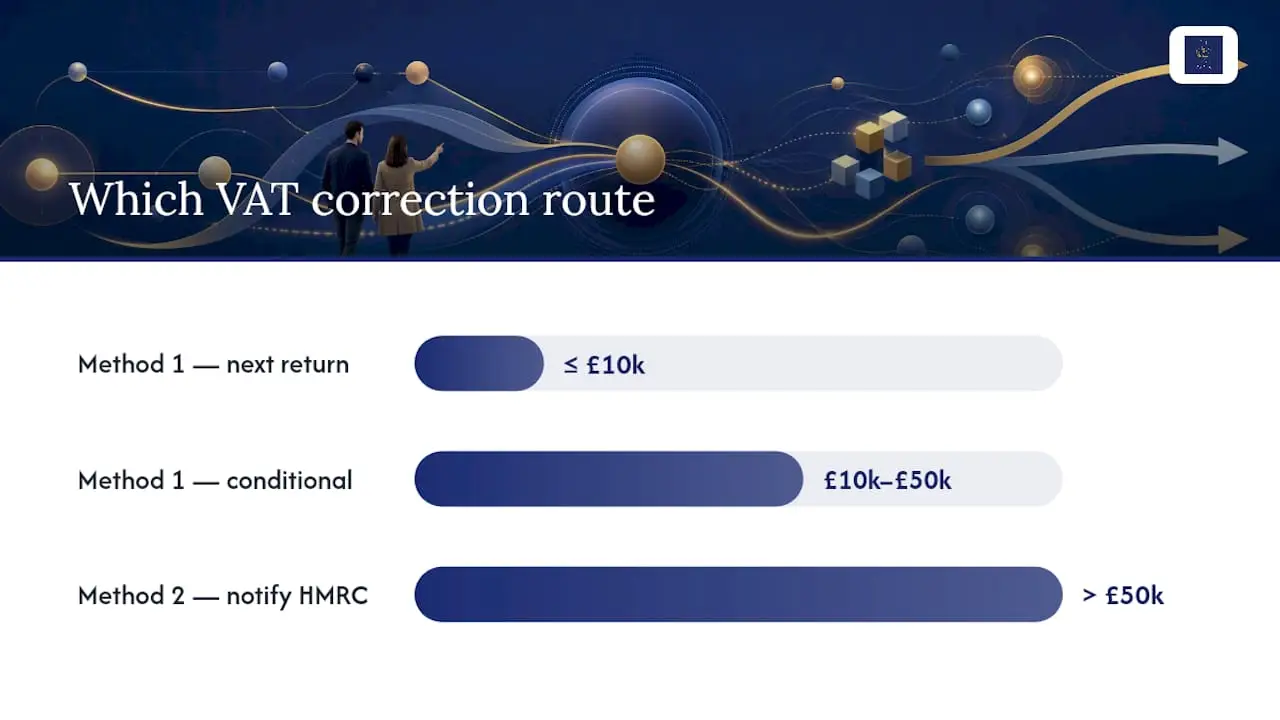
HMRC gives you two ways to put a VAT return error right, and the one you use depends entirely on the size of the net error and whether it was deliberate. VAT Notice 700/45 sets out the thresholds in detail, and they’re worth knowing by heart if you handle VAT regularly.
Method 1: adjust your next VAT return. This applies when:
- The net error is £10,000 or less, regardless of how it arose, or
- The net error is between £10,000 and £50,000, provided it’s less than 1% of your total sales (box 6) for the period in which you discovered it.
Method 2: separate notification to HMRC. You must use this route when:
- The net error exceeds £50,000, or
- It’s between £10,000 and £50,000 but breaches the 1% of box 6 test, or
- The error was deliberate, in which case Method 1 is never available, whatever the amount.
Calculating the net error is straightforward in principle: take the total additional VAT due to HMRC and subtract the total VAT due back to you, following the correct method for calculating your HST returns. According to HMRC’s internal manual, this net figure can only be properly determined once the accounting period has ended, which is why most practitioners wait until period end to total everything up.
In practice, Method 1 means adding the adjustment through box 1 or box 4 on your next return, with a note kept on file explaining the figures. Method 2 is more involved. It requires a full written notification to HMRC setting out how the error arose, the period affected, and your calculations. Method 1 remains sensible for small, routine slips, but a large or systemic problem is better handled through Method 2, where you’re being transparent about the scale rather than quietly folding it into a future return.
How far back can you go? Time limits explained
Most VAT return errors can be corrected up to four years after the end of the prescribed accounting period in which they occurred. Deliberate inaccuracies are treated very differently: HMRC can go back up to 20 years, according to its internal guidance on time limits.
A few timing quirks catch people out:
- Under-claimed input tax is measured from the due date of the return on which it should have appeared, not from the end of the accounting period.
- Most other errors are measured from the end of the prescribed accounting period itself.
- Waiting until period end to total up your net errors is the normal, sensible approach, because that’s the only point at which the net figure can genuinely be calculated.
- Immediate notification overrides waiting. If you already know a single error will breach the thresholds, don’t sit on it until the period closes. Notify straight away.
That last point matters more than it might seem. Waiting when you already know the threshold will be breached can look, in hindsight, like you were trying to bury a large error inside routine bookkeeping. Waiting to aggregate errors is only appropriate when you genuinely don’t yet know the scale.
How do I report a VAT correction to HMRC now?
The paper VAT652 form has gone. HMRC now expects most corrections to come through its online error correction route via the Government Gateway, and agents have had digital access to this since July 2025, according to ICAEW’s coverage of the change. If you’re MTD-exempt, a written notification by post or to HMRC’s dedicated inbox is still available.
Whichever channel you use, your notification needs to cover:
- How the error arose (a supplier invoice missed, a VAT code applied wrongly, a duplicate entry, and so on)
- The VAT accounting period affected
- Whether it’s input tax, output tax, or both
- Whether VAT was underdeclared or overdeclared, and by how much
- Your calculation method and the final totals
Submission should come from the business owner, a nominated officer, or an agent acting with proper authority. Whoever submits it, keep a copy of exactly what was sent, when, and who sent it. That record becomes part of your defence if HMRC later questions the timing or the figures. If you’re already working with an accountant on your VAT return, this is exactly the kind of task worth handing over, since the wording and supporting detail matter more than most people expect.
Will correcting a VAT error trigger a penalty?
Not automatically, and this is the point most business owners get wrong. Fixing the number on your VAT return corrects your tax position; it doesn’t automatically resolve any penalty question sitting alongside it. HMRC looks separately at behaviour.
Broadly, there are three categories:
- Reasonable care. You made a genuine mistake despite having sensible processes in place. Usually no penalty.
- Careless. The error happened because checks that should have caught it didn’t. A penalty is possible, though not guaranteed.
- Deliberate. You knew the return was wrong and submitted it anyway. This attracts the heaviest penalties and the 20 year time limit.
HMRC’s internal guidance on interest and penalties makes clear that voluntary disclosure and prompt correction generally work in your favour, though interest can still apply on VAT paid late regardless of behaviour. What tips the balance is evidence: clear notes on how you found the error, proof you have functioning checks, and a record of how quickly you acted once you knew.
Pro Tip: When you write to HMRC, don’t just state the figures. Explain what went wrong, what you’ve already changed to stop it happening again, and the exact date you discovered it. That framing does more to demonstrate reasonable care than the calculation itself.
If penalties are a recurring worry, it’s worth reading how late filing penalties get assessed too, since the same reasonable care principle runs through both.
Two worked examples: underclaimed input VAT and underdeclared output VAT
Example A: underclaimed input VAT. A small joinery business realises over three months it missed claiming VAT on several supplier invoices totalling £180 net error, well under the £10,000 threshold.
- List each missed invoice and the VAT amount.
- Add them together to get the net error, here £180.
- Since it’s under £10,000, use Method 1: include it in box 4 of your next VAT return.
- Keep the invoice list and a short note explaining the discovery, filed alongside your VAT records.
Example B: underdeclared output VAT. A retailer discovers a systems fault meant one month of sales was undercharged for VAT by £42,000, and box 6 sales for the discovery period are £3.2 million. That £42,000 exceeds 1% of box 6 (£32,000), so Method 1 isn’t available even though it’s under £50,000.
- Calculate the net error precisely: £42,000.
- Confirm it breaches the 1% test against box 6.
- Prepare a Method 2 notification setting out the fault, the period affected, how the figure was calculated, and the corrective steps taken.
- Submit online (or by post if MTD-exempt), keep a copy, and note who signed it off.
What records should you keep when correcting an error?
HMRC expects to see a proper trail, not just a corrected figure appearing from nowhere. Keep:
- A dated discovery note explaining what was found and when
- Original invoices alongside any corrected versions
- Supplier correspondence relevant to the error
- Calculation spreadsheets showing how you arrived at the net figure
- Notes of internal checks carried out afterwards
Digital, timestamped records genuinely help here. Cloud accounting makes the online correction route far more straightforward, because your working papers are already dated and stored rather than scattered across email threads. It also strengthens a reasonable care argument, since you can show exactly when something was flagged and what happened next. If you’re MTD-exempt, your record format doesn’t need to match MTD’s digital link rules, but a clear paper or digital trail still matters just as much for a written notification.
How I handle VAT return errors for clients
When a client flags a possible VAT mistake, I start the same way every time: reconcile the invoices against the VAT codes applied, check nothing’s been duplicated or misclassified, and chase any supplier detail that’s missing before touching the figures.
I record the discovery as a dated internal note, leave the original entries untouched, and build a correction worksheet showing each period’s adjustment with a running net-error total. That single document makes the Method 1 versus Method 2 decision obvious, and it’s the first thing I’d hand to HMRC if a question ever came up later.
Deciding whether to wait until period end or notify immediately comes down to one question: do I already know this breaches £50,000 or the 1% test? If yes, I notify straight away rather than waiting to see what else surfaces. I keep standard wording for disclosures and ask clients for the minimum needed to support it, usually just the invoices, a short explanation, and confirmation of when the error was first spotted.
My take: why the digital change matters more than the thresholds
The thresholds get most of the attention, but the real shift is procedural. Withdrawing VAT652 in favour of an online route via the Government Gateway pushes every business towards keeping digital, timestamped evidence, whether they realise it or not. That’s a genuine improvement, because a scanned form sitting in an inbox never demonstrated reasonable care the way a dated cloud record does.
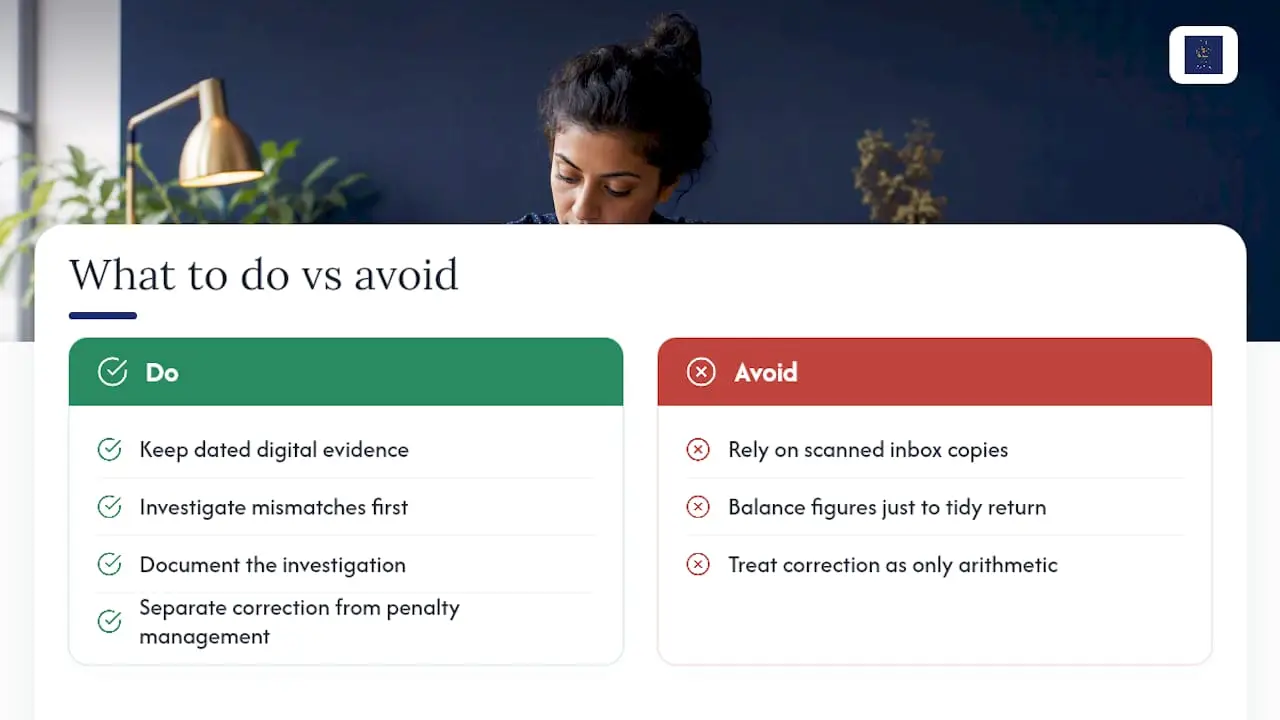
Where I think conventional advice falls short is treating error correction as purely arithmetic. Businesses fixate on getting the net figure right and forget that HMRC is separately weighing behaviour. Correcting the number and managing the penalty position are two different jobs, and the second one needs evidence, not just a revised total.
My priority for readers: don’t force figures to balance just to make a return look tidy. Investigate why the mismatch happened first. A properly documented investigation, even one that takes longer, puts you in a far stronger position than a quick fix that raises more questions than it answers.
— Chris
How I can help with VAT corrections and bookkeeping
CWABC is the alternative to guessing your way through an HMRC notification alone. I handle VAT return support, error correction and HMRC notifications directly, with scope and pricing agreed upfront before any work starts, so there are no surprises halfway through.

I work day to day in Xero, QuickBooks and FreeAgent, and I can either prepare the online notification for you or make the adjustment directly on your next return, whichever route your net error calls for. If ongoing bookkeeping would help stop these errors recurring, my bookkeeping services are built around exactly that. I support businesses across Kent and remotely throughout the UK. If you’ve found a VAT error and aren’t sure which method applies, get in touch through my VAT returns page and I’ll take a look at the figures with you.
Sources
This guide draws on VAT Notice 700/45 for correction methods and thresholds, GOV.UK’s guide to correcting errors for box-level steps, and HMRC’s internal manual entries on time limits and interest and penalties. ICAEW’s update on the digital process change covers the VAT652 withdrawal.
This article is general information, not a substitute for advice from a qualified financial advisor. Consult a qualified financial professional about your own circumstances before acting on anything here.
- How to correct VAT errors and make adjustments or claims (VAT Notice 700/45)
- HMRC updates process for correcting VAT errors
FAQ
What are the rules for correcting VAT return errors?
Errors of £10,000 or less, or up to £50,000 provided they’re under 1% of box 6, can be adjusted on your next VAT return. Larger or deliberate errors need separate notification to HMRC using its online correction route.
How far back can HMRC go for VAT errors?
The standard limit is four years from the end of the relevant accounting period. For deliberate inaccuracies, HMRC can go back up to 20 years.
What is the penalty for making an error in my VAT return?
There’s no automatic penalty. HMRC assesses whether you took reasonable care, were careless, or acted deliberately, and prompt voluntary disclosure generally works in your favour even though interest may still apply.
How long does a VAT error correction take?
A Method 1 adjustment takes effect as soon as you submit your next VAT return. A Method 2 notification depends on HMRC’s processing time once you’ve submitted it online or in writing, and there’s no fixed published turnaround.
Can I get help correcting a VAT error?
Yes. I offer direct VAT correction and notification support through my VAT returns service, with pricing agreed before any work begins.
Need help?
If you’ve spotted an error on a submitted VAT return and aren’t sure which method applies, or you’d rather someone experienced handled the notification, get in touch with CWABC and I’ll talk you through the options.