Allowable expenses for sole traders are business costs that HMRC permits you to deduct from your income before calculating your tax bill. The legal basis sits in Section 34 ITTOIA 2005, which states that a cost must be incurred “wholly and exclusively” for the purposes of your trade to qualify. Get this right and you pay tax only on your actual profit, not your total turnover. Get it wrong and you either overpay tax or face an HMRC enquiry. This guide covers allowable expenses sole trader explained in plain English, including the key rules, common categories, claim methods, and the mistakes that cost sole traders money every year.
What qualifies as an allowable expense under HMRC rules?
An expense qualifies as a deductible business cost when it passes the “wholly and exclusively” test under Section 34 ITTOIA 2005. This is the single most important rule in sole trader tax deductions, and understanding it properly saves you money and stress.
The rule works in three ways:
- Wholly business: The cost is 100% for business purposes. You claim the full amount. A dedicated business phone line is a clear example.
- Wholly personal: The cost has no business purpose. You cannot claim any of it. Your weekly food shop is personal, full stop.
- Mixed use: The cost serves both business and personal purposes. You can claim the business portion only, provided you can separate it with a reasonable calculation.
HMRC does allow apportionment for mixed expenses, but only when the business and personal elements are genuinely separable. If you cannot draw a clear line between the two, HMRC may reject the entire claim. A useful test is intent: if you wouldn’t have purchased the item but for your business, it generally qualifies. That principle helps when you are unsure whether something sits on the right side of the line.
Some costs are explicitly disallowed regardless of how you frame them. Clothing is a common trap. A suit worn to client meetings is not allowable because you could wear it outside work. A branded uniform or specialist protective gear is allowable because it has no realistic personal use. Commuting costs between your home and a regular workplace are never deductible, even if you work long hours or travel a significant distance.
Pro Tip: Keep a brief written note at the time of purchase explaining the business reason for each expense. HMRC can ask you to justify claims up to four years later, and a contemporaneous note is far more convincing than a memory.
How to claim home office and vehicle expenses as a sole trader
Home office and vehicle costs are the two categories where sole traders most often get confused. Both involve mixed use, and both offer a choice between claiming actual costs or using HMRC’s simplified flat rates.
Home office expenses
Working from home means a portion of your household bills becomes a legitimate business cost. You have two methods to choose from.
Actual cost apportionment divides your household costs by the number of rooms used for work and the proportion of time spent working. For example, if you use one room in a five-room house for business eight hours a day, you calculate the relevant fraction of your rent or mortgage interest, heating, electricity, and broadband. This method requires more record keeping but often produces a higher deduction.
HMRC’s simplified flat rates remove the calculation entirely. Flat rates correspond to business use hours per month and are updated periodically by HMRC. The current tiers are:
| Hours worked from home per month | Monthly flat rate |
|---|---|
| 25–50 hours | £10 |
| 51–100 hours | £18 |
| 101 hours or more | £26 |
The flat rate covers heat, light, and power only. It does not cover broadband, phone, or mortgage interest, so you can still claim those separately on an apportioned basis.
Vehicle expenses
For a personal vehicle used partly for business, you again have two options. The actual cost method requires you to track all running costs (fuel, insurance, servicing, road tax) and multiply the total by your business mileage percentage. This suits sole traders with high actual costs and a high proportion of business use.
The mileage allowance method is simpler. Mileage rates are 45p for the first 10,000 miles and 25p per mile thereafter in the 2026/27 tax year. This single rate covers all running costs, so you cannot claim fuel or servicing on top. Once you choose the mileage method for a vehicle, you must stick with it for the life of that vehicle.
Commuting expenses are never allowable for sole traders, regardless of distance. Driving from home to your regular place of work is personal travel in HMRC’s view, even if you run your own business.
Pro Tip: Log every business journey in a simple mileage record: date, destination, purpose, and miles. A spreadsheet or a dedicated mileage app works well. Consistent records are your best defence if HMRC questions your vehicle claims.
What are the common categories of allowable expenses for sole traders?
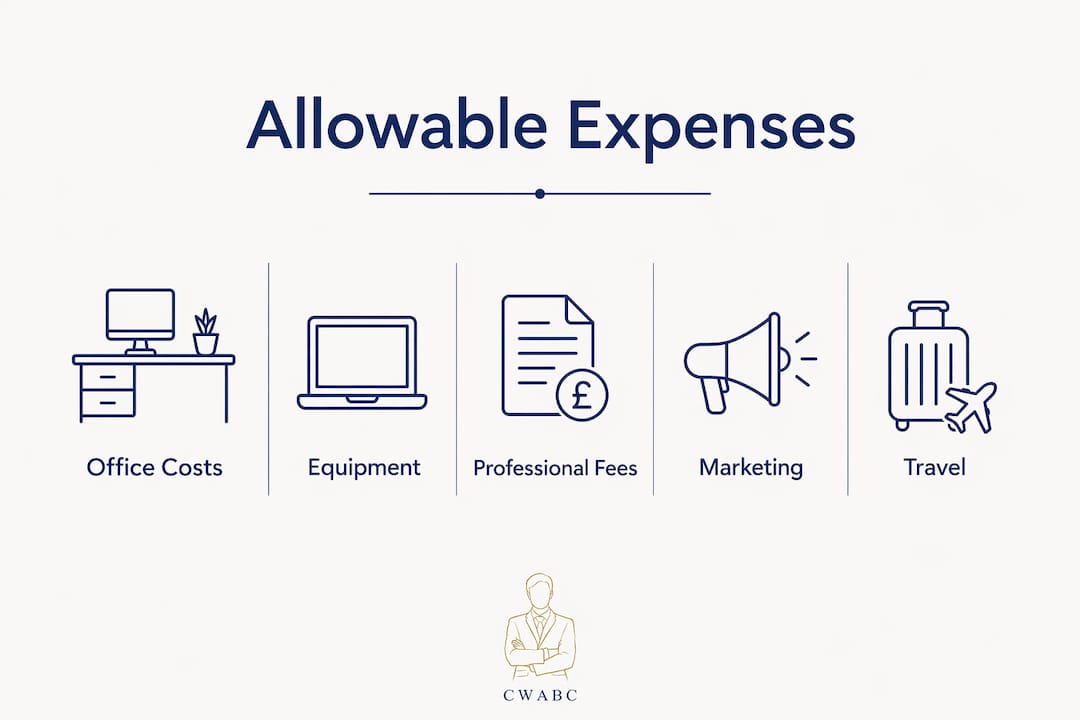
Most sole trader expenses fall into a handful of clear categories. Knowing these categories helps you spot costs you may be missing and keeps your records organised for your self-assessment tax return.
Office and administration costs
Stationery, printer ink, postage, and business software subscriptions all qualify. Your business mobile phone bill is allowable in full if the phone is used exclusively for business, or on an apportioned basis for a personal phone with business use. Cloud storage, accounting software, and project management tools used for your trade are deductible.

Equipment and capital allowances
Laptops, cameras, tools, and machinery used in your business qualify for relief. Smaller items used wholly for business can often be expensed in full in the year of purchase under the Annual Investment Allowance (AIA). Larger or mixed-use assets may need to go through the capital allowances system instead. The key point is that equipment is not simply “expensed” in the same way as a phone bill. Speak to an accountant if you are unsure which route applies.
Professional fees and training
Accountancy, bookkeeping, solicitor fees, and professional indemnity insurance are fully allowable expenses. These are among the most commonly overlooked deductions, which means many sole traders pay more tax than they need to. Legal fees for business contracts or debt recovery also qualify.
Training costs are allowable only when they maintain or update skills you already use in your trade. A plumber attending a refresher course on current regulations can claim the cost. The same plumber attending a course to qualify as an electrician cannot, because training to acquire new skills falls outside the allowable definition.
Marketing and advertising
Website costs, business cards, online advertising, and social media promotion all qualify. Sponsorship of a local event can qualify if there is a clear business benefit. Branded merchandise given to clients as part of a marketing campaign is generally allowable.
Travel and subsistence
Business travel to client sites, supplier meetings, and temporary workplaces is deductible. Meals during overnight business travel and client meals directly related to business discussions can be allowable if properly documented. General client entertainment, such as taking a client to a restaurant without a specific business discussion, is not allowable. Keep receipts and note the business purpose on each one.
Costs that are not allowable
The following are explicitly disallowed:
- Commuting between home and your regular workplace
- General clothing not specific to your trade
- Client entertainment and hospitality
- Personal mobile phone costs where no business use exists
- Fines and penalties, including parking fines
- Personal pension contributions (these go through a different relief mechanism)
How do you optimise your expense claims as a sole trader?
Claiming expenses correctly is one part of the picture. Claiming them well, and avoiding common errors, is where sole traders often leave money on the table or create problems for themselves later.
The £1,000 trading allowance
The trading allowance lets you deduct a flat £1,000 from your gross income instead of claiming actual expenses. The trading allowance cannot be combined with actual expenses. You choose one or the other each tax year. If your actual allowable expenses total less than £1,000, the trading allowance gives you a higher deduction with zero record keeping. If your expenses exceed £1,000, claiming actual costs is almost always better. You can switch between the two methods year to year, so it pays to calculate both before filing.
Record keeping that protects you
HMRC expects you to keep financial records for sole traders for at least five years after the relevant Self Assessment deadline. That means receipts, bank statements, mileage logs, and invoices. Digital records are perfectly acceptable and make retrieval far easier. Making Tax Digital for Income Tax, which applies to sole traders with qualifying income from April 2026, requires digital record keeping as standard.
Good records also let you calculate your business use percentages accurately. If you claim 60% business use on your broadband, you need evidence that supports that figure. A log of business versus personal use over a representative period is the most defensible approach.
Common mistakes to avoid
- Claiming commuting as a business travel cost
- Claiming the full cost of a mixed-use phone or vehicle without apportionment
- Forgetting to claim professional fees such as accountancy costs
- Mixing personal and business spending in one bank account, which makes apportionment harder to prove
- Claiming client entertainment as a subsistence cost
Pro Tip: Review your expense claims at the end of each quarter, not just at year-end. Catching a miscategorised cost in october is far easier than untangling twelve months of records in january.
Key takeaways
Sole traders who understand and apply the “wholly and exclusively” rule correctly will always pay the right amount of tax, no more and no less.
| Point | Details |
|---|---|
| The core legal test | Expenses must be wholly and exclusively for business under Section 34 ITTOIA 2005 to be deductible. |
| Mixed-use apportionment | You can claim the business portion of mixed expenses, but only when the split is clearly evidenced. |
| Home office and vehicle choice | HMRC flat rates simplify claims; actual cost apportionment often produces a higher deduction. |
| Trading allowance option | The £1,000 trading allowance suits sole traders with low actual expenses and removes the need for detailed records. |
| Record keeping is non-negotiable | Keep receipts, logs, and bank records for at least five years to support every claim you make. |
What I have learned from working with sole traders on their expenses
Working with sole traders across Kent and beyond, I see the same patterns come up again and again. The “wholly and exclusively” rule sounds simple on paper, but in practice it catches people out in subtle ways.
The biggest surprise for most sole traders is how many professional service costs they have never claimed. Accountancy fees, bookkeeping costs, and professional indemnity insurance are all fully deductible. Failing to claim these costs means paying tax on income that was genuinely spent running the business. That is not a grey area. It is a straightforward deduction that gets missed because people assume professional fees are somehow different from other expenses.
I also see sole traders overcomplicating the home office calculation when the simplified flat rates would serve them perfectly well. If you work from home for more than 101 hours a month, you claim £26 per month with no further calculation needed. That is a clean, defensible figure that HMRC accepts without question. For many sole traders, particularly those just starting out, simplicity is worth more than squeezing out an extra few pounds through a complex apportionment.
The area where I urge the most caution is vehicle expenses. The mileage allowance method is straightforward, but once you commit to it for a vehicle, you cannot switch to actual costs for that same vehicle. Make the decision carefully at the start, and keep your mileage log from day one. A mileage log with gaps is almost as problematic as no log at all.
My honest advice: do not wait until january to think about your expenses. Set up a simple system in the first week of your trading year. A dedicated business bank account, a folder for receipts (physical or digital), and a monthly review takes less than an hour a month. That hour saves you far more in tax and stress than any last-minute scramble ever will. If you are unsure whether a cost qualifies, ask before you claim it, not after. The signs you need an accountant are often visible long before a problem becomes serious.
— Chris
Need help with your sole trader expenses?
Sorting out your allowable expenses does not need to be stressful. Cwabc works with sole traders across Tonbridge and Kent to make sure every legitimate deduction is claimed correctly and every record is in order before your Self Assessment deadline.
Whether you need help setting up a bookkeeping system that tracks your expenses from day one, or you want someone to review your current claims and spot what you might be missing, Cwabc offers clear, upfront pricing and no-jargon advice. We also support sole traders with Making Tax Digital compliance, accounting software setup, and accurate tax return preparation. Visit our bookkeeping FAQs or contact us for a free, no-obligation conversation.
FAQ
What does “wholly and exclusively” mean for sole traders?
“Wholly and exclusively” means the expense must have been incurred solely for business purposes to be deductible under Section 34 ITTOIA 2005. Costs with a personal element can only be claimed if the business and personal portions are clearly separable.
Can I claim both the trading allowance and actual expenses?
No. The £1,000 trading allowance and actual expense claims are mutually exclusive. You choose one method per tax year, though you can switch between them in different years.
Are home office costs allowable if I work from home part-time?
Yes. You can claim either an apportioned share of actual household costs or HMRC’s simplified flat rates, which start at £10 per month for 25–50 hours of home working per month.
What vehicle expenses can I claim as a sole trader?
You can claim either the HMRC mileage allowance (45p per mile for the first 10,000 business miles, then 25p per mile) or actual running costs apportioned by business mileage. Commuting between home and your regular workplace is never allowable.
Do I need receipts for every expense I claim?
HMRC expects you to keep records supporting every claim, including receipts, invoices, and bank statements, for at least five years after the relevant Self Assessment filing deadline. Digital copies are acceptable and recommended for ease of retrieval.