Payments on account are two advance instalments towards your next Self Assessment tax bill. HMRC (His Majesty’s Revenue and Customs, the UK tax authority) usually asks for them on 31 January and 31 July, and each is normally half of your previous year’s bill. If your income has dropped, you can ask to reduce them. If this is the first time you have seen them, the January figure can look alarming, but it is not a penalty. I’ll take you through it calmly, step by step.
TL;DR
- Payments on account are advance payments towards next year’s tax and Class 4 National Insurance. They are due on 31 January and 31 July.
- Each one is normally 50% of your previous year’s Self Assessment bill. You can skip them if that bill was under £1,000, or if more than 80% was already paid at source.
- Your 31 January payment is often much bigger than you expect, because it can include a balancing payment and the first payment on account together.
- If your profits or other income have fallen, you can apply to reduce the payments. Do it through your HMRC online account or with form SA303.
- Setting money aside as you earn is the simplest way to take the stress out of it.
Table of Contents
- What payments on account actually are
- Who has to make them
- When they are due
- How HMRC calculates them
- A worked example
- What if your income falls?
- Common mistakes I see people make
- Can’t pay on time?
- Planning for payments on account
- Does this affect landlords differently?
- Making Tax Digital for Income Tax
- My perspective
- How I can help
- FAQ
- Need help with payments on account?
- Sources
What payments on account actually are
HMRC describes payments on account as payments towards your next tax bill, including Class 4 National Insurance if you are self-employed. They exist to spread the cost of your tax into two instalments rather than one large payment.
A good way to think about it is this. If you are an employee, tax comes out of every payslip. If you are self-employed or a landlord, nobody deducts anything for you. Payments on account are HMRC’s way of collecting something during the year, using last year’s figures as a guide.
They are not an extra tax. You are paying next year’s bill early, in two parts. When you file your next return, the payments you have already made are deducted from what you owe.
They are also not optional once they have been calculated. They arise automatically, which is why many people first find out about them when the first bill arrives.
Who has to make them
The rules are straightforward once you see them side by side. HMRC says you must make two payments on account each year, unless your last Self Assessment bill was under £1,000, or you already paid more than 80% of it through tax deducted at source. Examples of tax deducted at source are PAYE on a salary and CIS (Construction Industry Scheme) deductions.
| Your situation | Payments on account? |
|---|---|
| Self-employed, last bill £4,000, nothing deducted at source | Yes |
| Landlord with a salary, last Self Assessment bill £800 | No, bill under £1,000 |
| Employee with side income, last bill £3,000, of which £2,700 was paid through PAYE | No, 90% paid at source |
| Subcontractor, last bill £5,000, £3,000 paid through CIS deductions | Yes, only 60% paid at source |
The 80% test catches people out. Having some tax deducted is not enough. It has to be more than 80% of your total liability for the year. If you are close to the line, it is worth checking your figures before you assume either way.
The first year you file Self Assessment you do not have payments on account, because there is no previous bill to base them on. Instead you pay the whole bill in one go on 31 January. The next January is when it often hits: your bill for the year just ended plus the first advance payment for the year ahead. That is the “January surprise” I explain in more detail in my post on the first big January bill.
When they are due
There are two dates to remember:
- 31 January: any balancing payment for the tax year that has just ended, plus your first payment on account for the new tax year.
- 31 July: your second payment on account.
These match HMRC’s usual payment deadlines. The dates in a current example:
- The 2025 to 2026 tax year ended on 5 April 2026.
- The balancing payment for 2025 to 2026 and the first payment on account for 2026 to 2027 are due by 31 January 2027.
- The second payment on account for 2026 to 2027 is due by 31 July 2027.
Payments need to reach HMRC by the deadline, so do not leave it to the last evening. HMRC’s own guidance covers the ways to pay, and the HMRC app is increasingly popular for Self Assessment payments.
How HMRC calculates them
There is one main method. When you file your Self Assessment return, HMRC looks at your total bill for that year (income tax and Class 4 National Insurance, less anything deducted at source). Each payment on account is half of that figure. HMRC’s manual sets out the statutory basis for the calculation if you want the technical detail.
The key points:
- The calculation is based on last year’s liability, not your current income.
- It is purely backward-looking. If your profits fell this year, HMRC does not know until you tell it, or until you file.
- Once your return is filed and the true figure is known, any difference is settled in the balancing payment.
That last point is what makes payments on account feel confusing. You are always paying one year ahead on an estimate, then settling up afterwards.
A worked example
Let’s use round numbers. This is an illustration, not your tax calculation.
Sam is a self-employed electrician. There is no tax deducted at source and no other income.
Step 1: the year before. Sam’s 2024 to 2025 Self Assessment bill, including Class 4 National Insurance, was £6,000. That is over £1,000 and nothing was paid at source, so payments on account arise for 2025 to 2026:
- First payment on account: £3,000 (due 31 January 2026)
- Second payment on account: £3,000 (due 31 July 2026)
Step 2: the year ends. Sam has a better year. When the 2025 to 2026 return is filed, the real bill is £8,000. Sam has already paid £6,000 on account, so the difference is a balancing payment of £2,000.
Step 3: next year’s payments on account. Because the 2025 to 2026 bill was £8,000, the new payments on account for 2026 to 2027 are £4,000 each.
Step 4: what Sam pays on 31 January 2027.
| Item | Amount |
|---|---|
| Balancing payment for 2025 to 2026 | £2,000 |
| First payment on account for 2026 to 2027 | £4,000 |
| Total due 31 January 2027 | £6,000 |
Step 5: 31 July 2027. Sam pays the second payment on account of £4,000.
The real bill for 2026 to 2027 will only be known when that return is filed. Say it comes to £8,500. Sam has paid £8,000 on account and owes a balancing payment of £500 by 31 January 2028, plus the first payment on account for 2027 to 2028.
If the bill turned out to be £7,000 instead, Sam would have overpaid by £1,000. HMRC would either refund it or put it towards another bill. That is why reducing payments in advance matters when income genuinely falls, which is next.
What if your income falls?
Suppose Sam’s work dries up in 2026 to 2027 and the expected bill is only £5,000. Paying £4,000 twice would mean lending HMRC £3,000 until the return is processed. You can ask HMRC to reduce the payments instead.
HMRC says you can apply to reduce your payments on account if:
- your business profits or other income have gone down
- the tax relief you are entitled to has gone up
- tax deducted at source is more than in the previous tax year
In Sam’s case, a reduced estimate of £5,000 would mean £2,500 on each date instead of £4,000.
You can apply online or by filling in form SA303 on screen, printing it and posting it. HMRC also says you need to claim by 31 January after the end of the tax year. In practice, do it well before the payment you want to change falls due, so the lower figure is in place on time.
How to reduce them, step by step
- Estimate your current year’s tax. Use your actual figures to date. Cloud software helps, because you can see profit as it builds.
- Compare it with last year’s bill. If you reasonably expect it to be lower, a reduction may be justified.
- Log in to your HMRC online account and use the reduction service, or complete SA303.
- Give a figure you can support. Keep your workings and records.
- Check HMRC’s confirmation and diary the new amounts.
A caution about reducing too far
Reducing is not a free lunch. If you cut your payments too low and your final bill turns out higher, HMRC can charge interest on what you underpaid, and it can issue penalties if you gave a figure you did not reasonably believe. Aim for an honest, evidenced estimate, not the lowest number you can get away with. If your income is uneven, say seasonal trading or lettings with gaps between tenants, ask for a second opinion before you claim.
If your income has gone up instead, you do not need to do anything. The extra gets settled in the balancing payment.
Common mistakes I see people make
- Treating the January bill as one payment. It is often two or three things stacked together. Check each part.
- Forgetting Class 4 National Insurance. It is included in the calculation if you are self-employed.
- Not budgeting for the first year. The first January with payments on account feels like paying two years of tax at once, because in cash terms you are.
- Assuming the 80% rule applies because some tax was deducted. It must be more than 80% of the whole bill.
- Waiting until the bill arrives to reduce. If your income has clearly fallen, act early so your cash stays in the business.
- Ignoring a second payment. 31 July is easy to forget because it sits in the quiet part of the year.
Can’t pay on time?
If you cannot pay in full, do not ignore it. HMRC has said people who cannot pay by the deadline may be able to set up a Time to Pay arrangement online and spread the cost over monthly instalments. Eligibility depends on your circumstances and the amount owed, so check HMRC’s current guidance. Interest still accrues on any amount paid late.
Planning for payments on account
The simplest approach is a separate savings pot for tax.
- Move a fixed percentage of every payment received into a savings account. Your accountant can suggest a sensible percentage based on your profits.
- Look at your bill early in the year. Do not wait for the autumn.
- Keep records up to date. A monthly bookkeeping routine means you know your profit when you need to decide whether to reduce.
- Diary the dates. Put 31 January and 31 July in your calendar, with a reminder a month ahead.
If you want a structured way to do this, my guide to a small business tax payment budget plan walks through it. And if you are a landlord, my pages on rental income tax and the annual landlord tax deadline checklist show how rental profit feeds into the same bill.
A longer explanation of the basics is also on my page about Self Assessment payments on account.
Does this affect landlords differently?
The rules are the same, but the pattern of income can be different. A landlord whose property was empty for several months, who has paid for a big repair, or who has sold a property may find that this year’s rental profit is well below last year’s. Those are exactly the situations where a reduction can make sense.
It also works the other way. If you have raised rents or added a property, your bill will probably rise and the balancing payment will catch up. Knowing that in advance means no nasty surprise.
Making Tax Digital for Income Tax
Making Tax Digital for Income Tax (MTD for Income Tax) is HMRC’s move to digital record-keeping and quarterly updates for many self-employed people and landlords. It does not abolish payments on account, but keeping digital records throughout the year does make it much easier to see your profit as it builds. If you want to know how it applies to you, see my page on Making Tax Digital for Income Tax support.
My perspective
When clients first meet payments on account, the reaction is usually the same: “Why am I being asked for tax I haven’t earned yet?” It feels like a tax rise. It is really a pre-payment of your own liability, and I find it helps to treat it as a budgeting tool. Once you can see the two dates and the likely amounts, the January scramble loses most of its power.
The part where I add most value is the middle of the year. HMRC’s calculation looks backwards. Your business does not. If I can see your figures in cloud software such as Xero, QuickBooks or FreeAgent, I can help you estimate where this year is heading and whether a reduction is worth claiming. I work directly with each client, explain the numbers in plain English, and keep it practical.
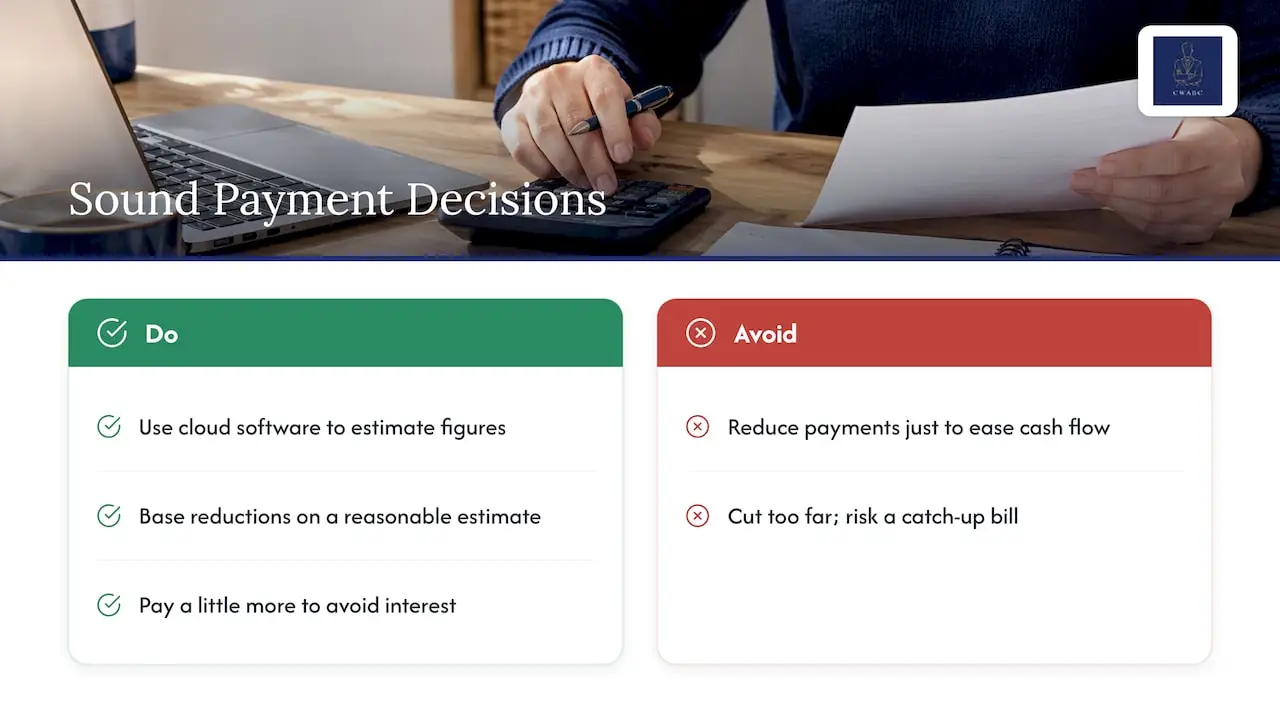
I would also say this plainly: I will not tell you to reduce payments just to ease cash flow if the figures do not support it. A reduction has to be based on a reasonable estimate, and I would rather you pay a little more and avoid interest than cut too far and face a catch-up bill. Everything here is general information and your own position will depend on your circumstances.
— Chris
How I can help
If payments on account are catching you out, I can help in practical ways:
- Explain your bill. I can break down what is balancing payment and what is payment on account, so you know what each number is for.
- Prepare your return. My Self Assessment tax return service starts from £250 one-off.
- Keep your records ready. My bookkeeping services keep your profit visible through the year, so a decision on reducing is based on real figures.
- Plan ahead. I can help you review whether a reduction is appropriate, and put aside the right amounts for the next two dates.
I work with sole traders, landlords and small business owners in Tonbridge, Sevenoaks and across Kent, and remotely across the UK. Pricing beyond the Self Assessment starting figure is agreed clearly upfront, depending on what you need.
FAQ
What does “payment on account” mean?
It means an advance payment towards your next tax bill. HMRC asks for two a year, on 31 January and 31 July, each usually half of your previous year’s bill. They are credited against your final bill once your return is filed.
Can I avoid payments on account?
You do not have to make them if your last Self Assessment bill was under £1,000, or if more than 80% of it was already paid through tax deducted at source. Otherwise they arise automatically. You can reduce them if your income has fallen, but not simply to avoid them.
What happens if I reduce them too much?
If your final bill is higher than the reduced payments covered, you pay the shortfall as a balancing payment. HMRC can charge interest on the underpaid amount, and penalties may apply if the claim was not reasonable. Base your figure on real records, and talk to an accountant if you are unsure.
Will I get a refund if I overpaid?
Yes. If your payments on account were more than your final bill, the difference is credited to you. HMRC can refund it or use it against other tax you owe. Reducing in advance avoids tying up the money in the meantime.
Do payments on account apply in my first year?
Not in your first year of Self Assessment, because there is no earlier bill to base them on. You pay the full bill by 31 January. The following year, payments on account usually begin if the earlier bill was £1,000 or more and not mostly covered at source.
Need help with payments on account?
If you would like help understanding your upcoming payments, checking whether a reduction is right for you, or planning ahead for 31 January and 31 July, I’d be happy to talk it through. Get in touch with me here. I will give you a clear, jargon-free answer, though I cannot guarantee any particular outcome with HMRC.
Sources
- Understand your Self Assessment tax bill: Payments on account, GOV.UK
- Claim to reduce payments on account, GOV.UK
- Pay your Self Assessment tax bill: Overview, GOV.UK
- SAM1010 Calculation of payments on account, HMRC internal manual
- 65% rise in Self Assessment payments via the HMRC app, GOV.UK
- HMRC offers time to help pay your tax bill, GOV.UK