
If your property has been your only or main residence for the relevant period, Private Residence Relief will usually exempt the gain from Capital Gains Tax. Check three things now: whether the home was genuinely your main residence throughout, whether any part was let or used exclusively for business, and whether you need to file a 60 day return. Exceptions around letting, business use and lengthy absences can reduce the relief, so it’s worth confirming your position before you assume the sale is tax free.
TL;DR:
- For disposals on or after April 6, 2020, the final 9 months count automatically; calculate relief by dividing qualifying months by total ownership months.
- Absences may qualify for 3 years for any reason or 4 years for work relocation if the property was your main residence before and after.
- Lettings relief requires you to live in one part while renting another, and is capped at the lowest of PRR, £40,000, or the related gain.
- Only rooms used exclusively for business fall outside relief; a room that also serves personal needs, such as a guest bedroom, remains covered.
- If a chargeable gain remains, UK residents must report and pay within 60 days of completion, then include the disposal on their Self Assessment return.
Table of Contents
- Who qualifies for full private residence relief
- How PRR is calculated when you don’t qualify for full relief
- Periods of absence and deemed occupation rules
- Lettings relief and the post-2020 restrictions
- Business use and apportionment where part of the property was used for trade
- Reporting, claiming and immediate steps
- Worked example and guidance for using a PRR/CGT calculator
- How an AAT-licensed accountant helps sellers with evidence, traps and services
- A note on getting the detail right
- Get help with your private residence relief calculation
- FAQ
- Sources
- Need help?
Who qualifies for full private residence relief
HMRC looks at whether a property was your “only or main residence” throughout the period you owned it. This isn’t just about where your post goes. HMRC weighs up how long you lived there, the quality of occupation, and your intentions at the time, according to commentary from Deloitte’s TaxScape, which notes there’s no set minimum residence period, just a factual assessment of permanence and continuity.
A few conditions need to stack up before you can rely on full relief:
- The property was your only or main home for the whole time you owned it, or qualifies through the allowed exceptions covered later in this guide.
- The garden and grounds sit within the permitted area, normally up to 0.5 hectares including the footprint of the house, though HMRC can accept more where the size is in keeping with the character and size of the house.
- No part of the home was used exclusively for a trade or business, since that portion falls outside the relief.
- Your period of ownership for relief purposes starts no earlier than 31 March 1982, so any gain attributable to ownership before that date is simply not in scope.
The final period before you sell counts automatically towards occupation, even if you’d already moved out, which helps smooth over the practical gap between moving and completing a sale. We cover exactly how long that final period runs later in this guide, since it changed in 2020.
How PRR is calculated when you don’t qualify for full relief
When part of your ownership period doesn’t count as qualifying residence, you don’t lose the whole relief. Instead, HMRC uses time apportionment: the exempt fraction is qualifying months divided by total months of ownership, applied to the total gain.
For disposals on or after 6 April 2020, the final 9 months of ownership count as qualifying time automatically, even if you’d already moved out, under CG64985.
9 months is the final period exemption for disposals on or after 6 April 2020, replacing the longer 18 and 36-month periods that applied to earlier disposals. That single change catches out a lot of sellers who remember the old rules from a previous sale.
Here’s the arithmetic, step by step:
- Work out the total gain: sale proceeds minus purchase price minus allowable costs (legal fees, agent fees, qualifying improvements).
- Count total months of ownership and qualifying months (actual occupation plus any deemed periods plus the final 9 months).
- Divide qualifying months by total months to get the exempt fraction.
- Multiply the total gain by that fraction to find the exempt amount, then subtract it from the total gain to find the chargeable amount.
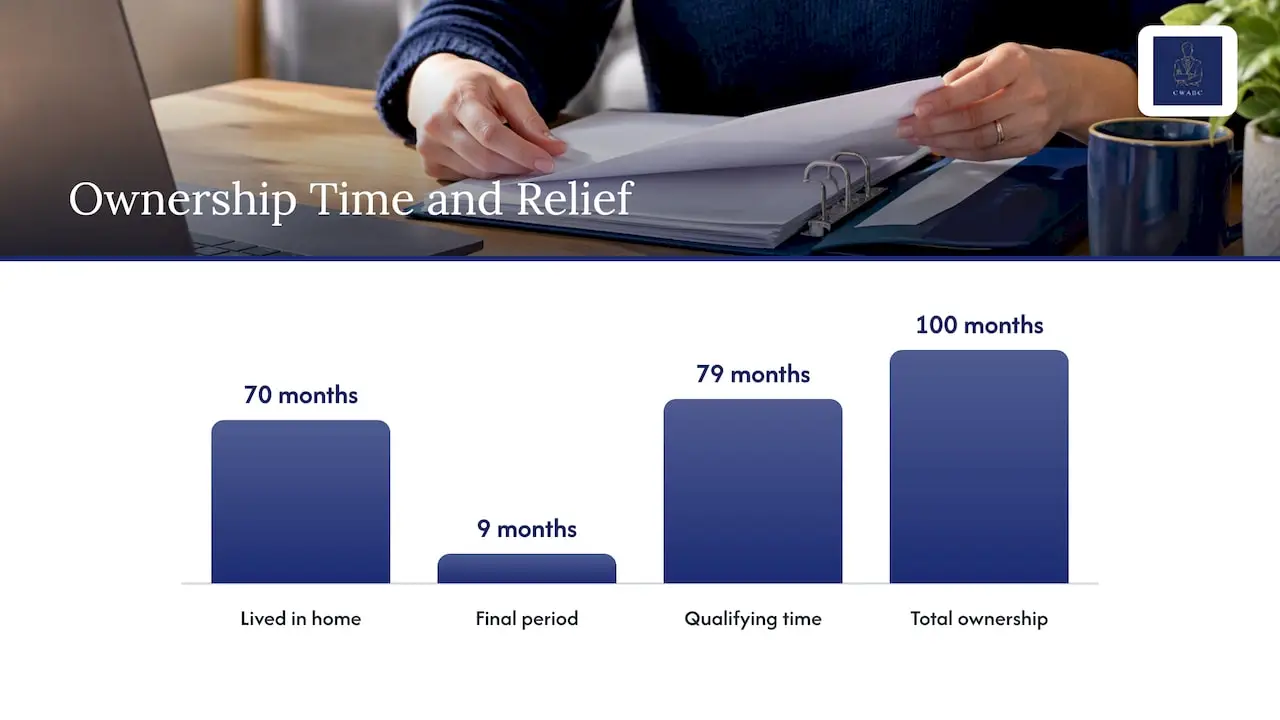
Say a flat cost £200,000 and sold for £320,000 after £5,000 of allowable costs, giving a total gain of £115,000. If you owned it for 100 months and lived in it for 70 of those, plus the final 9 months count automatically, that’s 79 qualifying months out of 100.
Keep your completion dates, purchase and sale contracts, and any records of when you moved in and out. Those dates are the only inputs that really matter to get the fraction right.
Periods of absence and deemed occupation rules
Not every gap in occupation breaks your claim to relief. HMRC treats certain absences as deemed occupation, provided the property was your main residence before the absence and, in most cases, afterwards too.
The allowed periods, confirmed in HMRC’s Capital Gains Manual, are:
- Up to 3 years away for any reason at all, which can be used once or in separate periods.
- Up to 4 years where your employer requires you to live elsewhere, whether in the UK or abroad.
- Any period working abroad in an employment where all duties are performed overseas, which has no time limit under the relevant rules.
- Matching treatment for spouses and civil partners, since only one main residence can be nominated between a couple living together.
Older guidance sometimes refers to 36 month or 18 month final periods. Those figures only apply to disposals before 6 April 2020; for a sale happening now, the final period exemption is 9 months, as set out in CG64985.
If you own more than one home, you can nominate which one counts as your main residence for PRR purposes. You have 2-year from acquiring the second property to make that nomination to HMRC, and missing the window can mean HMRC decides the question for you based on the facts.
Lettings relief and the post-2020 restrictions
Lettings relief used to cover a lot of former landlords selling a home they’d once rented out entirely. That changed in April 2020, and the rules are now much narrower.
- Lettings relief only applies where you were living in part of the property while another part was let out, so whole-house letting after you moved out no longer qualifies.
- The relief is capped at the lowest of three figures: the amount of PRR already given, £40,000, or the gain attributable to the letting period, according to HMRC’s HS283 helpsheet.
- It’s calculated after PRR itself, not instead of it, so you work out your time-apportioned relief first and then see whether any chargeable gain remains for lettings relief to reduce.
Say you lived in two rooms of a house while letting the rest to a lodger throughout ownership, and £15,000 of your overall chargeable gain relates to that letting period. Lettings relief would cover the full £15,000, since it’s below both the PRR amount and the £40,000 cap.
Pro Tip: If you moved out entirely and let the whole property before selling, don’t assume lettings relief applies, since it’s one of the most commonly misunderstood reliefs among people who sold a former rental home before checking the 2020 changes.
If this sounds like your situation, our guide to PRR for homes that have been rented out walks through the calculation in more detail.
Business use and apportionment where part of the property was used for trade
Only the part of your home used exclusively for a trade or business falls outside PRR. A spare room used as an office that doubles as a guest bedroom still counts as residential, because the business use isn’t exclusive.
- Under section 224(1) TCGA 1992, only rooms with no personal use at all are carved out of the relief, so most home working arrangements stay fully covered.
- Where use of a room has changed over time, for example a garage converted to a workshop and later back to storage, section 224(2) allows an adjustment made “in a manner which is just and reasonable”, which usually means apportioning by floor area and time.
- For a material dispute over values, it’s worth asking the Valuation Office Agency for a formal apportionment rather than relying on an estimate, particularly where a large sum turns on the split.
Reporting, claiming and immediate steps
If any chargeable gain remains after PRR and lettings relief, UK residents must report the disposal to HMRC within 60 days of completion, under the rules confirmed in HS283.
- Check whether a chargeable gain exists at all; if PRR covers the whole gain, there’s usually nothing to report.
- File the 60 day return online through your HMRC account if a chargeable gain remains, paying any tax due within the same window.
- Include the disposal on your Self Assessment return for the tax year as well, using the PRR or LET descriptions HMRC expects in the computation, as HS283 sets out.
- Keep supporting paperwork: completion statements, improvement invoices, tenancy agreements, council tax records and utility bills showing your occupation dates.
Our guide to the 60 day CGT return covers the filing process step by step if you need to report a gain.
Worked example and guidance for using a PRR/CGT calculator
If the gain is your only one for the year, deduct the Annual Exempt Amount of £3,000 for 2026/27, leaving £21,150 taxable.
CGT on residential property is charged at 18% within your basic rate band and 24% above it, under current rates for 2026/27.
To run your own rough estimate, a calculator needs:
- Purchase date, purchase price and sale completion date and price.
- Allowable costs: legal fees, agent fees, and qualifying capital improvements.
- Total months of ownership and months of actual or deemed occupation.
- Any months the property was let or used exclusively for business.
A rough calculator is fine for an early estimate, but once letting periods, business use or more than one property nomination come into play, it’s worth getting the figures checked properly before you file.
How an AAT-licensed accountant helps sellers with evidence, traps and services
I’ve seen how much smoother a PRR claim goes when the paperwork is already organised. A solid evidence file includes council tax records, utility bills, tenancy agreements, bank statements showing rent received, and purchase and improvement invoices.
Common traps I come across include assuming the final period is still 18 or 36 months, missing the 2 year nomination deadline when someone owns two properties, forgetting that pre-1982 ownership doesn’t count for relief purposes, and misunderstanding how narrow lettings relief became after 2020. I help clients with Self Assessment, 60 day return preparation, CGT computations and setting up cloud accounting so evidence is captured as you go, rather than reconstructed under pressure months later.
A note on getting the detail right
Most people selling their main home won’t pay a penny of CGT on the sale, and that’s worth holding onto as the starting point. Where I see problems is when HMRC asks questions years later and the seller can’t easily show when they moved in, when they moved out, or whether a room really was used exclusively for business.
My advice is simple: gather your dates and paperwork early, even if you think the sale is fully exempt, and check the 60 day deadline the moment contracts complete rather than afterwards.
— Chris
Get help with your private residence relief calculation
Working out whether your sale is fully exempt, partly exempt, or needs a 60 day return isn’t something I’d want you to guess at, especially once letting periods or business use come into it. I offer:
- Capital Gains Tax support to work through PRR, lettings relief and the final chargeable amount properly.
- Self Assessment Tax Returns, from £250 one off, to make sure the disposal is reported correctly alongside the rest of your tax affairs.
- Help to prepare your 60 day return so the deadline doesn’t catch you out after completion.
- Paperless, cloud-based record keeping so your evidence, contracts, invoices and bills are organised and ready if HMRC ever asks questions.
You deal with me directly throughout, with fees agreed clearly upfront before any work starts. If you’re weighing up a sale or you’ve already exchanged contracts, get in touch about Self Assessment and CGT support and I’ll talk you through what applies to your situation.

This article is general information, not a substitute for advice from a qualified financial advisor. Consult a qualified financial professional about your own circumstances before acting on anything here.
FAQ
What are the details of Private Residence Relief for 2026?
For 2026/27, Private Residence Relief fully exempts the gain on your only or main residence from Capital Gains Tax, provided you lived there throughout ownership or qualify through allowed absences. Where a gain does remain chargeable, current CGT rates are 18% within the basic rate band and 24% above it, with a £3,000 Annual Exempt Amount.
What is the 9 month final period rule for private residence relief?
The final period exemption treats the last 9 months of ownership as qualifying occupation automatically, even if you’d already moved out, for disposals on or after 6 April 2020. Older references to 18 or 36 months only apply to disposals before that date.
How do I calculate Private Residence Relief in the UK?
You divide your qualifying months of occupation, including any deemed periods and the final 9 months, by your total months of ownership to get an exempt fraction. Apply that fraction to your total gain to find the exempt amount, then subtract it to find any chargeable gain, as set out in HS283.
What counts as an allowed period of absence for the main residence exemption?
HMRC allows up to 3 years away for any reason and up to 4 years where your employer requires you to live elsewhere, as confirmed in HMRC’s Capital Gains Manual. The property usually needs to be your main residence both before and after the absence for it to count.
Do I still qualify for lettings relief if I rented out my whole home?
Lettings relief only applies where you lived in part of the property while another part was let, so renting out the whole home after you’d moved out doesn’t qualify under the rules in force since April 2020. Where it does apply, it’s capped at the lowest of the PRR already given, £40,000, or the gain from the letting period.
Need help?
If you’re unsure whether your sale qualifies for full relief, or you need help with a 60 day return or your Self Assessment entry, get in touch through my contact page and I’ll talk you through the next steps.