
Business Asset Disposal Relief cuts the Capital Gains Tax you pay on qualifying business disposals, with the rate rising to 18% for disposals made from 6 April 2026, up from 14% the year before, against a lifetime limit of £1,000,000 per person. Check the relevant requirements before you sell, and note your claim deadline early.
TL;DR:
- BADR applies to individuals and certain trustees, not companies disposing of their own assets, so a company sale of business premises does not qualify.
- Share claims require at least 5% ownership and voting rights, a profit or proceeds entitlement, and director or employee status throughout the two years.
- An associated disposal must involve a personally owned asset used in the business for at least three years, sold alongside or shortly after withdrawal.
- For a 2025 to 2026 disposal, file through Self Assessment or HS275 by January 31, 2028, and document the gain and earlier claims.
- Prearranged contracts or reorganizations near a rate change may be treated as later disposals, so check the structure before signing any contract.
Table of Contents
- What is Business Asset Disposal Relief and who it covers
- Eligibility: the detailed qualifying tests you must meet
- Rates, lifetime allowance and a worked example
- How to claim BADR and important deadlines
- Anti-forestalling and common pitfalls to avoid
- Practical checklist and recordkeeping
- A first-person view: common client scenarios and when to call an accountant
- How I help with BADR claims
- FAQ
- Sources
- Need help?
What is Business Asset Disposal Relief and who it covers
Business Asset Disposal Relief, known as BADR, replaced Entrepreneurs’ Relief in name only. The mechanics stayed largely the same: it reduces the Capital Gains Tax due when you dispose of all or part of a qualifying business, or shares in your trading company.
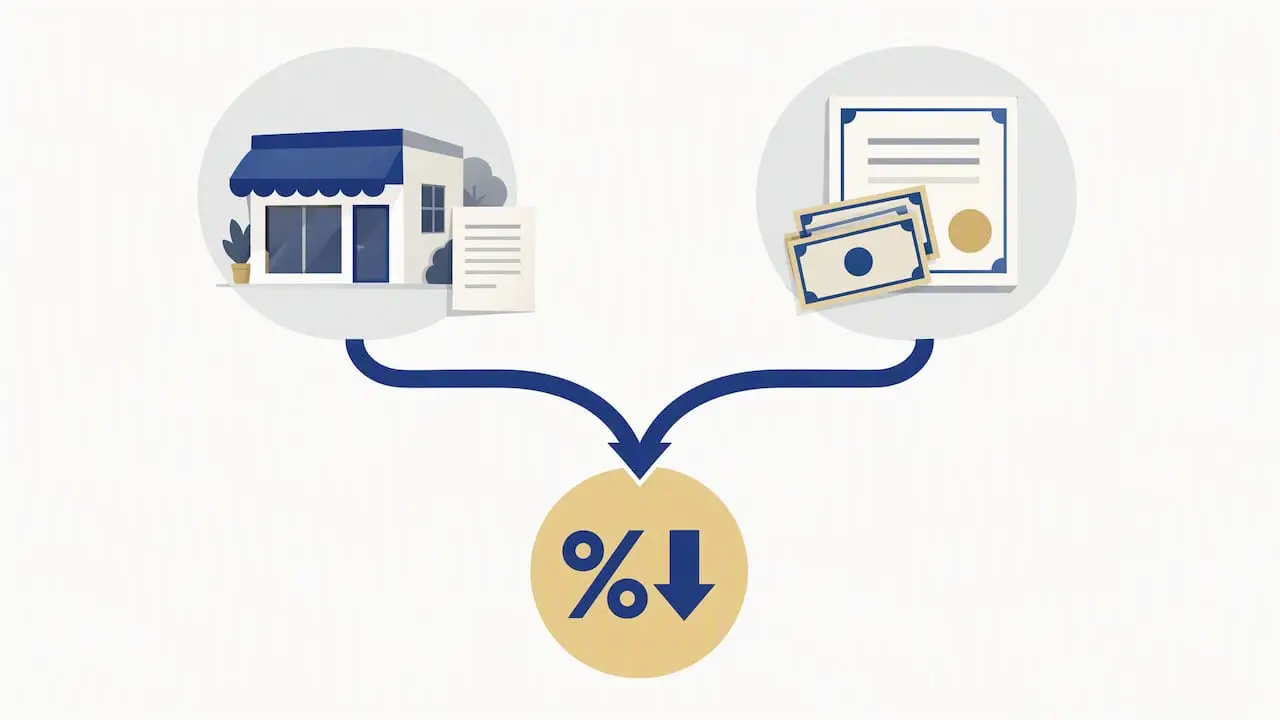
BADR is available to individuals and certain trustees. It is not available to companies disposing of their own assets, so if you run a limited company and sell business premises through the company itself, this relief will not apply to that gain.
Three categories of disposal qualify:
- A material disposal of your business, such as selling a sole trade or partnership interest.
- A disposal of shares or securities in your personal trading company.
- An associated disposal, where you sell an asset you used in a business alongside a related disposal of your business or shares.
Eligibility: the detailed qualifying tests you must meet
Each category of disposal carries its own tests, and missing one by even a few weeks can mean losing the relief entirely.
- Two-year qualifying period. You, or the business, must have owned the qualifying asset, shares or trading status for at least two years ending on the date of disposal, or on the date the business ceased trading if you sold after closure.
- 5% shareholding and voting rights test. For shares, you need at least 5% of the ordinary share capital and at least 5% of the voting rights throughout the two-year period. You also usually need an entitlement to 5% of either distributable profits and net assets, or sale proceeds.
- Officer or employee requirement. You must have been a director or employee of the company (or a related company in the same group) for the full two years before disposal. Being a passive shareholder with no working role will not satisfy this test.
- Associated disposals. If you are selling a personally owned asset used by your partnership or company, it must be sold alongside, or shortly after, your withdrawal from the business. The asset generally needs to have been used in the business for at least three years before disposal, and the link between the two disposals must be genuine rather than engineered for tax purposes.
- Trustee and partnership specifics. Trustees can claim BADR on trust business assets, but only where a beneficiary has an interest in possession and meets the personal qualifying conditions. Partnerships are treated individually, so each partner’s share and involvement is tested separately.
The statutory definitions behind these tests, including what counts as an associated disposal, sit in section 169K of the Taxation of Chargeable Gains Act 1992.
Rates, lifetime allowance and a worked example
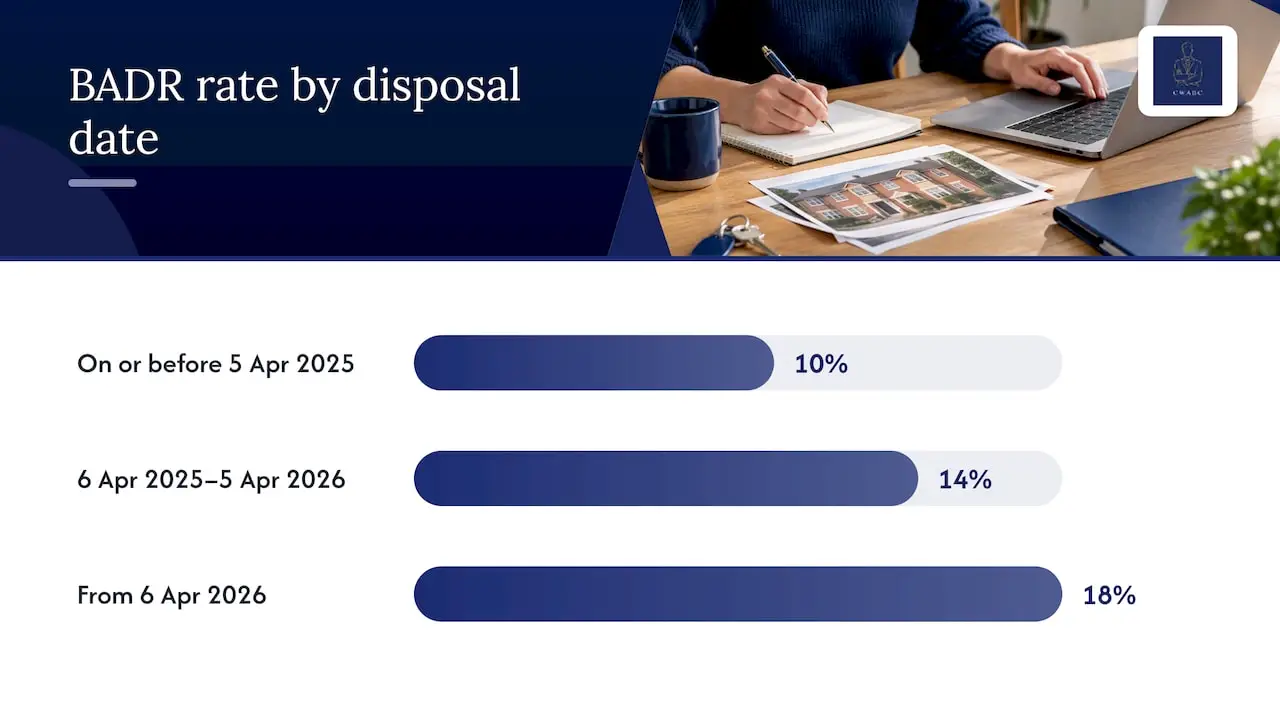
The BADR rate depends on when the disposal happens, not when you file the claim. According to HMRC’s Capital Gains Manual, the rate was 10% for disposals on or before 5 April 2025, rose to 14% for disposals between 6 April 2025 and 5 April 2026, and stands at 18% for disposals from 6 April 2026 onwards.
Business Asset Disposal Relief currently charges 18% Capital Gains Tax on qualifying gains for disposals made from 6 April 2026, against the standard higher CGT rates that would otherwise apply.
- The lifetime limit is £1,000,000 per person, and it is cumulative across every BADR claim you ever make, not an annual allowance that resets.
- Earlier claims reduce what is left: if you have already claimed relief on £400,000 of gains, only £600,000 of future qualifying gains can benefit from the reduced rate.
- Gains above your remaining lifetime limit are taxed at the normal Capital Gains Tax rates for that asset type.
Say you sell your trading company shares in June 2026 for a qualifying gain of £300,000, and you have made no previous BADR claims. The full £300,000 sits within your £1,000,000 lifetime limit, so it is taxed at 18% rather than the standard higher CGT rate, giving a BADR tax bill of £54,000.
How to claim BADR and important deadlines
You claim BADR either through your Self Assessment tax return for the relevant year, or separately by completing Section A of the HS275 helpsheet and sending it to HMRC.
- Work out your qualifying gain for each disposal before completing your return or the HS275 form.
- Submit your claim by the deadline, which is the first anniversary of the 31 January following the end of the tax year of disposal. For a disposal in the 2025 to 2026 tax year, that means a claim deadline of 31 January 2028.
- Attach supporting evidence, including your gain computation, a description of the asset or shares sold, and a record of any BADR claimed previously so HMRC can check your remaining lifetime limit.
- Trustees must make a joint claim with the qualifying beneficiary, and given the extra conditions involved, this is a point where formal advice is usually worthwhile.
The claim form itself, available as the HS275 claim form PDF, shows exactly the fields HMRC expects, including space to list prior claims and attach your computation.
Anti-forestalling and common pitfalls to avoid
HMRC has tightened anti-forestalling rules around BADR, aimed at arrangements set up purely to lock in a lower rate ahead of a known increase. Pre-arranged contracts or reorganisations completed shortly before a rate change can sometimes be treated as taking place on a later date for tax purposes, which defeats the planning entirely.
The most frequent reasons claims fail, in practice, come down to ordinary oversights rather than aggressive planning:
- Selling before the two-year ownership period is complete.
- Falling just under the 5% shareholding or voting rights threshold.
- Treating an unrelated personal asset sale as an associated disposal.
- Missing the claim deadline because the disposal happened in an earlier tax year than the client realised.
Pro Tip: If your sale involves a reorganisation, earn-out or staged completion, get the structure checked before contracts are signed, not after.
Practical checklist and recordkeeping
Good records are what turn a BADR claim from a guess into a defensible position if HMRC ever asks questions.
- Keep disposal contracts, gain computations and valuations for every qualifying sale.
- Maintain share registers and board minutes showing your officer or director status throughout the two-year period.
- Record every previous BADR claim with the gain amount, so you always know your remaining lifetime limit.
- Start gathering paperwork well before your filing deadline, since gain computations can take time to pin down accurately.
| Record type | Why it matters |
|---|---|
| Disposal contract and completion statement | Confirms the disposal date for rate and deadline purposes |
| Share register and company records | Evidences the 5% shareholding and voting rights test |
| Employment or director records | Evidences the officer/employee requirement |
| Running total of prior BADR claims | Tracks your remaining £1,000,000 lifetime limit |
Setting up cloud records early, through a platform like Xero, FreeAgent or QuickBooks, makes this evidence far easier to pull together when a claim deadline is approaching.
A first-person view: common client scenarios and when to call an accountant
I regularly see three types of BADR query: a sole trader winding down after decades in business, a director selling shares in a company they built, and trustees unsure whether a beneficiary’s involvement meets the tests.
I ask clients to start preparing as soon as a sale becomes likely, especially near a tax-year boundary or where a reorganisation is involved. Check your ownership dates and shareholding percentages now, well before any contract is drafted.
— Chris
How I help with BADR claims
Working out whether a disposal genuinely qualifies, calculating the gain correctly and completing HS275 accurately takes care, particularly when a sale spans a tax-year change. I offer:
- Capital Gains Tax support to work through your qualifying gain and BADR eligibility.
- Help completing HS275 and attaching the right supporting computations.
- Self Assessment return preparation and filing, including your BADR claim within the return.
- Bookkeeping and cloud-accounting setup so your records are claim-ready well ahead of any deadline.

As an AAT-licensed, paperless practice, I work directly with you rather than passing your file between departments, using cloud accounting software to keep everything organised. If a disposal is on the horizon, get in touch through my contact page and we can look at your claim deadline together before it creeps up on you.
This article is general information, not a substitute for advice from a qualified financial advisor. Consult a qualified financial professional about your own circumstances before acting on anything here.
FAQ
What are the Business Asset Disposal Relief rates for 2025 and 2026?
The rate was 10% for disposals on or before 5 April 2025, rising to 14% for disposals between 6 April 2025 and 5 April 2026, and to 18% for disposals from 6 April 2026 onwards. Which rate applies depends on your actual disposal date, not your filing date.
Is BADR still charged at 10%?
No. The 10% rate only applied to disposals made on or before 5 April 2025. Disposals from 6 April 2026 are charged at 18%.
What are the qualifying conditions for a BADR claim?
Associated disposals need a genuine link to your withdrawal from the business, with the asset typically used in it for at least three years.
What is the two-year rule for Business Asset Disposal Relief?
The two-year rule means you must meet the qualifying conditions, such as share ownership, voting rights and employment status, for a continuous two-year period ending on the date of disposal or cessation of trade. Falling short of this period by even a short time generally means the disposal does not qualify, so checking your ownership dates before a sale matters.
Need help?
If you are weighing up a business or share sale and want to know where you stand on Business Asset Disposal Relief, get in touch through my contact page and we can talk through your situation and the deadlines that apply to you.