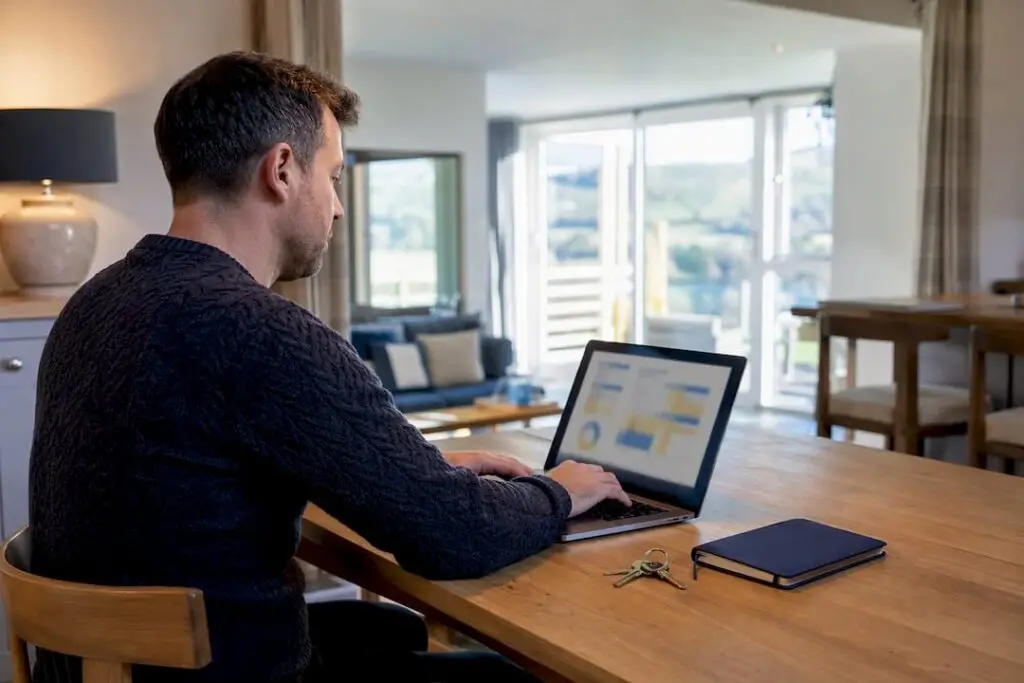
Self-employed taxpayers have two routes to claim use of home as office costs: HMRC’s simplified expenses flat rate, or a reasonable business proportion of actual household costs. The flat rate needs at least 25 business hours a month at home and tops out at £26/month. For most people running a proper home-based business, running both calculations before filing is the only way to know which one actually saves more tax.
TL;DR:
- The flat rate for home office use costs up to £26 per month, requiring at least 25 hours of work from home, but often underestimates actual expenses.
- Claiming a proportion of genuine household costs can yield larger deductions, especially if costs are apportioned by room, area, or time spent working.
- Directors of limited companies cannot use sole trader flat rates and should instead rely on company allowances or rent arrangements, which require proper documentation.
- Maintaining detailed records of hours worked, bills, apportionment methods, and agreements is essential for defending your claim and avoiding tax pitfalls.
- Using a fully exclusive home office space can risk losing part of Private Residence Relief upon sale, making tailored advice advisable before setting up a strictly business-only room.
Table of Contents
- What is simplified expenses for use of home as office?
- The actual-cost method: working out a fair business proportion
- Directors take note: sole-trader rules do not apply to you
- Records to keep, and the CGT trap of exclusive business use
- Your five-step checklist for this tax year
- What I see go wrong with home-working claims
- How I can help with your home-working claim
- Where to check the rules yourself
- Sources
- FAQ
- Need help?
What is simplified expenses for use of home as office?
Simplified expenses is HMRC’s flat-rate shortcut for sole traders who work from home regularly. Instead of totting up bills and working out a fair proportion, you apply a fixed monthly amount based on how many hours you spend on your business at home.
To qualify, you need to work at least 25 hours a month from home on your business, whether that is admin, client calls, invoicing, or actual production work. The flat rate scales with hours worked:
- 25 to 50 hours a month: a flat rate as per HMRC guidance
- 51 to 100 hours a month: a higher flat rate
- 101 hours or more a month: the highest flat rate offered by HMRC
Those figures come straight from Gov, and they have stayed unchanged for several years, so don’t expect them to track inflation.
The flat rate is meant to cover general household running costs, such as heating and electricity, that are hard to apportion precisely. It does not cover telephone or internet, which HMRC treats separately and lets you claim as a proportion of the actual business use, on top of the flat rate. HMRC’s internal manual BIM75010 confirms the flat rate doesn’t stop you claiming identifiable fixed costs separately where a genuine business proportion applies.
The upside is obvious: no bill hunting, no arguments with HMRC about your calculation method. The downside is that £26 a month, £312 a year, rarely reflects the real cost of running a business from a spare room with the heating on all day.
The actual-cost method: working out a fair business proportion
Claiming a proportion of actual household costs usually produces a bigger deduction than the flat rate, provided you can justify the maths. HMRC accepts several ways to apportion costs, and there’s no single prescribed formula. The most common approaches are:
- By rooms — divide relevant costs by the total number of rooms in the house, then claim the fraction used for business.
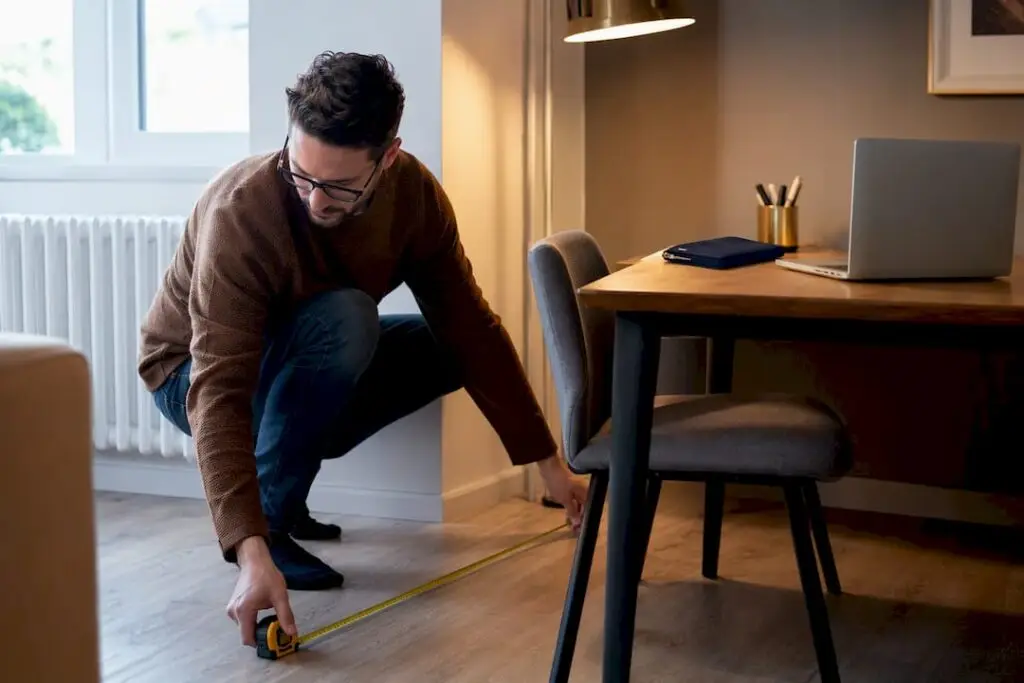
- By floor area — measure the square footage of your workspace against the whole property.
- By time — apply a percentage based on the hours per week or day the space is used for business.
Whichever method you choose, use it consistently and be ready to explain your logic if HMRC ever asks. BIM47815 makes clear that the critical test isn’t which formula you pick, it’s whether you can show your workings and evidence behind it.
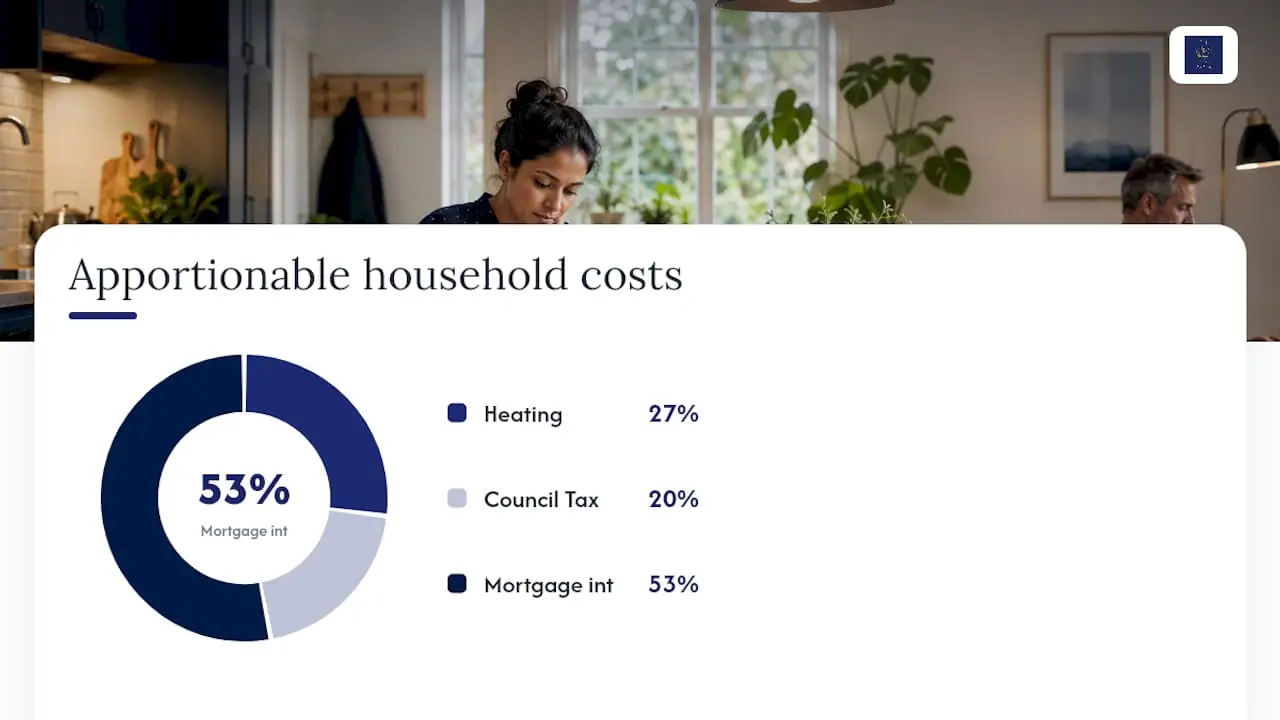
Costs worth apportioning typically include heating, electricity, Council Tax, and mortgage interest or rent, alongside a business share of internet and telephone. GOV.UK’s expenses guidance lists these as allowable in proportion to business use.
Pro Tip: Fixed costs like Council Tax and rent split fairly evenly by room or floor area, but variable costs like heating and electricity often deserve a time-based adjustment too, since a home office used eight hours a day costs more to heat than a spare room used two.
Here’s a worked example. Say your annual bills are: heating and electricity £2,400, Council Tax £1,800, and mortgage interest £4,800, total £9,000. If a room genuinely serves no other purpose than work, claiming closer to the full running cost for that space (rather than a token fraction) may be justified, but keep a clear note of why.
Directors take note: sole-trader rules do not apply to you
If you run your business through a limited company, you are an employee of that company, not a sole trader, and simplified expenses simply doesn’t apply to you. This trips up a lot of newly incorporated business owners who assume the same flat rates carry across.
- Directors and employees can receive up to £6 a week tax-free from their company for reasonable additional household costs, without needing receipts, provided there’s a genuine homeworking arrangement.
- That £6/week allowance needs a written homeworking agreement between the company and the director to stand up to scrutiny.
- Reimbursing more than the flat allowance requires evidence of actual additional costs, or the excess risks being treated as a taxable benefit.
- Get the documentation wrong and HMRC can reclassify the payment as salary, triggering PAYE and National Insurance.
ACCA’s guidance on work-from-home reliefs sets out these conditions clearly, and HMRC’s collection on expenses and benefits for directors covers the underlying valuation rules. Some directors instead set up a formal licence agreement to charge their company market rent for office space, which can be efficient but adds complexity, since the rent becomes personal income you must declare.
Records to keep, and the CGT trap of exclusive business use
Whichever method you use, keep evidence that backs it up. HMRC can enquiry into a Self Assessment return well after you’ve filed it, and a claim without paperwork behind it rarely survives a challenge.
- A log of hours worked from home each month, even a simple spreadsheet is fine.
- Copies of bills used in your calculation: energy, Council Tax, mortgage interest or rent, broadband, telephone.
- Your apportionment workings, showing the method and figures used.
- Any written homeworking agreement, if you’re a director.
Keep these for at least the standard Self Assessment retention period, generally five years after the 31 January filing deadline for the relevant tax year, longer if HMRC has opened an enquiry.
One point that catches people out: if part of your home is used exclusively and permanently for business, with no personal use whatsoever, that portion can lose Private Residence Relief when you eventually sell, meaning a slice of any gain becomes liable to Capital Gains Tax. This is a narrow trap, most home offices retain some dual use, but if you’re planning a strictly business-only room conversion, it’s worth getting tailored advice before you commit to that status.
Pro Tip: If in doubt, keep a small element of personal use for the room, even occasional storage of personal items, since HMRC’s tests for “exclusive” business use are strict, and losing full Private Residence Relief on a property sale can be a costly surprise years down the line.
Your five-step checklist for this tax year
- Log your hours. Track how many hours a month you spend working from home on the business, ideally from day one of the tax year.
- Estimate the actual-cost apportionment. Pull together your annual bills and apply your chosen method (rooms, floor area, or time) to see what a proportionate claim would produce.
- Compare the two totals. Weigh the flat-rate amount against your actual-cost figure for the same period.
- Factor in admin time. If the difference between the two methods is small, the simplified route may still win on convenience.
- Pick one method and document why. Once chosen, stay consistent year to year unless your circumstances genuinely change, such as moving to a bigger dedicated office space.
You’re allowed to switch methods between tax years if your situation shifts, working hours increase, you convert a room, or your household costs change materially. Just don’t chop and change without reason; HMRC expects a rational basis for any switch. Run both calculations before you file, and keep the workings from whichever one you don’t use. That paper trail is often the difference between a quick, calm HMRC query and a drawn-out one.
What I see go wrong with home-working claims
Most sole traders I speak to default to simplified expenses because it’s defensible and quick, even when the actual-cost method would put more money back in their pocket. That’s a reasonable trade-off if your workload is light, but it’s worth checking the numbers at least once a year rather than assuming.
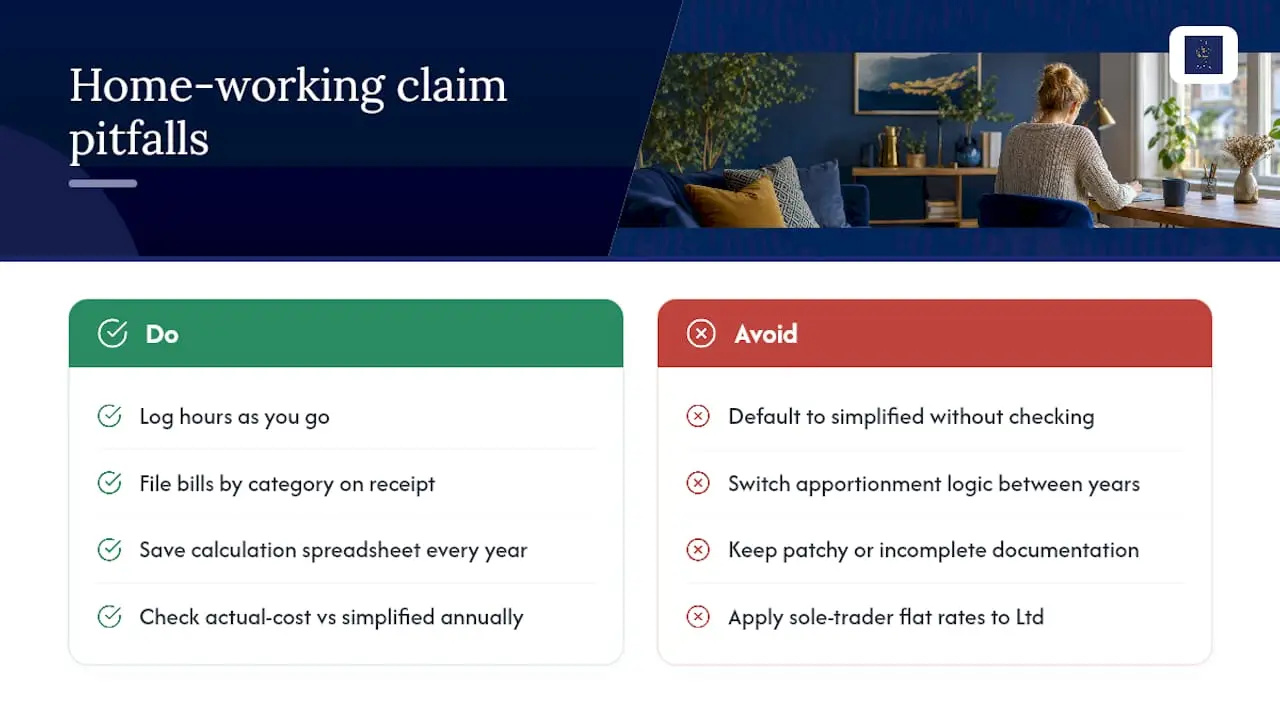
The pitfalls are fairly consistent: patchy documentation, switching apportionment logic between years without a reason, and directors applying sole-trader flat rates to a limited company by mistake. None of these are complicated to avoid. Log your hours as you go rather than reconstructing them in January, file bills by category as they arrive, and save your calculation spreadsheet every year, even the year you don’t use it. Small habits, but they’re what actually stand up when HMRC asks a question.
— Chris
How I can help with your home-working claim
Working out whether simplified expenses or actual-cost apportionment suits your business, then building a claim that stands up if HMRC ever asks, is exactly the kind of detail I handle daily for sole traders and small business owners across Tonbridge, Sevenoaks and Kent, and remotely UK-wide.
Through my Self Assessment Tax Returns service, I prepare HMRC-ready calculations for use of home as office and keep the supporting workings organised, so if a question ever comes in, the evidence is already there. If your recordkeeping needs a proper system behind it rather than a shoebox of receipts, my bookkeeping services set up cloud tools like Xero, QuickBooks or FreeAgent to track hours and bills as you go, and if you’re moving toward Making Tax Digital, my MTD for Income Tax support gets your digital records compliant ahead of the deadlines. Get in touch to talk through which method fits your business this year.
Where to check the rules yourself
- Gov
- HMRC manual BIM75010: use of home for business purposes
- HMRC manual BIM47815: apportionment and examples
- ACCA: changes to work-from-home reliefs
- For secure handling of the bills and records behind your claim, see this GDPR compliance playbook for accountants
This article is general information, not a substitute for advice from a qualified financial advisor. Consult a qualified financial professional about your own circumstances before acting on anything here.
Sources
- Simplified expenses if you’re self-employed: Working from home
- BIM75010 – Simplified expenses: use of home for business purposes
- Significant changes coming to work-from-home reliefs (ACCA)
FAQ
How much can I claim for use of home as office?
Under simplified expenses, the maximum is £26 a month (£312 a year) if you work 101 or more hours monthly, set out on GOV.UK. Under the actual-cost method, the amount depends entirely on your household bills and your apportionment, and it can be considerably higher, as the worked example above shows.
Does working from home automatically count as business use?
Not automatically. HMRC expects the space and hours to be genuinely used for business activity, admin, client work, or production, not just occasional emails at the kitchen table. You need at least 25 qualifying hours a month to use the simplified flat rate, and any actual-cost claim must reflect a fair, explainable proportion of real business use.
Can limited company directors use the same flat rates as sole traders?
No. Directors are employees of their company, so sole-trader simplified expenses don’t apply. Instead, companies can pay directors up to £6 a week tax-free for home-working costs, provided there’s a written homeworking arrangement, as ACCA explains.
Does claiming use of home as office affect Capital Gains Tax when I sell my house?
It can, but only in a specific scenario. If part of your home is used exclusively and permanently for business, with no personal use at all, that portion can lose Private Residence Relief, meaning part of any gain on sale becomes liable to Capital Gains Tax. Most home offices retain some dual use and avoid this, but it’s worth getting tailored advice if you’re converting a room to strictly business-only use.
What is the 183-day rule and does it affect home-working expense claims?
The rule concerning the number of days you spend in the UK relates to tax residence status and is separate from home-working expense claims. It has no bearing on whether you can claim simplified expenses or actual costs for use of home as office; those rules depend on hours worked and business use, not residence status.
Need help?
If you’d like a second opinion on whether simplified expenses or actual-cost apportionment suits your business, or want your Self Assessment return prepared with the calculations already backed by evidence, get in touch and I’ll talk you through it.