
Pay your company’s Corporation Tax by the correct HMRC deadline, using the right 17-character payment reference and a payment method that clears on time. That single sentence covers the three things that go wrong most often. The normal payment deadline is 9 months and 1 day after the end of your accounting period. Your CT600 Company Tax Return is due within a year after the period ends, which means you must pay before you file. Companies with taxable profits above a certain high threshold pay in quarterly instalments instead.
To pay correctly right now, take these steps:
- Log in to your HMRC online account and retrieve the 17-character Corporation Tax payment reference for the current accounting period.
- Confirm the tax amount due from your draft computations or your accountant’s calculation.
- Choose a payment method that will clear by the deadline: Faster Payments or CHAPS for same-day or next-day credit, or Direct Debit if already set up.
- Make the payment and save the confirmation as proof.
For deeper guidance on computing your liability, the CT600 filing guide on GOV.UK and Cwabc’s corporation tax guide for UK limited companies are both worth bookmarking.
Table of Contents
- What are the payment and filing deadlines you need to know?
- How do you work out what your company actually owes?
- How do you make a payment to HMRC for each accepted method?
- Why does the 17-character payment reference matter so much?
- Who must pay by instalments, and how does the schedule work?
- What does HMRC charge for late or incorrect payments?
- What are the most common payment mistakes, and how do you fix them?
- Your Corporation Tax payment checklist
- How Cwabc helps with Corporation Tax payments and filings
- Key takeaways
- Why professional support prevents most Corporation Tax problems
- Cwabc: straightforward Corporation Tax support for UK directors
- Useful sources
What are the payment and filing deadlines you need to know?
The two deadlines are different, and confusing them is one of the most common and costly mistakes directors make.
Payment deadline: 9 months and 1 day after the end of the accounting period. For a company with a 31 March accounting period end, the payment deadline falls in early January of the following year.
Filing deadline: 12 months after the end of the accounting period. For the same company, that is 31 March the following year.
Paying only when you file means your payment is late by several months. HMRC charges daily interest from shortly after the payment deadline, regardless of when you submit the CT600.
| Accounting period end | Payment due | CT600 filing due |
|---|---|---|
| 31 March 2025 | 1 January 2026 | 31 March 2026 |
| 30 June 2025 | 1 April 2026 | 30 June 2026 |
| 31 December 2025 | 1 October 2026 | 31 December 2026 |
For accounting periods shorter than 12 months (common in a company’s first year), both deadlines are calculated from the actual period end date, not a 12-month assumption. Periods longer than 12 months are split into two separate accounting periods for Corporation Tax purposes.
Pro Tip: If your payment deadline falls on a weekend or bank holiday, do not assume the next working day is acceptable. HMRC treats the date you initiate the payment as the payment date for Faster Payments and CHAPS. Initiate the payment on the last working day before the deadline to be safe. Check the small business tax deadline calendar to plan ahead.
How do you work out what your company actually owes?
Start with your company’s net profit from the accounts, then adjust it for tax purposes to arrive at taxable profits. The Corporation Tax rates that apply depend on your profit level.
- Small profits rate applies at a lower rate on profits below a certain threshold.
- Main rate applies on higher profits above an upper threshold.
- Marginal relief applies between these thresholds to taper the effective rate. Both thresholds adjust based on associated companies and accounting period length.
If your accounting period straddles a rate change, you apportion profits on a daily basis and apply the relevant rate to each portion.
Common adjustments to taxable profits include:
- Adding back disallowable expenses (client entertainment, fines, depreciation).
- Deducting capital allowances (Annual Investment Allowance, writing-down allowances) in place of depreciation.
- Adjusting for director’s loan account balances where a Section 455 charge applies.
- Deducting qualifying R&D expenditure where a claim is made.
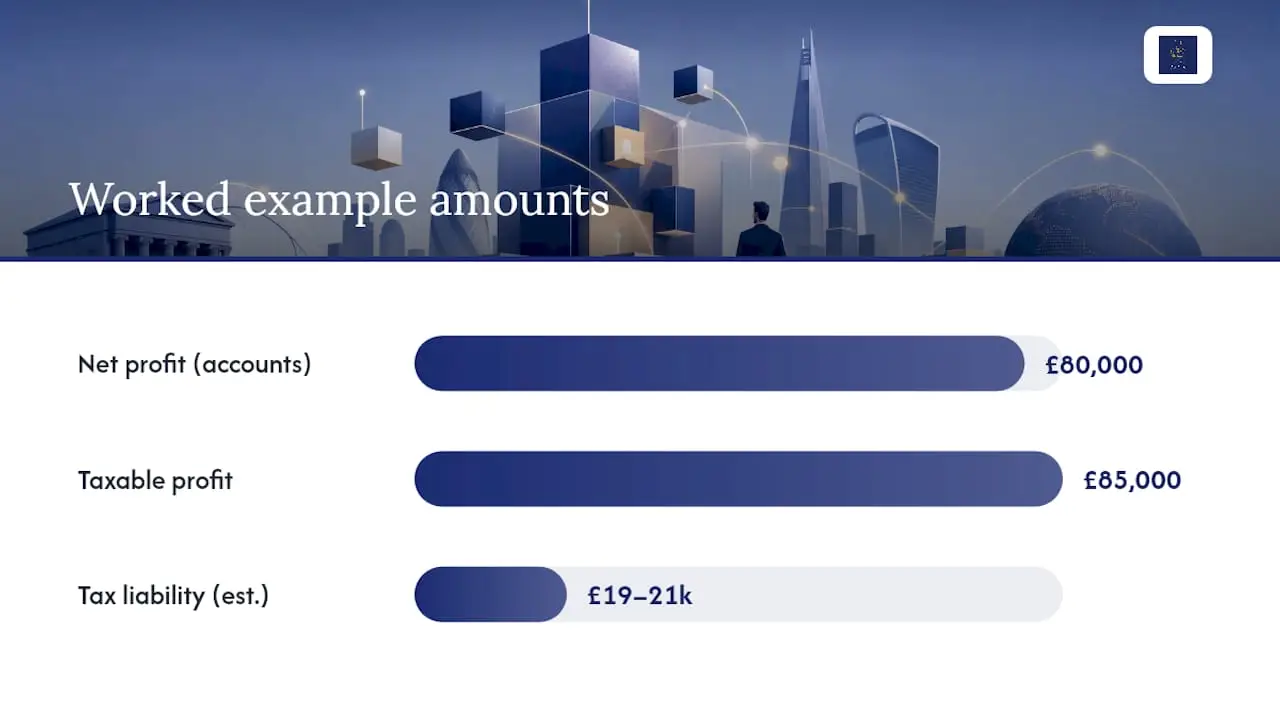
Worked example: A company with a 31 March 2025 year end has net profit of £80,000 after accounts. It adds back £3,000 of client entertainment and £10,000 of depreciation, then deducts £8,000 of capital allowances. Taxable profit is £85,000. Marginal relief applies, so the effective rate sits between 19% and 25%. The CT600 computation produces the precise figure, but a rough estimate puts the liability at around £19,000–£21,000 depending on the marginal relief fraction.
You must file a CT600 with full accounts and computations within 12 months of the period end. Late filing penalties apply even when no tax is due. For a step-by-step walkthrough of the computation, Cwabc’s small business corporation tax guide covers marginal relief in plain English.
How do you make a payment to HMRC for each accepted method?
HMRC accepts several payment methods, and the right choice depends on how much time you have before the deadline.
Faster Payments (online or telephone banking)
This is the most practical option for most companies. Log in to your business bank account, set up a new payee using HMRC’s sort code and account number (available on GOV.UK bank transfer guidance), enter the 17-character payment reference, and send the payment. Payments via Faster Payments typically credit HMRC very quickly, often within one day, including weekends and bank holidays. Check your bank’s single-payment limit, as some business accounts cap Faster Payments at £25,000 or £100,000.

CHAPS
Use CHAPS for large payments that need guaranteed same-day credit. Your bank will usually charge a fee (typically £15–£35, though this varies by bank). Initiate before your bank’s CHAPS cut-off time, which is usually mid-morning. CHAPS is the safest method when a deadline falls the same day.
Bacs
Bacs takes three working days to clear, so allow sufficient lead time. It is less common for one-off Corporation Tax payments but may suit companies with automated payment runs.
Direct Debit
Set up through your HMRC online account. First-time setup takes five working days; subsequent payments typically take three working days. Direct Debit cannot be used for payments exceeding a high monetary limit. Once set up, it is efficient for recurring payments because HMRC pulls the amount on the due date.
Debit or corporate credit card online
Card payments are accepted online via GOV.UK. Personal debit cards carry no fee. Corporate card payments incur a non-refundable fee. HMRC treats the date you make the payment as the payment date, which is useful when a deadline is imminent.
Bank or building society branch
You can pay over the counter at a branch using a paying-in slip from HMRC. Allow three working days for clearance. This method is becoming less practical as branches close, but it remains an option.
Cheque
Post a cheque made payable to ‘HM Revenue and Customs only’ with your 17-character reference written on the back. Allow five working days. Never rely on cheque for a tight deadline.
Pro Tip: For most companies, Direct Debit (once set up) or Faster Payments are the two best options. Direct Debit removes the risk of forgetting; Faster Payments gives you control right up to the deadline. Before any payment: confirm the reference is correct for this accounting period, check your bank’s daily transfer limit, and save the payment confirmation immediately.
Why does the 17-character payment reference matter so much?
The 17-character Corporation Tax payment reference is unique to each accounting period. Using the wrong reference routinely sends payments to HMRC’s suspense account, where they sit unallocated. HMRC may then issue a penalty notice for apparent non-payment, even though the money has left your account.
Where to find the correct reference:
- Your notice to deliver your Company Tax Return (the letter HMRC sends after the accounting period ends).
- Your HMRC online account: sign in, go to ‘Corporation Tax’, select ‘View Corporation Tax statement’, then choose the relevant accounting period. The reference appears there.
- HMRC reminder letters sent as the deadline approaches.
The reference follows a pattern: your 10-digit Unique Taxpayer Reference (UTR) followed by a 7-character period identifier (for example, A001234567612A00116A). The period identifier changes every accounting period, which is why reusing a saved bank payee entry from a previous year is a common source of errors.
Practical safeguards:
- Copy and paste the reference directly from HMRC online rather than typing it manually.
- Count the characters: the full reference is always 17 characters.
- Check any saved payee entries in your business bank account and update them before each payment.
- If you pay by Faster Payments, the bank’s reference field must contain the full 17-character string with no spaces.
Pro Tip: Screenshot the reference from HMRC online and paste it into your company’s payment workflow document or calendar reminder. One wrong character sends the payment to suspense and can trigger an automatic penalty notice, even when you paid on time.
Who must pay by instalments, and how does the schedule work?
Companies with taxable profits at an annual rate above £1.5 million are classified as ‘large’ for Corporation Tax purposes and must pay in quarterly instalments. A separate ‘very large’ category applies above £20 million, with an accelerated schedule.
For a standard accounting period, instalments are due quarterly starting several months into the accounting period, with the first two due before the period ends and others after.
How to estimate each instalment:
- Estimate the total Corporation Tax liability for the year.
- Divide by four for equal instalments, or weight them if profits are uneven across the year.
- Pay each instalment by its due date using the period-specific reference.
- If forecasts change, make a top-up payment as soon as possible to limit interest on underpaid instalments.
- If you overpay, HMRC credits interest on the overpayment and you can claim a repayment or carry the credit forward.
Key points on interest and penalties for instalments:
- HMRC charges interest on underpaid instalments from the due date of each instalment.
- Overpaid instalments attract repayment supplement (credit interest) from HMRC.
- Keep management accounts and updated forecasts on file to support any repayment claim or to demonstrate reasonable estimation if HMRC queries instalment amounts.
What does HMRC charge for late or incorrect payments?
Late payment and late filing carry separate charges, and it is worth understanding both clearly.
Interest on late payment
HMRC charges daily interest from the day after the payment deadline. The rate is linked to the Bank of England base rate. Interest accrues automatically and is not a penalty you can appeal on grounds of reasonable excuse alone; it is a statutory charge for late payment.
Late filing penalties for the CT600
These are statutory and apply even when no tax is due:
- £100 for filing up to three months late.
- £200 for filing more than three months late.
- Tax-geared penalties (10% of unpaid tax) for filing more than 18 months late.
- A further 10% if the return is more than 24 months late.
Common triggers for charges:
- Missing the 9 months and 1 day payment deadline.
- Payment sitting in suspense due to a wrong reference (HMRC treats this as unpaid until allocated).
- Underpaying quarterly instalments.
- Filing the CT600 late, even when the tax was paid on time.
Practical remedies:
- Contact HMRC early if cash flow is tight. A Time to Pay arrangement, agreed before the deadline, prevents late payment interest from accruing on the agreed schedule.
- If a payment went to suspense, call HMRC’s Corporation Tax helpline with your payment reference, bank statement, and the date of payment. HMRC can reallocate the payment and, in most cases, remove the penalty notice.
- Keep payment confirmations and bank statements for at least six years to support any dispute.
Pro Tip: Contact HMRC before the deadline if you cannot pay in full. A Time to Pay arrangement agreed in advance is far less damaging than a missed deadline followed by a penalty notice. HMRC’s Corporation Tax helpline is the right starting point.
What are the most common payment mistakes, and how do you fix them?
Most Corporation Tax payment problems fall into a small number of categories, each with a clear remedy.
- Wrong or old payment reference: The payment sits in HMRC’s suspense account. Call HMRC’s Corporation Tax helpline, quote the correct reference and the payment date, and ask for manual reallocation. Provide your bank statement as evidence. HMRC will usually reallocate and remove any automatic penalty notice once the payment is confirmed.
- Paying after the deadline due to weekend or bank holiday confusion: HMRC treats the date you initiate the payment (for Faster Payments and CHAPS) as the payment date. If you initiated on time, you have evidence to support a query. If you genuinely paid late, interest will apply from the due date; pay as soon as possible to limit the charge.
- Relying on the bank payment date rather than HMRC’s receipt date: For Bacs and cheque, the date HMRC receives the funds is what counts, not the date you sent them. Always allow processing time and initiate early.
- Saved bank payee details from a previous year: The sort code and account number for HMRC may be the same, but the 17-character reference changes each period. Update the reference in your bank’s saved payees before every payment.
- Overpayment: If you overpay, HMRC will hold the credit against future liabilities or refund it on request. Contact HMRC with your UTR and the accounting period details to request a repayment. Keep the supporting computation to show the correct amount.
- Underpayment: Pay the shortfall as soon as you identify it. Interest accrues daily, so a prompt top-up limits the charge. For instalment companies, revise your forecast and adjust the next instalment accordingly.
For help resolving allocation issues or recalculating what is owed, Cwabc’s bookkeeping services in Tonbridge and corporation tax accountant support are available for a straightforward conversation.
Your Corporation Tax payment checklist
Use this before every payment to make sure nothing is missed.
Gather before you pay:
- Company UTR (10 digits, shown on all HMRC correspondence).
- Correct accounting period start and end dates.
- 17-character payment reference retrieved from HMRC online for this specific period.
- Confirmed tax amount from your computations or accountant.
- Chosen payment method and confirmation your bank’s daily limit covers the amount.
- Authorisation from the relevant director or signatory if required by your bank mandate.
- Blank document or folder ready to save the payment confirmation.
Recommended timeline:
- T minus 30 days: Finalise draft computations; confirm the payment reference in HMRC online.
- T minus 7 days: Confirm the tax amount is agreed; check bank limits and authorisations.
- T minus 1 day: Retrieve the reference again from HMRC online (do not rely on a saved copy); initiate payment if using Bacs or cheque.
- Payment day: Initiate Faster Payments or CHAPS; save the bank confirmation immediately.
Cwabc’s corporation tax guide for UK limited companies includes a printable version of this checklist alongside CT600 filing guidance.
How Cwabc helps with Corporation Tax payments and filings
Cwabc — CW Licensed Bookkeeper and Accountant, based in Tonbridge — supports limited companies through every stage of the Corporation Tax process. The practical services include:
- Calculating taxable profits and preparing the CT600 computation.
- Preparing and filing the CT600 with HMRC, including accounts and supporting schedules.
- Calculating quarterly instalment amounts and flagging revised forecasts when profits change.
- Retrieving the correct payment reference and guiding directors through the payment process.
- Liaising with HMRC on allocation queries, suspense account issues, and Time to Pay arrangements.
Chris, as CW Licensed Bookkeeper and Accountant, authors the firm’s practical guides and works directly with company directors to reduce the risk of errors. The firm’s year-round bookkeeping approach means the numbers feeding into the CT600 are accurate before the deadline arrives, rather than being scrambled together at the last minute.
For directors who want professional support, the corporation tax accountant service in Tonbridge and the professional tax advice guide explain what to expect. Contact Cwabc for a free, no-obligation conversation via the contact page.
Key takeaways
Paying Corporation Tax correctly comes down to three things: the right deadline, the right reference, and a payment method that clears on time.
| Point | Details |
|---|---|
| Payment deadline | Pay 9 months and 1 day after the accounting period end, not when you file the CT600. |
| 17-character reference | Retrieve it from HMRC online for each period; one wrong character sends the payment to suspense. |
| Best payment methods | Faster Payments or CHAPS for speed; Direct Debit once set up for reliability. |
| Instalment threshold | Companies with profits above £1.5 million annually pay in four quarterly instalments. |
| Cwabc support | Cwabc handles CT600 preparation, instalment calculations, and HMRC queries for directors in Tonbridge and Kent. |
Why professional support prevents most Corporation Tax problems
Most Corporation Tax payment problems are not complicated in hindsight. A director reuses a saved bank payee from the previous year, the reference is wrong, the payment sits in suspense, and a penalty notice arrives three weeks later. By the time the director calls HMRC, the interest has already started running. The fix is usually straightforward once you know what to do, but the stress and the wasted time are real.
What I see repeatedly is that the errors cluster around two moments: the payment itself and the period just before the deadline when directors are also trying to finalise accounts. When bookkeeping is up to date throughout the year, the computation is straightforward, the reference is retrieved calmly, and the payment goes out on time. When the books are in disarray in month eleven, everything becomes rushed and that is when references get reused, amounts get estimated badly, and deadlines get missed by a day.
Cwabc’s approach is to keep the records clean year-round, using MTD-ready systems and scheduled payment checks, so that the Corporation Tax deadline is an event you are prepared for rather than a crisis you are reacting to. That is not a complicated idea, but it makes a significant practical difference when the deadline arrives.
Cwabc: straightforward Corporation Tax support for UK directors
Corporation Tax does not have to be a source of stress. Cwabc gives company directors in Tonbridge and Kent a clear, fixed-fee service that covers the full process: accurate bookkeeping throughout the year, CT600 preparation, instalment calculations, and direct HMRC liaison when something needs resolving.
The difference from doing it yourself is not just the time saved. It is the confidence that the reference is correct, the amount is right, and the payment will clear before the deadline. Cwabc’s pricing is transparent and agreed upfront, with no surprises at year end.
To start a free, no-obligation conversation about your company’s Corporation Tax, visit the bookkeeping services page or go straight to the contact page and get in touch today.
Useful sources
The rules, rates, and deadlines in this guide are drawn from the following GOV.UK pages. Tax rates and thresholds can change, so confirm the current figures on GOV.UK before acting, or contact Cwabc for a verification call.
| Source | What it covers |
|---|---|
| Pay your Corporation Tax bill: Overview | Payment deadline, payment reference, and general payment rules |
| Pay by bank transfer | Faster Payments, CHAPS, Bacs, and the 17-character reference requirement |
| Pay by Direct Debit | Direct Debit setup times, limits, and processing |
| Pay by debit or corporate credit card | Card payment options and fee rules |
| Pay in instalments (large companies) | Instalment schedule, thresholds, and due dates |
| Corporation Tax rates | Small profits rate, main rate, and marginal relief thresholds |
| Completing your Company Tax Return | CT600 filing requirements, deadlines, and penalties |
If you want help confirming which rules apply to your company’s specific situation, contact Cwabc for a free conversation.