
The Furnished Holiday Lettings regime was abolished for Income Tax and Capital Gains Tax from 6 April 2025, and for Corporation Tax from 1 April 2025. Holiday lets now follow the same rules as other rental property, which means a restriction on mortgage interest relief for individual landlords, the end of new capital allowances claims, and a shift towards Making Tax Digital reporting over the next few years.
TL;DR:
- Individual landlords can no longer deduct mortgage interest from rental profits; they receive a 20% basic rate tax credit, while companies can still deduct finance costs.
- Pools established by April 5, 2025, can continue receiving writing down allowances; new furniture qualifies for relief only when it replaces an existing item.
- For disposals on or after April 6, 2025, rollover relief and Business Asset Disposal Relief no longer apply; standard residential Capital Gains Tax rules govern.
- Business rates generally require 140 days’ availability and 70 days’ letting in the prior year, although some sites with multiple units follow a different test.
- Making Tax Digital starts in April 2026, 2027, or 2028, depending on income from property and self employment; begin digital bookkeeping early.
Table of Contents
- What changed and the legislative timeline
- How holiday-let income is treated now: income tax and capital gains implications
- Finance costs, mortgage interest and capital allowances: what you can and cannot claim
- Making Tax Digital for Income Tax: timetable, thresholds and how to prepare
- Business rates, council tax and other regulatory checks for holiday lets
- Practical next steps: checklist landlords should act on this tax year
- How I help landlords with the FHL transition
- Common mistakes and the one priority that matters most
- Services to help you comply: CWABC packages for landlords
- FAQ
- Sources
What changed and the legislative timeline
The repeal removed the special tax status that furnished holiday lets enjoyed for decades. Before April 2025, qualifying holiday lets sat outside standard property income rules: owners could claim full mortgage interest relief, capital allowances on furniture and equipment, and certain Capital Gains Tax reliefs normally reserved for trading businesses. GOV.UK confirms that abolition took effect from 6 April 2025 for Income Tax and Capital Gains Tax, and from 1 April 2025 for Corporation Tax.
For periods before those dates, FHL treatment still applies in full. Your 2024 to 2025 Self Assessment return, for example, is completed under the old rules if your property met the qualifying tests during that year. The transitional point to watch is the cutoff itself:
- Income earned and gains realised before the cutoff dates follow the old FHL rules in full.
- Income and disposals from the cutoff onwards follow standard property income and Capital Gains Tax rules.
- Anti-forestalling provisions catch arrangements designed purely to lock in FHL treatment after the rules changed.
The anti-forestalling rules matter most around disposals. If you exchanged contracts before 6 April 2025 but completed afterwards, HMRC’s internal manual sets out conditions under which the earlier, more favourable treatment can still apply. Getting the contract date wrong, or missing a required election, can mean losing a relief you reasonably expected to keep.
How holiday-let income is treated now: income tax and capital gains implications
Rental profits from a former FHL property are now calculated the same way as any other residential let: income less allowable expenses, reported as property income on your Self Assessment return rather than under the old FHL-specific rules. There is no longer a separate box treating the activity as a trade for Income Tax purposes.
The bigger shift is in Capital Gains Tax. Previously, a qualifying FHL could benefit from rollover relief and Business Asset Disposal Relief, both normally limited to trading businesses. For disposals on or after 6 April 2025, those reliefs no longer apply to holiday let properties, so a sale now attracts standard residential Capital Gains Tax treatment, including the usual rates and annual exemption.
One change that catches people out: capital allowance pools already in existence by 5 April 2025 are not wiped out. HMRC guidance confirms that writing-down allowances on expenditure pooled before that date continue to be claimed in future years, even though no new additions can go into the pool.
- Check whether your accountant pooled qualifying expenditure before 5 April 2025.
- Keep the original invoices and the pool calculation as supporting evidence.
- Review disposal plans with the anti-forestalling rules in mind before exchanging contracts.
Finance costs, mortgage interest and capital allowances: what you can and cannot claim
Individual landlords with a former holiday let now face the same mortgage interest restriction as other residential landlords: rather than deducting finance costs from rental profit, you receive a 20% basic-rate tax credit against your tax bill. If you are a higher or additional rate taxpayer, this generally means a bigger tax bill than under the old rules, where full interest relief was allowed. Landlords operating through a limited company are not subject to this restriction, since Corporation Tax rules allow finance costs to be deducted in full.
Capital allowances on new furniture, equipment and fixtures are no longer available for holiday lets. In their place, Replacement of Domestic Items Relief lets you claim the cost of replacing (not initially providing) items such as beds, sofas and white goods, in the same way other residential landlords always have.
- No new capital allowances claims from 6 April 2025 onwards.
- Replacement of Domestic Items Relief covers like-for-like replacements, not the first purchase.
- Pools created before 5 April 2025 keep writing down in future tax years.
Pro Tip: Ask whoever prepared your accounts for the 2024 to 2025 tax year to confirm, in writing, exactly what sits in your capital allowance pool, since it is the only new allowance you will ever add to.
Making Tax Digital for Income Tax: timetable, thresholds and how to prepare
If you are a landlord with qualifying income above the relevant threshold, you will need to keep digital records and submit quarterly updates through compatible software rather than a single annual tax return. GOV.UK sets out three staged start dates based on gross income from self-employment and property combined:
- From 6 April 2026, if your qualifying income is above the current threshold.
- From April 2027, if your qualifying income exceeds the applicable threshold then in force.
- From April 2028, if your qualifying income is above the relevant threshold at that time.
Preparing early means choosing MTD-compatible software, signing up with HMRC, and getting used to recording income and expenses as you go rather than in one annual scramble.
Pro Tip: Start quarterly bookkeeping now, even before your start date arrives, so the habit is already in place when MTD becomes mandatory for you.
Business rates, council tax and other regulatory checks for holiday lets
Separately from the tax changes, a self-catering property’s liability for business rates rather than council tax depends on how it is actually used. GOV.UK guidance confirms the standard test: the property must be available to let for at least 140 days and actually let for at least 70 days in the previous 12 months. A July 2026 amendment removed the 70-day actual letting test for certain multi-unit or mixed hereditament cases, so check which test applies if you let more than one unit on the same site.
- Apply to the Valuation Office Agency with booking records as evidence of availability and actual lettings.
- Confirm your Energy Performance Certificate is current, since holiday lets generally need one.
- Check planning permission, fire safety rules and insurance cover remain appropriate for short-term letting.
Practical next steps: checklist landlords should act on this tax year
The abolition is a tax change, not a reason to stop letting your property. The priority now is protecting what you are entitled to and preparing for what comes next.
- Confirm your capital allowance pool position as it stood on 5 April 2025 and keep the records safe.
- Recalculate your cashflow forecasts using the 20% basic-rate finance cost credit rather than full interest relief.
- Decide on MTD-compatible software or appoint an agent well before your mandatory start date.
- Apply for business rates if your letting pattern meets the thresholds, and keep disposal evidence if you are selling around the cutoff.
Pro Tip: Review your annual filing deadlines now, since the FHL change often coincides with other reporting dates landlords forget to diarise.
How I help landlords with the FHL transition
I support landlords working through exactly this kind of change, whether that means recalculating your position after the FHL abolition, setting up Making Tax Digital reporting, or getting your bookkeeping onto Xero, FreeAgent or QuickBooks so quarterly submissions become routine rather than stressful.
- Self Assessment preparation reflecting the post-abolition rules.
- Making Tax Digital setup and ongoing quarterly reporting support.
- Capital gains calculations for holiday let disposals.
- Cloud bookkeeping setup so your records are always submission-ready.
I work paperless and deal with clients directly to provide a streamlined service. If you would like to talk through your situation, you can get in touch for a short initial conversation.
Common mistakes and the one priority that matters most
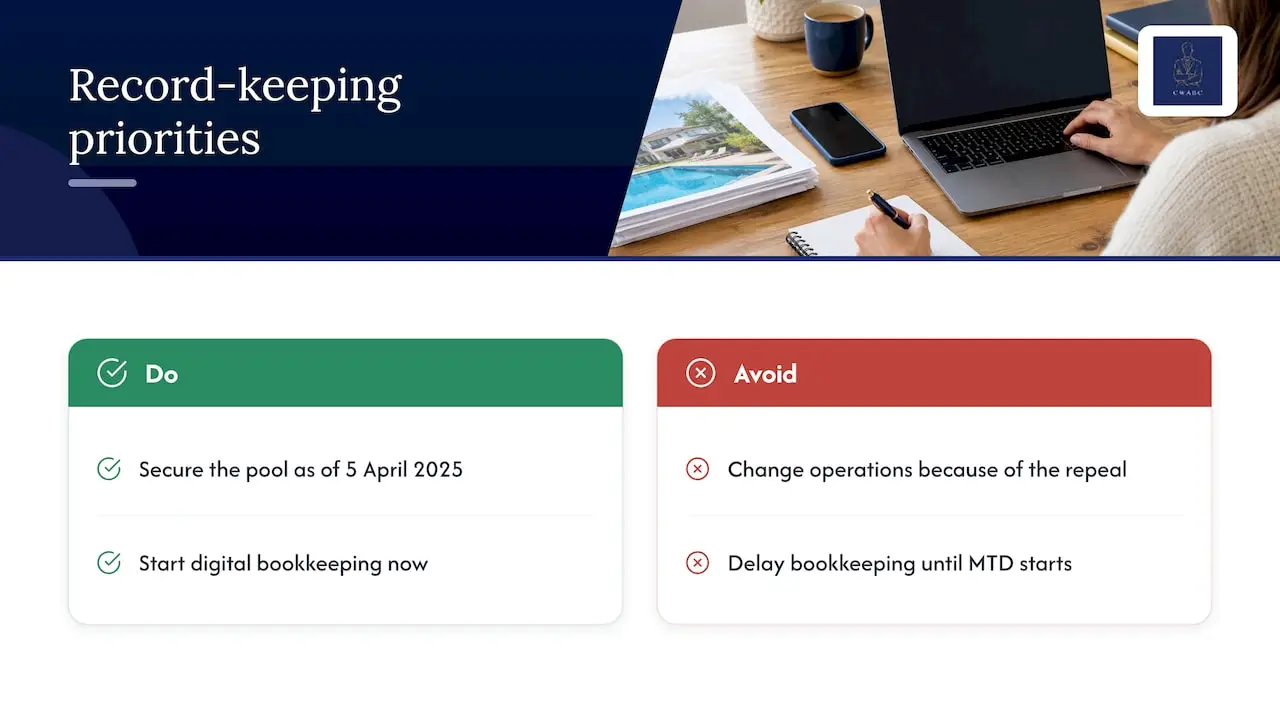
The mistake I see most often is landlords assuming the FHL repeal means they need to change how they operate, perhaps letting their property less, or treating it as a problem to solve by stopping altogether. That is not what happened. HMRC’s own clarification confirms the repeal changes the tax framework, not the commercial reality of running a holiday let.
The single priority I would put above everything else is record-keeping: locking down your capital allowance pool as it stood on 5 April 2025, and starting digital bookkeeping now rather than waiting for your Making Tax Digital start date to force the issue. Landlords who delay this tend to spend far more time, and often more money, catching up later than they would have spent getting it right from the outset.
— Chris
Services to help you comply: CWABC packages for landlords
Working through the FHL changes alongside your usual Self Assessment and bookkeeping can feel like a lot to manage on top of actually running your holiday let. I offer Self Assessment Tax Returns built around the current post-abolition rules, along with ongoing bookkeeping support and Making Tax Digital setup so your records are ready well before your mandatory start date.

- Self Assessment returns reflecting your capital allowance pool and finance cost credit correctly.
- Rental bookkeeping set up on Xero, FreeAgent or QuickBooks for straightforward quarterly reporting.
- Making Tax Digital sign-up and software support ahead of your 2026, 2027 or 2028 start date.
Fees are agreed clearly upfront once your situation is understood, with no surprises along the way. If your mortgage is also due for review following the finance cost changes, independent mortgage guidance for self-employed property owners is worth a look alongside your tax planning. The simplest next step is a short call to scope out exactly what you need: get in touch here.
This article is general information, not a substitute for advice from a qualified financial advisor. Consult a qualified financial professional about your own circumstances before acting on anything here.
FAQ
What are the legal requirements for holiday lets?
Holiday lets must generally have a current Energy Performance Certificate, appropriate planning permission, fire safety measures and adequate insurance cover. GOV.UK guidance also flags a proposed national registration scheme for short-term lets in England, expected to arrive in due course, so check current requirements before letting.
What expenses can I claim for a furnished holiday let?
You can claim ordinary running costs such as cleaning, utilities, insurance and letting agent fees, plus Replacement of Domestic Items Relief when you replace furniture or appliances. Mortgage interest for individual landlords now qualifies only for the 20% basic-rate tax credit rather than full deduction.
What is the 90 day rule for short-term lets?
There is no single specific ‘day rule’ in UK tax law for self-catering properties. The relevant test for business rates is that a property must be available for a certain minimum number of days and actually let for a minimum number of days in a 12-month period, as set out by GOV.UK.
Do I need an EPC for holiday letting my property?
Yes, self-catering holiday properties generally need a valid Energy Performance Certificate, as confirmed in GOV.UK guidance on letting out a self-catering holiday home. Check the current certificate requirements for your specific letting arrangement before you advertise the property.
Need help?
If any of this leaves you unsure where you stand, I am happy to talk it through. Get in touch and I will help you work out exactly what the FHL changes mean for your property and your tax return.