
If your company’s augmented profits fall between £50,000 and £250,000, marginal relief corporation tax reduces the 25% main rate charge, so your effective rate gradually moves from 19% up towards 25% rather than jumping straight to it. Associated companies and short accounting periods can shift those thresholds. The worked example and calculator further down show exactly how the sums play out for your own figures.
TL;DR:
- Marginal relief adjusts the effective corporation tax rate between 19% and 25% for profits between £50,000 and £250,000, depending on augmented profits.
- Eligibility for marginal relief automatically applies to most UK trading companies within this profit band, but excludes close investment holding companies and certain liquidation cases.
- Associated companies and short accounting periods reduce the thresholds proportionally, often requiring detailed tracking of group structures and period adjustments.
- The relief is calculated via a formula involving augmented profits, taxable profits, and the upper limit, with the standard fraction set at 3/200 to create a gradual tax rate transition.
- Professionals emphasize verifying figures with HMRC’s calculator and maintaining detailed records to avoid common mistakes like miscounting associated companies or neglecting period pro-ration.
Table of Contents
- What marginal relief actually means for your tax bill
- Who can claim marginal relief and who’s excluded?
- How is the marginal relief formula worked out?
- How associated companies and short periods change the limits
- Checking your figures and reporting marginal relief correctly
- Mistakes I see most often, and simple ways to plan around them
- How I help clients work through marginal relief
- How I can help: practical next steps
- Sources
- FAQ
What marginal relief actually means for your tax bill
Corporation tax now runs on two rates. Companies with profits up to £50,000 pay the small profits rate of 19%. Companies with profits over £250,000 pay the main rate of 25%. Between those two figures, marginal relief steps in to smooth the transition, so a company earning £100,000 doesn’t suddenly lose an extra 6% on every pound.
Marginal relief is not a rebate, a refund, or money HMRC sends back to you. It’s a deduction applied against the tax calculated at the main rate, which brings the effective rate down somewhere between 19% and 25% depending on where your profits sit in the band.
A few things worth knowing before you calculate anything:
- The small profits rate applies automatically below £50,000; you don’t need to claim it separately.
- Marginal relief applies to what’s called “augmented profits”, not simply your taxable profit.
- Augmented profits add certain exempt dividends received from non-group companies on top of your taxable profits, which can occasionally push a company into the relief band even when its taxable profit looks lower.
That augmented profits point catches out more directors than you’d expect, particularly those with modest investment income sitting alongside trading profits.
Who can claim marginal relief and who’s excluded?
Most UK trading companies with profits in the band starting at £50,000 and up to £250,000 qualify automatically when they file their Corporation Tax return; there’s no separate claim form to complete. The relief is worked out as part of your normal Corporation Tax computation.
A handful of company types don’t get marginal relief at all:
- Close investment holding companies, which pay the main rate on all their profits regardless of size.
- Companies in liquidation for periods after the winding-up commences, in certain circumstances.
- Non-UK resident companies without a UK permanent establishment.
For everyone else, eligibility depends on augmented profits rather than the taxable profit figure alone. HMRC’s own marginal relief guidance confirms that exempt distributions from non-group companies count towards this figure, which is why two companies with identical trading profits can end up in different tax positions. On top of that, the £50,000 and £250,000 limits themselves move if you have associated companies or a short accounting period, both of which I cover next.
How is the marginal relief formula worked out?
HMRC uses a set formula to work out the reduction, and it’s worth understanding even if you’ll ultimately let software or an accountant run the numbers. The statutory formula is:
(U − A) × (N ÷ A) × F
Each letter means something specific:
- U is the upper limit, £250,000 (adjusted for associated companies or a short period, if relevant).
- A is augmented profits, your taxable profits plus certain exempt distributions.
- N is your taxable total profits (the figure Corporation Tax is actually charged on).
- F is the standard fraction, currently 3/200.
That 3/200 fraction isn’t arbitrary. It’s calibrated to produce exactly the right taper between 19% and 25% across the £200,000 band between the lower and upper limits, and HMRC has held it steady since the two-rate system returned in April 2023.
Worked example: Say a company has taxable total profits and augmented profits both of £100,000, with a 12-month accounting period and no associated companies. Tax at the main rate would be £25,000. Marginal relief works out as (£250,000 − £100,000) × (£100,000 ÷ £100,000) × 3/200 = £2,250. That leaves a Corporation Tax bill of £22,750, an effective rate of 22.75%, sitting neatly between the two headline rates.
Every business’s numbers differ, so treat this as an illustration of the mechanics rather than a substitute for your own computation.
How associated companies and short periods change the limits
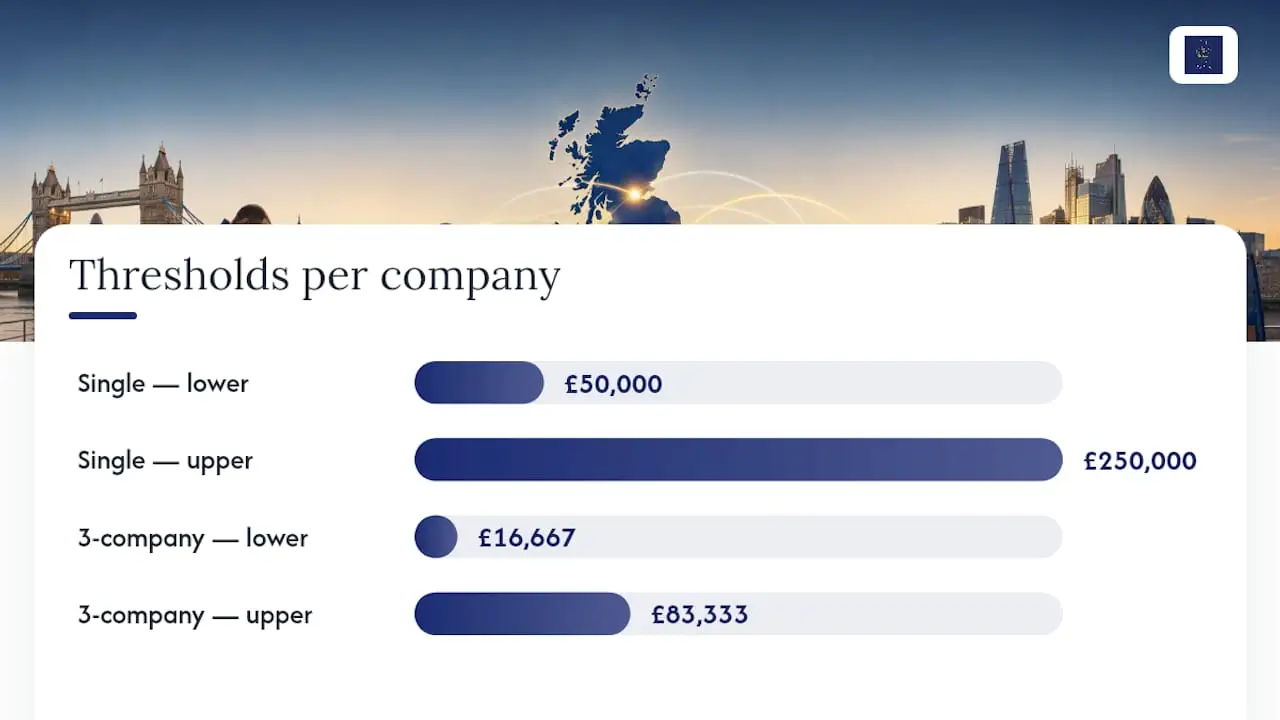
The £50,000 and £250,000 thresholds aren’t fixed once you have associated companies. Each limit gets divided by (1 + the number of associated companies), which shrinks the band available to each one. Two associated companies means dividing by 3, so a group of three companies shares a lower limit of roughly £16,667 and an upper limit of roughly £83,333 each, as ICAEW’s guidance sets out with worked examples.
Short accounting periods work similarly. If your accounting period runs six months instead of twelve, both limits are halved, so the small profits threshold becomes £25,000 rather than £50,000.
Common slip-ups I see:
- Forgetting dormant associated companies still count towards the total.
- Missing non-UK associated companies, which count too even without a UK tax presence.
- Not pro-rating limits when a company changes its year-end mid-year.
Pro Tip: Keep a simple running list of associated companies with the exact dates each association started or ended. It saves a scramble later and stops you understating the group total when HMRC cross-checks filings.
For a fuller explanation of counting rules, my associated companies guide walks through several group scenarios in more detail.
Checking your figures and reporting marginal relief correctly
Before you file, it’s sensible to check your own workings against an independent source rather than trust a single spreadsheet formula.
- Use HMRC’s marginal relief calculator to cross-check the figure your software or accountant has produced.
- Report the relief on your CT600 return, where it reduces the tax charged, typically appearing around box 435 alongside your main rate computation.
- Keep a supporting computation showing augmented profits, associated company adjustments, and the formula workings, in case HMRC queries the figure later.
- Get professional input if your group structure, dividend income, or accounting period changed during the year, since these are exactly the situations that trip the formula up.
Anyone filing their own return through commercial software should still sense-check the output against the calculator; small data entry errors in profit figures ripple straight through the formula. My guide to paying Corporation Tax correctly covers the filing side in more depth.
Mistakes I see most often, and simple ways to plan around them
Miscounting associated companies is the single biggest source of errors I come across. Directors often forget dormant companies, forget companies held through family members, or forget that a non-UK subsidiary still counts towards the total even though it pays no UK tax itself.
Short accounting periods are the second trap. If you’ve shortened your year-end for any reason, both the lower and upper limits shrink proportionately, and forgetting to adjust for that can leave your Corporation Tax return understating what’s due.
On the planning side, there’s genuine scope for legitimate, modest steps: timing when exempt distributions are received, reviewing pension contributions before the year-end, and forecasting profits early enough to see whether you’re heading into the relief band at all. None of this is aggressive tax avoidance, just sensible timing within the rules.
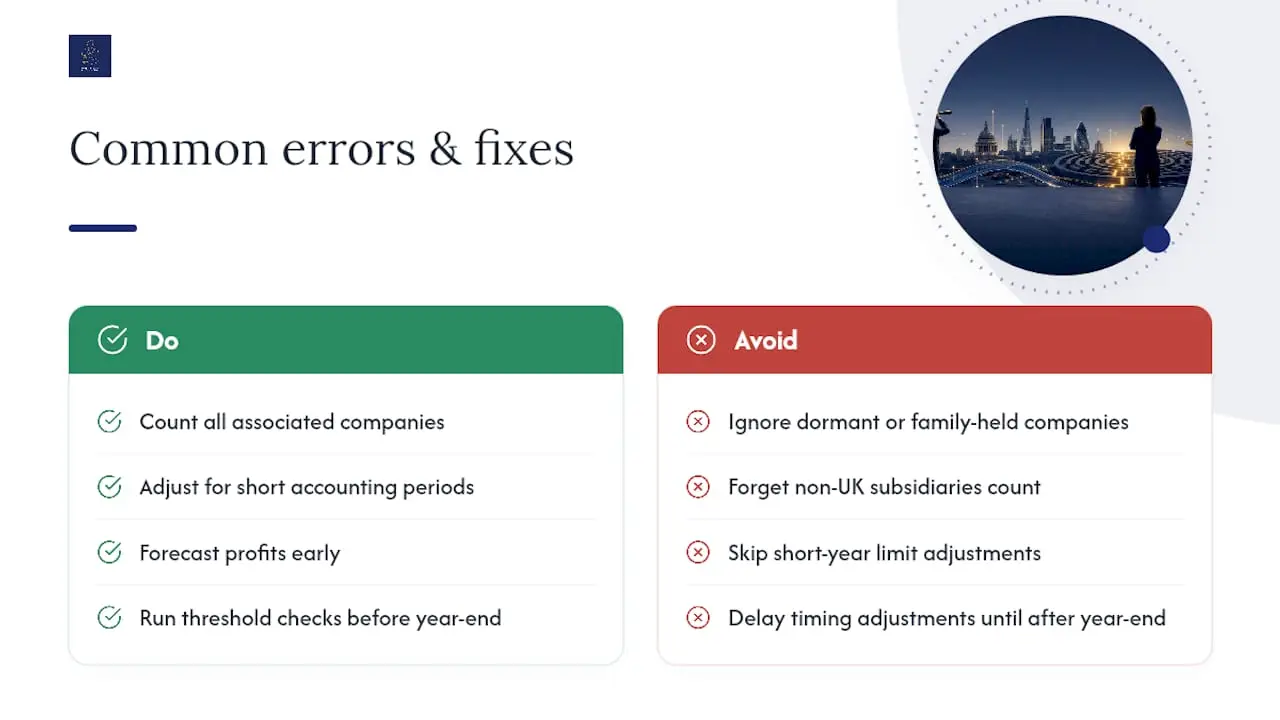
Pro Tip: If you’re within a few thousand pounds of either the £50,000 or £250,000 threshold, run the numbers before your year-end, not after. Small, lawful timing adjustments are far easier to make with a few months’ notice than retrospectively.
When you sit down with an accountant, bring your management accounts, a list of associated companies with dates, and details of any dividends received from outside your group. My tax planning strategies guide has further ideas worth reviewing ahead of that conversation.
— Chris
How I help clients work through marginal relief
When clients bring me their Corporation Tax figures, I’m usually checking three things: whether augmented profits have been calculated correctly, whether every associated company has been accounted for, and whether the accounting period itself needs pro-rating. I ask for management accounts, a list of related companies with dates of association, and details of any dividends received from outside the group.
Getting this right early, rather than at filing deadline, tends to avoid last-minute corrections and gives you time to make any legitimate timing decisions before your year-end closes. If you’d rather talk it through than work it out alone, my contact page is the easiest way to start that conversation.
How I can help: practical next steps
I provide Corporation Tax support as a paperless, technology-led accountant, offering friendly, jargon-free explanations and clear upfront pricing, with personal service delivered directly by me.

I handle Corporation Tax computations and CT600 filing, bookkeeping that keeps your figures accurate throughout the year, and forecasting so you can see whether your profits are heading into the marginal relief band before your year-end arrives. My Corporation Tax and Annual Accounts service covers the computation and filing side directly, and if your books need tidying up first, my Bookkeeping Services can get your records ready for an accurate calculation. If you’d like a straightforward quote or want to book a review of your current figures, get in touch and I’ll talk you through what I need from you and what it’s likely to cost.
Sources
This article is general information, not a substitute for advice from a qualified financial advisor. Consult a qualified financial professional about your own circumstances before acting on anything here.
FAQ
How is marginal relief calculated in the UK?
Marginal relief is calculated using the formula (U − A) × (N ÷ A) × F, where U is the upper limit, A is augmented profits, N is taxable total profits, and F is the standard fraction of 3/200. The result reduces the tax otherwise due at the 25% main rate.
Who is eligible for marginal relief?
Most UK trading companies with augmented profits between £50,000 and £250,000 qualify automatically when filing their Corporation Tax return. Close investment holding companies and some companies in liquidation are excluded, and the limits themselves shrink if you have associated companies or a short accounting period.
What is the marginal tax rate for a corporation in this band?
There’s no single flat rate inside the band; the effective rate tapers gradually from 19% at £50,000 towards 25% at £250,000 as profits rise. Professional guidance from the ATT notes the marginal effect on extra profit within the band works out at roughly 26.5%, higher than either headline rate, because of how the taper is structured.